Chinese fishing fleets invading and robbing other countries fishing zones
Reports from various sources confirm that large Chinese fishing fleets frequently engage in illegal, unreported, and unregulated (IUU) fishing, often violating other nations' Exclusive Economic Zones (EEZs) through activities like overfishing squid and other species, leading to resource depletion and conflicts, with countries like Argentina and Peru increasing naval patrols to counter these incursions by China's massive, subsidized fleet.
SECNAV Del Toro Sounds Alarm Over Chinese Illegal Fishing
Illegal and unreported fishing “is happening on an industrial scale” around the globe and the culprit often is China’s subsidized fishing fleet, Navy Secretary Carlos Del Toro said today.
Speaking Thursday at the Center for Strategic and International Studies, he added, “one in five fish” sold on international markets is illegally caught. Declining fish populations due to climate change and overfishing are having a profound effect on sources of protein in poorer nations’ food supplies, the secretary said.
In his meetings with counterparts in Oceania and other nations, Del Toro said, “violations of their Exclusive Economic Zones rise to the top of their concerns,” as does their need for better maritime awareness of what is happening in their waters to include mineral and energy exploration.
Earlier, Monica Medina, assistant secretary of state for oceans and international environmental and scientific affairs, said sometimes in dealing with China and illegal fishing there “is a race to the bottom” on addressing the problem.
Coast Guard Commandant Adm. Karl Schultz, speaking at the same forum, said the United States “can bring some leadership” to raising that awareness through hands-on training in maritime law enforcement and information sharing with South American, African and Pacific navies and coast guards.
As an example of the difficulty in tracing illegal fishing, Schultz noted that the automatic identification systems, or AIS, aboard many of those vessels are turned off, so they are not readily plotted. “If we’re chasing folks who are spoofing AIS, I’m not sure we’re winning there.”
“Maybe we [the United States Coast Guard] help stitch” these arrangements together through the State Department’s legwork, he added.
“These kind of arrangements weren’t there before,” Medina said. “We’re only just beginning [to move] on how to use” new technological tools with other nations in law enforcement in the maritime domain. “We need to harmonize things better” inside and outside the United States government and with the private sector on what can be done better collectively.
She saw value in expanding focus on this issue in the United Nations and before the International Maritime Organization. “We have to know where the fish are,” and those organizations can help in tracking that as Arctic waters warm and fish stock is depleted in the tropics.
Medina added that nations and organizations engaged in illegal fishing follow those changes closely.
To drive the point home on how important illegal fishing is to the American public, Schultz said “we need to put a face” on the challenge that can be understood in ways that supply chain disruptions are now.
Del Toro said exercises with other nations show how other countries can work with the American sea services and U.S. allies and partners, like Australia and New Zealand in Oceania, in building their capacity to protect their own territory. He and Schultz said the Coast Guard law enforcement detachments aboard Navy ships also could provide a model for those nations in collaboration to monitor illegal activities beyond drug smuggling.
Schultz said “persistent partnerships” have an impact in Southeast Asia, the Philippines and Oceania, – which share concerns over future food supplies and the fishing industry’s history of forced labor practices – as they have in the anti-narcotics efforts in Latin America.
He added the U.S. Coast Guard is not interested in “being the world’s fish cops.”
Schultz said the Coast Guard is “absolutely a key enabler” when collaborating with the Navy in showing presence internationally and carrying out operations other than ones that are purely military.
Chinese illegal fishing on South American coasts, affecting the prices of their local products

Chinese fishing fleets in Indian Ocean accused of abuses

"There was no such word as 'rest' on Chinese fishing vessels," explained a former crew member to a group of investigators from the Environmental Justice Foundation (EJF), a London-based NGO. "If there were a lot of fish, the work could be up to 22 hours long."
The testimony was part of a recently released report by the EJF accusing China's fishing fleets of environmental and human rights abuses in the southwestern Indian Ocean.
As a leading fishing nation, China's distant water fishing (DWF) industry is the world's largest in both catch volume and fleet size. And according to the Illegal, Unreported and Unregulated Fishing Index, China ranks as the worst offender among 152 countries worldwide.
The EJF report provides the first comprehensive investigation of Chinese fishing activities off the East African coast.
China's DWF fleet has mainly faced scrutiny for illegal activities in Latin America and West Africa. However, the EJF report provides the first comprehensive investigation of Chinese fishing activities off the East African coast.

China's 'systematic' illegal fishing
While China is not solely responsible for illegal, unreported and unregulated fishing in the region, it is seen as one of the major culprits. East African countries, such as Madagascar and Mozambique, are among the hardest hit.
Callum Nolan, a senior researcher at the EJF who led much of the study, told DW that "there's real cause for concern" as the Chinese fleet's illegal fishing activity is "systematic."
"This isn't a handful of bad actors or captains. What we're seeing is a fleet-wide issue on the Chinese distant-water fleet," he said.
The report comes as China is developing fishery infrastructure in cooperation with East African coastal countries and sending fleets out to fishing grounds in the southwest Indian Ocean.
The EJF interviewed 44 fishermen who had worked on China's fleet in the Indian Ocean, the third-largest of the world's five oceanic divisions.
When quizzed about illegal activities aboard Chinese boats, 80% of them had reported shark finning — the act of removing fins from sharks and discarding the rest of the shark back into the ocean — and 59% reported the deliberate capture and/or injury of vulnerable marine megafauna, including manta rays, dolphins and sharks.
"The sharks were caught. They only took the fins and threw the bodies away," a fisherman told the EJF in a video interview.

Another common illegal behavior is entering a fishing zone reserved only for local fishers, Nolan said.
He said Chinese trawlers often come into the zone at night, which has led to collisions between small skiffs and industrial vessels.
"That creates huge economic problems for local people," Nolan pointed out, adding that these fishers may have to suspend their work for weeks and months to repair the damage to their skiffs.
Forced to eat 'rotten' food and drink distilled seawater
Chinese DWF vessels rely heavily on recruiting foreign fishermen, mostly from Indonesia and the Philippines.
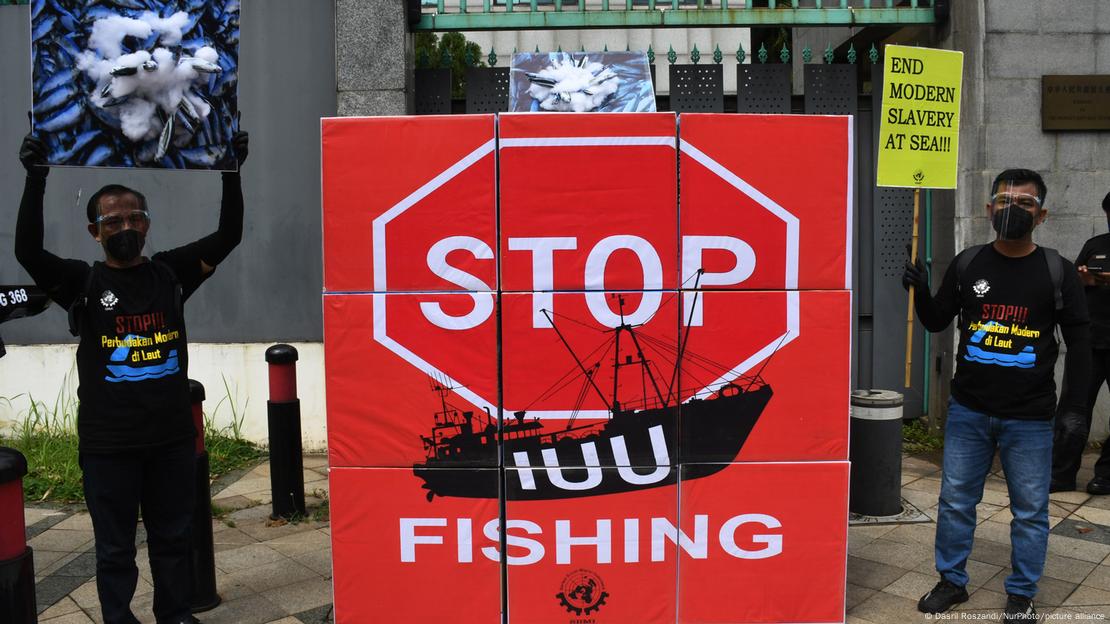
Dios Lumban Gaol, a coordinator at Indonesian migrant workers union SBMI, told DW that the EJF report vividly portrays exploitation, violence and harsh working conditions faced by Indonesian crew members on Chinese-flagged ships, a situation "which continues today."
Of 44 crew members interviewed by EJF, all of them reported abusive working and living conditions, 96% excessive overtime and 55% physical violence.
Between 2017 and 2023, four deaths were reported by interviewees on board Chinese tuna longliners.
Gaol said there have been reports of Indonesian crew members on Chinese vessels being provided with poorly distilled seawater to drink and expired, canned, rotten foods for meals.

China widens its net in the Indian Ocean
The EJF report also mentioned that via China's global infrastructure investment scheme, the Belt and Road Initiative (BRI), its fishing fleet has been given more access to the resources of East African countries receiving BRI investments that may "feel obligated" to cooperate.
Since the BRI's launch in 2013, 52 African countries have joined, which has helped China deepen its footprint in Africa by constructing roads, rail lines and ports.
Meanwhile, China's "nearly unparalleled" influence in the United Nations also plays a role in holding back criticism of China's activities in Africa, said Elizabeth Freund Larus, adjunct senior fellow at Pacific Forum, a US-based foreign policy think tank.
"The BRI literally buys China a lot of compliance," she said, indicating that member countries "are reticent or hesitant to criticize China" and would likely "carry the water" for the country. "So, no one should expect that the UN is going to take on this issue in any meaningful way."
Besides, it's challenging to scrutinize activities aboard remote Chinese vessels, and China's DWF industry in general usually lacks transparency, said Nolan.
For example, flags flown by vessels may not accurately represent their true ownership and onboard observers may be bribed or threatened.
China denies any wrongdoing
The Chinese government has repeatedly denied any mismanagement in response to the accusations of illegal and unregulated fishing.
A 2023 government white paper on the development of distant-water fisheries said China holds a "zero tolerance" attitude toward illegal fishing and has "the world's strictest management measures and regulations" on DWF fleets.
China also claimed in the paper that it has made "notable progress" on critical issues and in priority areas by introducing policies such as closed seasons, a total allowable catch and regular company assessment.
A list of Chinese firms was also included in EJF's report, including "Shandong Zhonglu" and the "Zhejiang Ocean Family."
Their tuna fishing fleets have been accused of being the top offenders of illegal and unregulated fishing or human rights abuse cases in the southwest Indian Ocean as of 2023.
DW reached out to the firms for comment.
Shandong Zhonglu said it is currently verifying the relevant issues mentioned in the EJF report.
Zhejiang Ocean Family said it has launched an internal investigation, but said it found the accusations in the report lacking "factual basis and rigor."

No comments:
Post a Comment
Comments always welcome!