Keeping an eye on Communist, Totalitarian China, and its influence both globally, and we as Canadians. I have come to the opinion that we are rarely privy to truth regarding the real goal, the agenda of China, it's ambitions for Canada [including special focus on the UK, US & Australia]. No more can we trust the legacy media as there appears to be increasing censorship applied to the topic of communist China. I ask why. Here is what I find.
GOOGLE EMPLOYEES HAVE UNCOVERED ONGOING WORK ON CENSORED CHINA SEARCH
March 4 2019
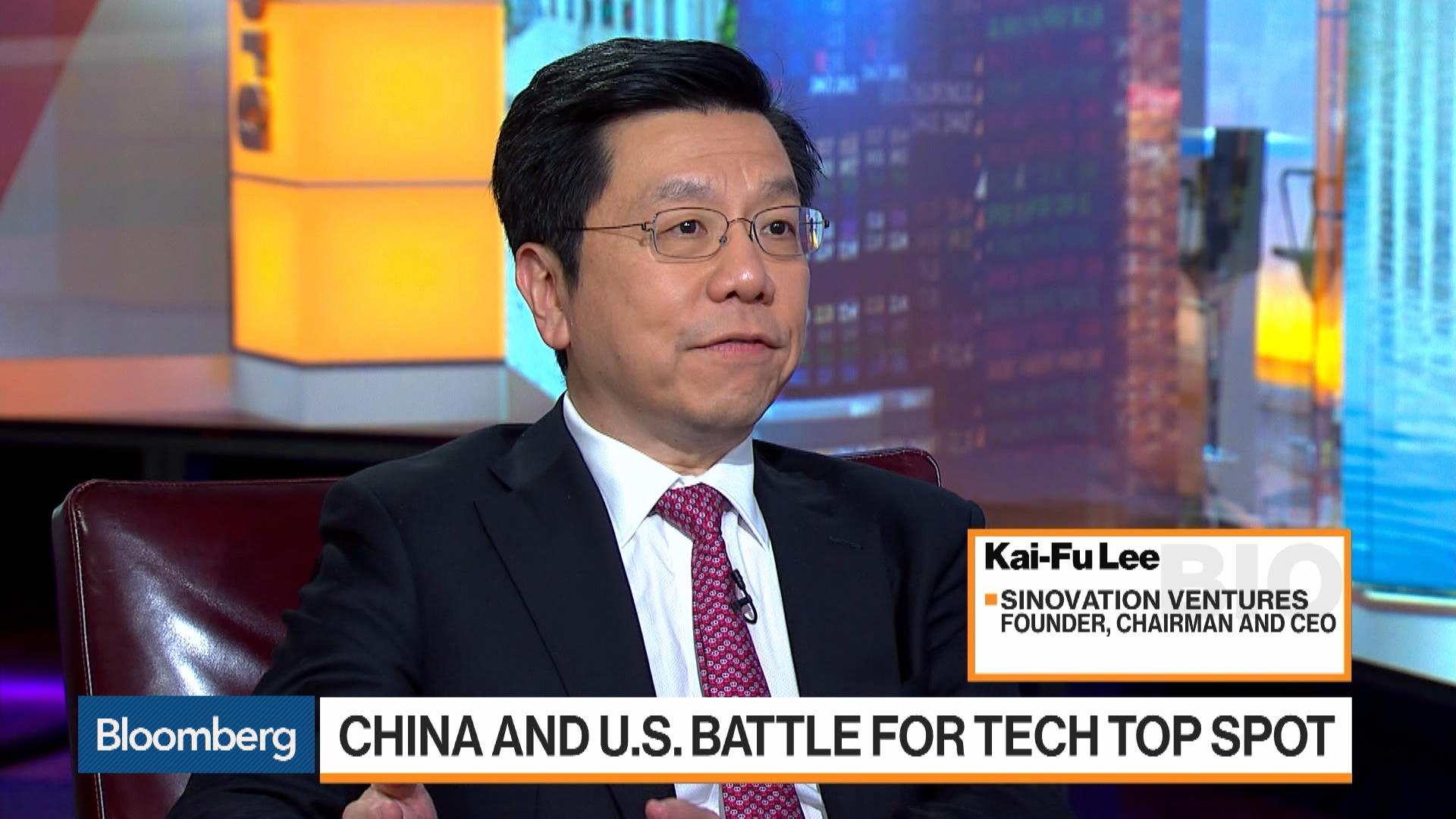
Lee Kai Fu, former president of Google in China, is moving on with his new company Innovation Works.
GOOGLE EMPLOYEES HAVE carried out their own investigation into the company’s plan to launch a censored search engine for China and say they are concerned that development of the project remains ongoing, The Intercept can reveal.
Late last year, bosses moved engineers away from working on the controversial project, known as Dragonfly, and said that there were no current plans to launch it. However, a group of employees at the company was unsatisfied with the lack of information from leadership on the issue — and took matters into their own hands.
There has been controversy around Project Dragonfly, Google's secret effort around 2018 to build a censored search engine for China that would comply with Beijing's strict internet rules, sparking internal dissent, employee protests, and public outcry over ethical concerns, human rights, and alignment with state surveillance, ultimately lead to significant backlash against the project.
Hundreds of Google employees have written to the company to protest against plans to launch a "censored search engine" in China.
They said the project raised "urgent moral and ethical questions" and urged the firm to be more transparent.
"Currently we do not have the information required to make ethically-informed decisions about our work," they added.
Google, which has never spoken publicly about the plans, declined to comment.
The firm, which is owned by Alphabet, quit China eight years ago in protest at the country's censorship laws and alleged government hacks.
However, reports last month claimed it had been secretively working on a new Chinese search service, referred to internally as Dragonfly.
The platform, which still requires Chinese government approval, would block certain websites and search terms like human rights and religion.
This has angered some employees who fear they have been unwittingly working on technology that will help China suppress free expression. 'Open processes' In their letter, which was shared with various media organisations, they also argue it would violate the "don't be evil" clause in Google's code of conduct.
"We urgently need more transparency, a seat at the table, and a commitment to clear and open processes: Google employees need to know what we're building," the letter said.
It is not the first time Google employees have spoken out against the company's decisions.
In April, thousands of staff criticized its work on a US military programme developing artificial intelligence for drones.
Google has since ended its AI contract with the Pentagon.
China has the world's largest internet audience but US tech firms have struggled to take off in China due to content restrictions and blockages.
Facebook, Google, Twitter and Instagram are all banned, although Google still has three offices in the country.
Update 20 August:
Google chief executive Sundar Pichai told staff that "we are not close to launching a search product in China", according to the New York Times.
What makes China so sensitive when it comes to the Tibet question? How does one explain its almost paranoid state?
China is a great power in making and the Chinese elite are conscious of that. All countries in the world recognise Chinese sovereignty over Tibet and are in awe ofits rapid development -- the railways being the most famous example. Even the Dalai Lama insists that Tibet's future is within China.
What then makes China so sensitive when it comes to the Tibet question? How does one explain its almost paranoid state? The answer does not lie in putative notion of timeless Chinese culture but in a mix of strategic location of Tibet, regime type and, most importantly, modern Chinese nationalism.
Contrary to popular belief, China is not a closed society. Debates and dissent are part and parcel of life--except on matters of national security. But, yes, the state does not dialogue with those dubbed as separatists. And, unfortunately, all protests in Tibet are viewed from the lens of 'splittism'-- even when they are over issues that fall well within Chinese constitutional framework.
As we saw during the recent events, within China the news of the protests was strictly controlled and represented solely as unacceptable ethnic violence conducted against innocent Han and Hui Chinese by very few Tibetans instigated by the "Dalai clique"
If the past is any guide, we can now expect an increased repression, policing, surveillance, and 'patriotic education' in Tibet but no attempt to understand why, despite years of rule and serious efforts by China to develop Tibet economically and to allow significant religious and cultural freedom, some Tibetans protest knowing fully well the high cost of it.
The Dalai Lama's bending over backwards to show how he remains committed to Tibet being an autonomous region within China has won him no kudos from China.
The intolerance of protests is not unique to the Tibetan case. The public face of politics at the top-level remains stage-managed for the domestic as well as international audience. If this is the case in mainland China, what else can one expect in Tibet which is seen as strategically important?
One should note that China's conceptualisation of Tibet as a site of strategic vulnerability is a direct product of British invasion of Tibet in 1904. The imperialist invasion radically altered the Chinese perception of Tibet--the traditional loose political control characteristic of the Qing imperial rule was no longer acceptable in the nationalising China. The Qing court, regional governors, nationalists, communists-- all major actors in the rapidly changing China in the first part of the 20th century now conceptualised Tibet's position as strategic bulwark against hostile incursions from the south of the Himalayas.
However, a focus on the location of Tibet in geographically strategic context (say vis-a-vis India) does not fully explain China's sensitivity. The most important factor is the role of Tibet in modern Chinese nationalist imaginary.
Contemporary Chinese claim over Tibet is based on a version of Chinese history that sees the present-day nation-state as a successor to a longer history of Chinese civilization marked by a number of imperial phases. Tibet was historically linked with various Chinese empires and therefore it is'an integral' part of modern China. What was the exact nature of Tibet's status is not deemed a crucial factor; what is held to be important is Tibet's political subservience to the Sino-centric empires. This historical subservience is argued as affirming Chinese sovereignty over Tibet forever. The Western vocabulary of sovereignty is adopted as easily translatable to capture traditional Sino-Tibetan historical relations.
Tibet's religio-political relations with Sino-centric rulers (often Buddhist Mongols and Manchus) was of mchod-yon (patron-priest). Modern Chinese translation of this as 'domestic affair of China' was part of a wider development at the start of the 20th century when nationalism emerged strongly. China, imagined as a modern nation, maintained a schizophrenic attitude toward its imperial past, especially toward the Manchus (Qing court).
Chinese exoticisation of Tibetan minority culture: Chinese tourists often wear traditional Tibetan dress and pose in front of Potala palace.
While the Manchus and other 'barbarians' were held responsible for the decline of the 'great' Han Chinese civilisation and for failing to adjust and counter the rising European (and Japanese) powers, the territorial legacy of the Qing empire was seen as legitimate. The minoritisation of Manchus, Mongols, Tibetans, Hui, and several other 'nationalities' went hand in hand with the construction of 'Han' identity as the leading force within the multi-national Chinese nationalism.
In this nationalising China, traditional religio-political fuzzy relations that marked Tibet's relations with the Qing court and, before that, with the Mongols, were seen as anomalous and sovereignty talk along absolutist European lines became dominant.
The development of modern Chinese nationalism was consciously inclusive. Despite the overwhelming 'Han' (a constructed category in itself) majority, political elite of all shades were careful in imagining China as consisting of different nationalities marching together to modernise the new China. After PRC was formed in 1949, the communist party went out of its way to fashion a unitary state that was based on an inclusive nationality policy.
Recognition, accommodation, assimilation, and repression were all part of the evolving state-majority-minority relations. While officially all nationalities were equal, there was a strong paternalist assumption of Hans being the 'elder brother' who will help other more backward but colourful minorities to develop.
But what if the 'younger brother' refuses to be grateful? Do you punish or listen? This is what Chinese state faces with Tibetans and it should realise that its best interlocutor is the Dalai Lama. The neurotic state of China is more a symptom of fear than of strength. One wonders what China is afraid of! A stable prosperous China that accommodates and respects its diverse population and deals with dissent within its constitutional framework is what Chinese people of all nationalities deserve and the world expects. Globally The Neurosis Expands
Western intelligence agencies are increasingly concerned about the unprecedented scale and ambition of China's global espionage operations, which aim to collect vast amounts of data and technology to advance the interests of the Chinese Communist Party.
Overview of China's Espionage Activities
Intelligence officials from the U.S., UK, and Europe describe a multi-faceted approach to spying that goes beyond traditional intelligence gathering.
Scale and Scope: China's primary intelligence agency, the Ministry of State Security (MSS), is considered the largest and most active spy agency in the world, with a reported apparatus of up to 600,000 personnel.
Intelligence Goals: The main objective is to acquire Western technology and intellectual property to drive economic growth and military modernization, a form of state-sponsored technology transfer that often involves sharing gathered information with Chinese state-run companies.
Global Reach: Chinese intelligence activities span the globe, including alleged spy bases in Cuba to monitor U.S. communications, and extensive operations across Europe, North America, and Australia.
Key Espionage Tactics
China utilizes a range of tactics, from human intelligence gathering to cutting-edge technology and mass data collection.
Human Intelligence (HUMINT):
Recruitment: Chinese intelligence services actively attempt to recruit individuals with access to sensitive information in government, academia, think tanks, and technology sectors.
Influence Operations: This includes cultivating contacts through networking sites like LinkedIn, study trips, and seemingly innocuous social interactions, which can eventually lead to intelligence gathering.
Extraterritorial Laws: Expansive national security laws require Chinese citizens and entities anywhere in the world to assist and cooperate with China's intelligence services, creating a broad potential network.
Technology and Data:
Cyber Attacks: Chinese state actors are frequently implicated in large-scale cyber attacks and intellectual property theft targeting Western nations.
Mass Data Collection: Intelligence agencies warn that Chinese technology, apps like TikTok, and even Chinese-made infrastructure equipment can be used to gather bulk data on foreign populations, which is then analyzed using big data analytics and AI.
Surveillance Tools: High-altitude surveillance balloons have been used to target over 40 countries, and concerns exist about Chinese-made cameras in critical infrastructure.
International Response
Western nations, including the U.S. and UK, have escalated their response, with MI5 and the FBI publicly calling China the primary long-term national security threat. This has led to:
Issuing formal espionage alerts to government officials and the public.
Investigations into the use of Chinese-made technology and infrastructure.
Public campaigns by agencies like the CIA to recruit disaffected Chinese officials.
Despite these concerns, China consistently denies all accusations of espionage, labeling them as attempts to "smear" the country and insisting it does not interfere in other nations' internal affairs.
The Sneaky Chinese Illicit Drug Industry in America
Chinese Chemical Company, Senior Leaders Indicted for Fentanyl Manufacturing, Distribution
LOS ANGELES — A joint investigation resulted in charges for Hubei Aoks Bio-Tech Co. Ltd., a chemical company based in Wuhan, China, its director and three senior employees in U.S. federal court Nov. 7, for allegedly selling fentanyl precursor chemicals and xylazine — known as “tranq” — globally.
This Homeland Security Investigations (HSI) Los Angeles investigation was worked collaboratively with Southern California Drug Task Force, with significant contribution from DEA, Food and Drug Administration, U.S. Customs and Border Protection (CBP), U.S. Postal Inspection Service, and the California Department of Justice.
“HSI is dedicated to disrupting the flow of fentanyl, and the precursor chemicals necessary to produce this poison, entering our communities,” said HSI Los Angeles Special Agent in Charge Eddy Wang. “Today’s announcement of charges is a warning to those who seek to profit from the sales of these precursor chemicals used to manufacture fentanyl and other manufactured narcotics.”
The company is charged with one count of conspiracy to manufacture and distribute fentanyl and to distribute listed chemicals for the manufacture of fentanyl, one count of conspiracy to distribute listed chemicals for importation to the United States, two counts of distribution of listed chemicals for importation, two counts of distribution of listed chemicals for manufacture into controlled substances, and seven counts of introduction of misbranded drugs into interstate commerce.
Also charged in the recently unsealed indictment are:
Xuening Gao, 38, Hubei Aoks’ sole director, who is charged with two conspiracy counts;
Guangzhao Gao, 36, the operator of Hubei Aoks’ cryptocurrency wallets used for fentanyl precursor sales and who is charged with a total of six felonies, including four distribution-related counts;
Yajing Li, 30, a Hubei Aoks sales manager who also is charged with six felonies, including conspiracy and distribution of a listed chemical; and
A fifth defendant who uses the alias “Jessie Lee,” a Hubei Aoks sales manager charged with two conspiracy counts.
The People’s Republic of China’s Ministry of Public Security took law enforcement action against the defendants by dissolving the indicted Chinese company and arresting the four indicted Chinese national subjects. The Chinese Ministry of Public Security is further coordinating with the Department of Justice on the investigation.
“Companies such as Hubei Aoks disguise their illicit activities as legitimate business operations yet continue to knowingly contribute to the fentanyl crisis in the United States,” said Special Agent in Charge Tyler Hatcher, IRS Criminal Investigation, Los Angeles Field Office. “This indictment highlights our commitment to partnering with other law enforcement agencies to combat this epidemic. IRS Criminal Investigation is the best in the world at following the money, whether it be within traditional banking systems or via cryptocurrency platforms, and we will tirelessly pursue the necessary evidence to bring suspects to justice.”
According to the indictment, for more than a decade, Xuening Gao and Guangzhou Gao have sold controlled substances and precursor chemicals, including fentanyl precursors, to customers throughout the United States. Both men are linked to chemical companies operating in China, including one that sold fentanyl and acetyl-fentanyl that was imported into the United States as far back as 2015.
Hubei Aoks exported chemicals to at least 100 countries, including the United States, and advertised online and through various social media platforms. Hubei Aoks sales representatives tailored their precursor recommendations depending on the customer’s geographical market and would suggest alternative chemicals if one was not available. Hubei Aoks claimed that fentanyl precursors were most popular in Mexico and sold them in 25-kilogram fiber drums, each of which can produce 10 million fentanyl pills. Representatives claimed that their profit on precursors sales to Mexico was worth the risk.
From at least November 2016 to November 2023, Hubei Aoks sold and imported to the United States 11 kilograms of fentanyl precursors, capable of producing millions of fentanyl pills, along with two kilograms of xylazine, a tranquilizer, used by veterinarians to sedate cattle, horses, and other large animals. As part of an undercover investigation, the chemicals were falsely imported into the United States as furniture parts, vases, makeup, and other items.
“This enforcement action reflects CBP whole-of-government effort to anticipate, identify, mitigate, and disrupt illicit synthetic drug producers, suppliers, and traffickers,” said Cheryl M. Davies, CBP Director of Field Operations in Los Angeles. “This comprehensive approach brings the unique, formidable, and wide-ranging capabilities and authorities of CBP to bear on the illicit synthetic drug trade and build capacity and collaboration with our partners – domestic and international – to ensure the safety of the American public.”
“The shipment of dangerous substances like fentanyl precursor chemicals through the U.S. Mail helps to fuel a pandemic that affects many Americans today,” said Inspector in Charge of the United States Postal Inspection Service in Los Angeles, Matt Shields. “Precursor chemicals are extremely dangerous substances and pose a serious threat to the health and well-being of our society. The U.S. Postal Inspection Service stands proudly with our federal law enforcement partners as we continue to fight to protect the U.S. Postal Service and Americans from illegal and dangerous substances.”
The U.S. can do more to stop the illicit drug trade
The United States needs to overhaul protocols to combat illicit money entering our country. A recent investigation by the Wall Street Journalfound that an underground banking network has funneled $50 million in drug trafficking proceeds through a complex web of cartels, Chinese money-laundering operatives, and U.S. financial institutions.
In 2024, there were 80,000 drug overdose deaths in the United States. While this is down significantly from 100,000 in 2023, it still is a staggering loss. In addition to taking American lives, the drug crisis poses a serious national security threat. The Chinese Communist Party uses drug warfare as a way to spread disaster in countries that have a military advantage like the U.S, according to a playbook authored by two former senior Chinese military officials.
One of the techniques used to funnel money into the U.S. by Mexican drug cartels is known as the black market peso exchange, a system used by Colombian cartels during the 1970s and 80s drug trade. With the proceeds of their illegal sales stuck in the United States, Colombian kingpins had to convert the funds in the country from the U.S. dollar to the Colombian peso. The result was a deceptively simple network of various U.S. bank accounts, shell companies, and money brokers capable of sending the money to Colombia as goods to be sold and converted to pesos.
Despite its apparent simplicity, the black market peso exchange persists, used by Mexican cartels and Chinese nationals seeking to circumvent China’s strict capital control laws. The process is as follows:
The cartel sells drugs in the U.S. and is paid in U.S. dollars.
This “dirty money” is bought by a broker and sold to a Chinese national, who pays for the dollars in Chinese yuan.
The broker then uses the yuan to buy Chinese goods and send them to Mexico.
The goods are sold in Mexico and converted into pesos before returning to the cartels.
This process allows Chinese nationals to circumvent restrictions on how much money they can send out of China and enables cartels to convert the money from their drug sales into pesos without repercussions.
Anti-money laundering laws that were used to prevent such activity originated in the 1970s. After the Bank Secrecy Act (BSA) of 1970 was signed into law, banks began to submit reports to the Department of the Treasury on suspicious activity and high-value cash deposits. However, these laws have seen minor updates since then.
To protect against the threat of illegal drugs entering the U.S., Washington must protect the integrity of its financial institutions.
Banks already must comply with reporting requirements. However, the volume of these reports far exceeds the capacity of the Department of Treasury. In 2023, banks filed nearly five million Suspicious Activity Reports and 23 million Currency Transaction Reports. The Treasury’s Financial Crimes Enforcement Network (FinCEN) has approximately 300 employees–an amount far too small to examine all documentation.
To streamline the process, financial institutions should know the most helpful information to submit. Banks likely have little clarity on what information is useful, resulting in excessive and unnecessary reporting.
Treasury’s FinCEN Exchange – a public-private information sharing partnership between law enforcement, FinCEN, and financial institutions – can be used to clarify what data is most pertinent to send.
The U.S. government should also put to better use Section 6201 of the Anti-Money Laundering Act of 2020, which requires the attorney general to notify the secretary of the Treasury what bank information is most useful for investigations, thereby enhancing the effectiveness of anti-money laundering efforts. Based on a 2024 report from the Government Accountability Office, the Department of Justice continues to face challenges sharing the information that is most effective in leading to arrests.
Furthermore, the BSA E-Filing System, the platform banks use to submit these reports to the Treasury Department, should categorize the suspicious activity the bank is reporting. Doing so will help eliminate the lack of clarity surrounding the drug trade.
Lastly, the U.S. government should collect the beneficial ownership information for domestic companies to determine who financially benefits from them. Without knowing the benefactors, law enforcement will face challenges in determining the criminals behind these networks.
Policymakers should be concerned that the method being used by drug traffickers to launder money in the U.S. has remained in use for decades. Old policies and protocols have failed to stop the flow of drug money in the U.S. Without action, this illicit money will likely continue to flow through our country’s financial institutions. Stopping the drug crisis is a priority. Policymakers must treat it as such.
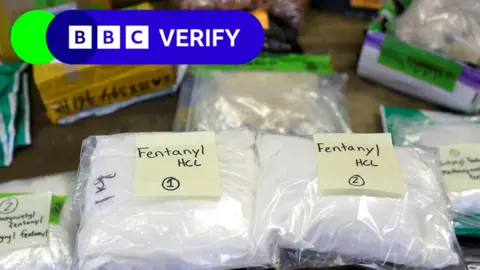
How does fentanyl get into the US?
Reuters
US President Donald Trump has raised tariffs on Canadian imports, while maintaining existing tariffs on Mexico and China, citing their failure to curb the trade in fentanyl and its component chemicals.
He has also threatened higher tariffs on Mexican imports but delayed enforcement to allow for negotiations to take place.
How serious is the fentanyl crisis in the US?
Fentanyl is a synthetic drug manufactured from a combination of chemicals. US regulators approved it for use in medical settings as a pain reliever in the 1960s, but it has since become the main drug responsible for opioid overdose deaths in the US.
The US has long accused Chinese corporations of knowingly supplying the chemical components to gangs who trade in them. The White House has also accused Canada and Mexico of failing to prevent criminal gangs from smuggling fentanyl into the US.
It is frequently mixed with other illicit drugs, leading many users to be unaware that the substances they are consuming contain fentanyl.
As little as a two milligram dose of fentanyl - roughly the size of a pencil tip - can be fatal.
Over the past decade, the global fentanyl supply chain has expanded, making it harder for law enforcement and policymakers to control.
China is the primary source of the precursor chemicals used to produce fentanyl.
Canada's role in the fentanyl trade
President Trump has accused Canada - alongside Mexico - of allowing "vast numbers of people to come in and fentanyl to come in" to the US.
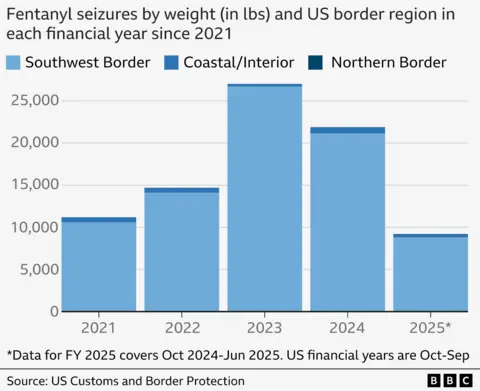
According to data from the US Customs and Border Patrol, only about 0.8% of all seizures of fentanyl entering the US so far this year were made at the Canadian border. Almost all of the rest is confiscated at the US border with Mexico.
But in January, Canada's financial intelligence agency reported that organised criminal groups in Canada are increasingly involved in the production of fentanyl by importing chemicals used to make it and lab equipment from China.
The trade in fentanyl takes place in both directions.
In the first 10 months of 2024, the Canadian border service reported seizing 10.8lb (4.9kg) of fentanyl entering from the US, while US Border Patrol intercepted 32.1lb (14.6kg) of fentanyl coming from Canada.
In December, the country pledged C$1.3bn ($900m; £700m) for combating fentanyl and enhancing border security.
And in February, Prime Minister Justin Trudeau announced the appointment Kevin Brosseau, as Canada's fentanyl czar.
Almost all (96%) was intercepted at the south-west border with Mexico. Less than 1% was seized across the northern US border with Canada. The remainder was from sea routes or other US checkpoints.
According to the US Drug Enforcement Agency (DEA), Mexican criminal organisations - including the Sinaloa Cartel - play a key role in producing and delivering fentanyl, methamphetamine and other illicit drugs into the US.
The chemicals used to make fentanyl are sourced from China by traffickers and turned into the finished product in labs in Mexico before being smuggled into the US.
According to the DEA, the Sinaloa Cartel uses a variety of tactics to conceal shipments coming into Mexico, such as hiding the chemicals among legitimate commercial goods, mislabelling the containers, using front companies, and shipping through third party countries.
The Trump administration has accused the Mexican government of colluding with the drug cartels. Mexico's President Sheinbaum says the claims are "slander."
In December, shortly after Trump had threatened Mexico with tariffs, the country's security forces announced their largest ever seizure of fentanyl - equivalent to around 20 million doses.
In response to the threat of tariffs from the US, in February the Mexican government launched Operation Northern Border, deploying 10,000 national guard troops along the US-Mexico border.
China is the source of fentanyl chemicals
In 2019, China classified fentanyl as a controlled narcotic and later added some of the chemicals used to make it to the list.
Despite this, the trade in other chemicals involved in the manufacturing of fentanyl - some of which can have legitimate purposes - remain uncontrolled, as those involved in the trade find new ways to evade the law.
A review of several US indictments, which include details of undercover agents communicating with Chinese manufacturers, suggests that some chemical companies in China have been selling chemicals - including controlled ones - in the knowledge that they are intended to make fentanyl.
Dozens of indictments reviewed by BBC Verify detail instances where Chinese manufacturers have provided instructions on how to make fentanyl from products they sell, through encrypted platforms and cryptocurrency payments.
"So you have these massive loopholes where criminals engage in selling legal products, but they knowingly sell them to criminal entities," says Vanda Felbab-Brown, senior fellow in foreign policy at the Brookings Institute.
In a statement, China said it had some of the strictest drugs laws in the world and had conducted joint operations with the US in the past.
"The US needs to view and solve its own fentanyl issue," it said.
In a US indictment from January 2025, two chemical companies in India were charged with supplying the chemicals used to make fentanyl to the US and Mexico.