Tuesday, February 13, 2024

How do China's deadly drugs get into Canada?


How do China's deadly drugs get into Canada?
Feb 13 2024

The opioid crisis and record-setting death counts caused by fentanyl flooding into Canada could get worse because of a growing diplomatic dispute with China, sources have informed Global News.

Canadian law enforcement agencies have found that fentanyl and its chemical precursors are mostly produced in southern China factories and sent to North America via shipping containers, and in the mail.

In public, Canada’s federal government claims there is co-operation with China in the fight against fentanyl. It isn’t politically feasible for Ottawa to openly criticize Beijing on the opioid crisis, especially as the two governments pursue deeper trade ties.

But behind the scenes, sources say frustration is growing over China’s inaction.

“This is a very hot issue diplomatically right now,” a source with knowledge of international policing said.

The situation has gone from bad to worse, after Canada recently turned down China’s request to insert a new police liaison officer in China’s Vancouver consulate.

“It’s a huge fight with China right now, and if you anger the Chinese they won’t work with you,” said a source, who could not be identified. “The fentanyl coming into Canada is going to get worse. Nothing will happen because we have to satisfy what they (the Chinese government) want.”

Responding to questions from Global News following the G20 summit on Saturday, Prime Minister Justin Trudeau maintained that China is cooperating with Canada on the fentanyl crisis.

“China has been actually working with Canadian officials and Canadian law enforcement over the past months, to take measures on the flow of fentanyl into Canada.  There is, obviously as you say, more to do, we recognize that this is a crisis that is continuing in Canada and indeed getting worse,” Trudeau said.

What China wants, is freedom in B.C. to pursue alleged corruption suspects and financial fugitives, including a suspect accused of absconding with about $1 billion from a Beijing company. The suspect is laundering the money in Vancouver real estate, a source said, and using Vancouver as a hub to launder dirty money around the world.

China’s request to send a police liaison to Vancouver was rejected by Canada’s department of Global Affairs because of national security concerns, according to a source.

The concern is the police liaison could have worked for China’s Ministry of State Security, which is the non-military agency responsible for China’s counter-intelligence, foreign intelligence and political security operations.

“There are cases where people come to Canada working for the Ministry of State Security,” a source said.

It is not known what triggered Canada’s suspicion in this case, but reportedly, the so-called Five Eyes intelligence countries, including Canada, Australia, and the U.S., have recently increased information sharing on China’s alleged foreign influence, investment and spying campaigns.

Global News requested interviews with Global Affairs officials regarding the diplomatic dispute but the requests were declined.

A brief prepared statement did not address or refute the alleged case.

“Canadian and Chinese authorities continue to work together on law enforcement and legal-judicial issues, including fentanyl and opioids,” Global Affairs spokesman Guillaume Bérubé wrote.

Click to play video: 'Mothers losing children to fentanyl overdoses speak out on small community in crisis'
Mothers losing children to fentanyl overdoses speak out on small community in crisis

Global News repeatedly contacted officials in China’s embassies in Ottawa and Vancouver to ask questions for this story, but was unable to obtain responses.

In an interview, Conservative critic for foreign affairs Erin O’Toole said “We have people dying. And if they are slow to crack down on production facilities that are perpetuating this horrible drug … the very fact that China might be dragging its feet on investigating and shutting down production facilities in Mainland China, is deeply concerning. And we should raise it at the highest level.”

And regarding the allegation that China is seeking diplomatic concessions from Canada in order to crack down on fentanyl exports, O’Toole said: “There should be no diplomatic quid pro quo. There are lives at stake here.”

Meanwhile, Senator Vern White, a former Ottawa police chief, said Canada should take punitive trade actions if China will not act to stem fentanyl arriving in North America from state-regulated factories in China.

“China has shown no willingness to stop this,” White said in an interview. White said his colleagues in the United States tell him they are concerned about fentanyl from China flowing south through B.C.

“Imagine if we were producing fentanyl in factories and sending it into the U.S.,” White said.

It is not just China’s lack of action on fentanyl imports that is hindering Canadian efforts to crack down on illicit opioid supply. Police experts interviewed by Global News say that Canada doesn’t have the human resources or aggressive policing strategies needed to mount complicated transnational organized crime investigations.

Veterans in drug-trafficking investigations say that Canadian privacy and court procedure time limits also tend to severely limit pursuit of international criminals in Canada, in comparison to investigations by United States and Australian federal police.

Sources have said that Canadian police must file hundreds of pages of evidence in order to get phone intercepts for suspected drug kingpins approved by judges. But in the U.S., they say, such processes require much less paperwork and a more practical standard of evidence.

Australia and United States federal forces also have anti-drug trafficking policing operations in China that the RCMP lacks, sources said.

As a result of these weaknesses, U.S. investigators and officials are expressing frustration with the limits of Canadian law enforcement, and concern about the growing reach of Chinese organized crime in B.C., an official confirmed to Global News. And the U.S. has established a significant number of federal law and drug enforcement officers in the U.S.’s Vancouver consulate, multiple sources confirmed.

Click to play video: 'Growing calls for public inquiry into deadly fentanyl'
Growing calls for public inquiry into deadly fentanyl

Christine Duhaime, an anti-money laundering lawyer in Vancouver, said she recognizes the United States government is increasingly watching Chinese criminal networks in B.C.

“With the fentanyl crisis, and Vancouver being ground zero with imports from China paid with Bitcoin from unregulated exchanges, the U.S. government is concerned about Vancouver,” Duhaime said. “The fact that Vancouver has emerged as a safe haven for proceeds of crime is even more concerning.”

Tension between China and Canada over police agents is not a new phenomenon.

In the most famous case, agents claiming to be Chinese businessmen falsely obtained visas to enter B.C., and conducted covert operations in Richmond in pursuit of China’s most-wanted criminal, Lai Changxing. Lai was a billionaire smuggler and organized crime associate with ties to drug-trafficking and police and military officials in southern China, court records and sources say.

When a bribery and corruption case escalated in China, Lai fled to Hong Kong, and gained entry to Canada under immigrant investor status. He was a prolific VIP gambler in Richmond, associated to notorious loan sharks, and Big Circle Boys associates in British Columbia and Ontario, court records allege.

After a 12-year legal and diplomatic battle over China’s efforts to extradite Lai, a deal was struck in which China promised that Lai would not be executed if he was returned to face prosecution. He was sent to China in 2011 and imprisoned.

There are conflicting reports in China about Lai’s current condition.

“In accordance with the legal terms/parameters of Mr. Lai’s return to China, as outlined in the Federal Court Decision of 2011, as well as diplomatic assurances received at the time, Canadian officials have been monitoring Mr. Lai’s situation, pursuant to the assurances provided and in cooperation with Chinese officials,” Global Affairs stated, in response to questions about Lai’s health.

Sunday, February 4, 2024

Centennial of anti-Chinese immigration law coincides with campaign against proposed registry of foreign agents

Centennial of anti-Chinese immigration law coincides with campaign against proposed registry of foreign agents

Attempts to link the proposed registry of foreign agents with the centennial of a discriminatory law plays into the hands of the Chinese government, says a human rights advocate.

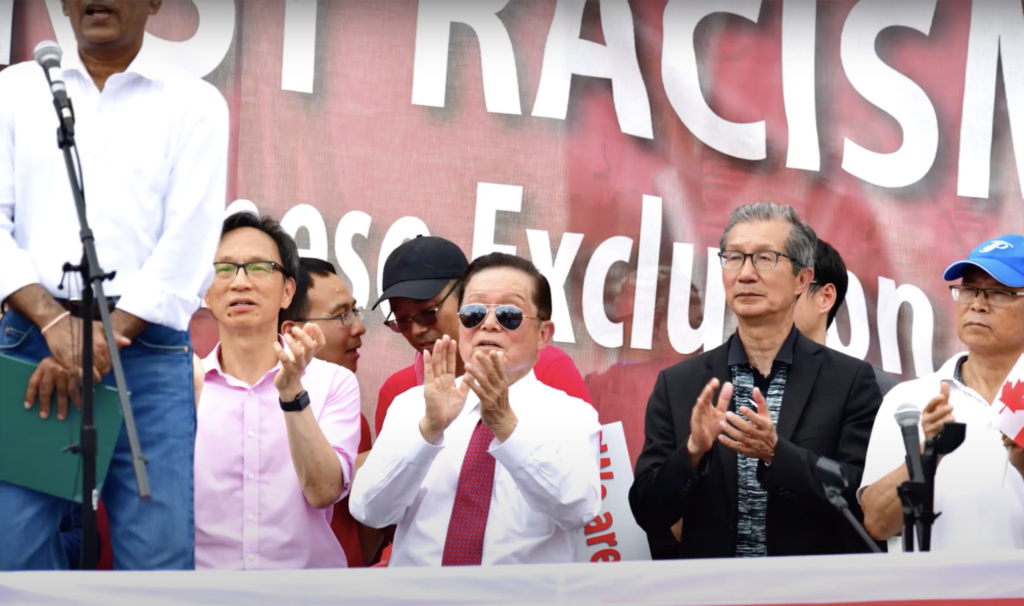
SENATORS YUEN PAU WOO (LEFT) AND VICTOR OH, WITH ONTARIO POLITICIANS MICHAEL CHAN AND VINCENT KE, APPLAUDING TRUDEAU LIBERAL BACKBENCHER CHANDRA ARYA ON JUNE 24 AT PARLIAMENT HILL


A rally took place at Parliament Hill and the Supreme Court on June 24. 2023

Ivy Li of the Canadian Friends of Hong Kong said that the senators are using public money and resources, and their official platform, to “serve a foreign dictatorship’s interest.”


“The goal is very obvious,” Li said. “The Exclusion Act, of course, is a terrible, racist history that all Canadians should know and all of us should remember that something like that actually has happened in Canada. Using that to say that what we are doing today can be the repeat of that, and take it totally out of context, is the common strategy of [the Chinese Communist Party’s] racist card and victimhood card.” 

Woo also helped draft the April-launched e-petition against such a registry. Sponsored by backbench Liberal MP Chandra Arya (Nepean), the e-petition’s initiator is Coquitlam activist Ally Wang. With three weeks to go, it has more than 2,400 supporters, exceeding the 500 minimum for presentation to the House of Commons. 


In 2021, Wang co-founded the Stop Anti-Asian Hate Crimes Advocacy Group Association of Canada (SAAHCAG) and the Chinese Canadians Goto Vote Association (CCGVA). During the 2021 federal election, supporters of the latter group helped Liberal Parm Bains upset Kenny Chiu, the Conservative incumbent who originally proposed the foreign agents registry and voted to condemn China for committing genocide against Uyghur Muslims. 

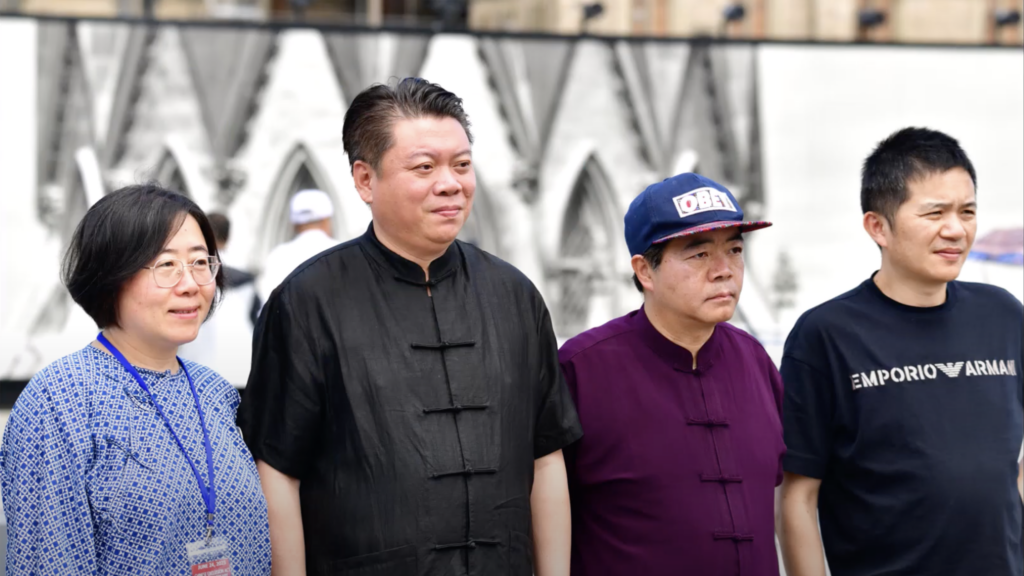
COQUITLAM ACTIVIST ALLY WANG (LEFT) AND TORONTO UNITED FRONT LEADER WENG GUONING ON PARLIAMENT HILL JUNE 24 

At a news conference on March 16, Woo said the 1923 law was the result of “groupthink” and rejected a reporter’s suggestion that he is cozy with the Chinese government. 

“Think about all the other Chinese people who don’t have my privilege or my protections,” Woo said. “Are they going to be accused of being fifth columnists, because of the views they hold? Are we going to have a foreign influence registry, that’s going to use the views that one holds as the litmus test of being a foreign agent?”

Wang was featured in a March 21 report by pro-Beijing Phoenix TV about leaks from the Canadian Security Intelligence Service alleging Tong Xiaoling, China’s former top diplomat in Vancouver, meddled in Canadian elections to help candidates friendly to China. Wang said that memorial activities would help fight systemic racism against not only Chinese, but Indigenous, African and Muslim communities, “because we all face the same white supremacy.”


Li said such a message stokes resentment and fear between ethnic communities. 

“If we want a multicultural society to succeed, we have to be very aware of these kinds of divide and control tactics, from regimes like the CCP, like Russia,” she said.

Wang, who traveled to Ottawa, said she was unavailable for an interview, but referred a reporter to Ivan Pak, who co-founded the two associations and is also in Ottawa. Pak, who ran for the People’s Party of Canada in Richmond Centre in 2019, said he supports Wang’s petition because he does not want the Chinese-Canadian community to “become collateral damage.” 


“I personally doubt about whether this registry is going to help,” Pak said. 

Pak describes himself as “pretty much anti-CCP,” but admits some of the groups involved in commemorating the centennial and opposing the foreign agents registry have deep ties to the Chinese government and businessmen in Mainland China.

WECHAT AD FOR THE MAY 3 LECTURE BY ALLY WANG, WHO IS BEHIND AN E-PETITION AGAINST A FOREIGN AGENTS REGISTRY.


“Some of them, they are not pro-CCP, but pro-China,” Pak said. “They want a strong China, they feel proud to have a strong China.”

However, a WeChat notice from the organizing committee of the rally tried to distance the event from the e-petition campaign. It asked participants not to raise the Chinese national flag, sing the Chinese national anthem or shout pro-China slogans.

Pak said SAAHCAG raised around $17,000 in January at a Sheraton Vancouver Airport Hotel banquet in memory of the 1923 law. He also said SAAHCAG paid for his and Wang’s airfare to Ottawa, but not accommodation. 

The organization is the recipient of federal and B.C. government grants that he Pak says are separate from the petition. The $24,400 from Employment and Social Development Canada’s New Horizons for Seniors Program is a year-long project to promote volunteerism, mentoring, social participation and inclusion, and expand awareness of elder abuse, including financial abuse. 

In April, the B.C. government announced $5,000 for SAAHCAG’s 123 Anti-Discrimination Exhibition, which is billed as “in memory of those affected by the Chinese Immigration Act.”

SAAHCAG now counts 15 directors, including unsuccessful 2022 Vancouver city council candidates May He of Progress Vancouver and Morning Lee of the NPA. During last fall’s campaign, Lee was in damage control after a so-called Chinese blessing video starring impoverished African children was found on the YouTube account for Lee’s real estate company.


SAAHCAG and CCGV supporters include Richmond’s Wenzhou Friendship Society, which is under an RCMP national security investigation for allegedly hosting an illegal Chinese police station.


Wang’s promotional campaign for the e-petition included a lecture via Zoom for seniors involved in the Mississauga, Ont.-based Chinese Age-well Research and Education (CARE). An ad for the May 3 event featuring Wag said “this project is supported by the Government of Canada.” 

However, two departments that granted funds to CARE said it wasn’t. 

Department of Canadian Heritage said it provided CARE $4,000 last September to commemorate Queen Elizabeth II. The $25,000 from ESDC’s New Horizons for Seniors program ended March 27, more than a month before the presentation. 

“Given this, the organization is not able to claim that this event is related to funding received through the New Horizons for Seniors Program,” said Natalie Huneault, a communications manager with ESDC. “Of note, an event of this nature would not be allowable under the terms and conditions of the NHSP, and is not an eligible activity.”


CARE founder Weiguo Zhang, a University of Toronto sociology professor, did not explain why the ad said the May 3 lecture was federally sponsored. An April 23 hybrid symposium, that also included Wang, was supported by ESDC, he said by email.


Richmond resident starts petition against foreign influence registry


But another group thinks playing the race card to deflect criticism of Chinese interference is ‘alarming’

Screenshot of Ally Wang's video encouraging Chinese Canadians to vote.


Activists of Chinese ethnicity are at odds about whether Canada should keep a record of people advocating on behalf of foreign governments.

Ally Wang, an advocate against anti-Asian racism in Richmond, launched a petition to the Canadian government last week claiming that starting a foreign interference registry is a “misleading” way to pinpoint sources of foreign influence.

Wang had led protests during the trial of a racist incident at Steveston’s Rocanini Coffee Roasters, and her video encouraging Chinese Canadians to vote briefly went viral in 2021

The petition is a response to the Canadian government’s potential plan to implement a foreign influence transparency registry. The consultation period for the merits of the plan began last month, where community members are asked to answer a six-question anonymous survey before May 9, 2023.

“It is difficult to distinguish between positive and malign foreign influence, which goes well beyond agents who are acting for foreign governments,” reads the petition, adding that broadly defining foreign influence can infringe on charter rights and stifle commercial and societal connections.

The petition also argues that the registry would pose a “serious harassment and stigmatization risk for racialized communities” and potentially discourage vulnerable communities from civic engagement and public service.

However, it doesn’t appear to be completely against the registry.

“… if a registry is necessary, it should apply to all countries equally and be based on specific arrangements such as monetary payment between individuals or organizations and a foreign state, rather than on hypothetical or presumed arrangements,” reads the petition.

It adds that only those lobbying government officials and politicians should be registered and the registry should not be based on “country of origin, ethnicity, business and civil society affiliations, and most importantly, on one’s views.”

So far, 748 signatures have been recorded with 302 from B.C.

Race card can’t be used as a shield against wrongdoing

Meanwhile, the Chinese Canadian Concern Group on CCP’s Human Rights Violations, a group made up of immigrants from Hong Kong, is cautioning against shying away from the investigations based on racism allegations.


“The CCP (Chinese Communist Party) has often used racism as a shield to deflect criticism of its human rights violations.

“Some even equate the discrimination and persecution experienced by Chinese and Japanese Canadians in the past with the call to investigate and prevent China infiltration and interference today, including some historians, which is truly alarming,” reads their open letter to David Johnston, the Liberal appointed special rapporteur investigating foreign interference in Canada’s recent federal elections.


Members of the concern group, including Richmond’s Victor Ho and Bill Chu, have lived in Canada for an average of 25 years.

The letter lists a variety of infiltration tactics by the Chinese Communist Party, including mobilization efforts through Chinese Canadian community organizations, manipulation of Canadian Chinese-language media, censorship and propaganda on Chinese social media such as WeChat, and connections with local politicians and influential figures.

In Richmond, former Steveston-Richmond East MP Kenny Chiu has claimed that he lost his seat due to a misinformation campaign, while the Wenzhou Friendship Society on Hazelbridge Way is currently under investigation for being an alleged “overseas Chinese police station.” Two protests have been held outside the location after it was suspected to have interfered in Canadian politics.


“The government cannot ignore foreign interference for fear of being accused of ‘racism,’” reads the letter.

“Conversely, those who claim to be community leaders and use ‘racism’ as a smokescreen to deflect the CCP’s human rights violations and other atrocities should ask themselves if their actions and words would call the Chinese-Canadian community’s loyalty into question more than having a transparent and accountable investigation process.”

The foreign influence registry petition is by no means Wang’s first foray into online advocacy.

In 2021, Wang signed a petition in support of retired judge Bill Yee. Yee was removed from the B.C. Chinese-Canadian Community Advisory Committee after he gave an interview on Cantonese radio where he dismissed allegations of the Xinjiang genocide as lies.


She also penned an article claiming the backlash on B.C. senator Yuen Pau Woo, who opposed to labelling China’s treatment of Uyghurs in Xinjiang as genocide, was motivated by racism.


Regarding the foreign influence registry, Senator Woo has compared the investigation into China interference in Canada to the Chinese Exclusion Act a hundred years ago.

Clearly the race card has been played and seeks to be conflated in this matter through agitation.
 Two completely different unrelated purposes.

Saturday, February 3, 2024

The Liberal Party of Canada is allowing security to slip in favour of Communist China

The Liberal Party of Canada is allowing security to slip in favour of Communist China
Feb 3 2024


China’s offensive on Canada, in plain sight

Terry Glavin: Huawei is a key weapon in Beijing’s global economic and political ambitions. The Liberals are playing a dangerous game pretending otherwise.

It’s been on the front pages and at the top of the nightly newscasts for months. Diplomatic relations between China and Canada have collapsed. Beijing has arbitrarily imprisoned Canadian diplomat-on-leave Michael Kovrig and entrepreneur Michael Spavor, embargoed Canadian canola and pork exports, and threatened more pain to come. And China and the United States are at the brink of an all-out trade war.

There’s the shadowy role the Chinese telecom giant Huawei is playing in everything, and all the exotica about digital espionage, mass surveillance and the coming “internet of things” we’re supposed to sort out, and what it all might mean for Canada’s national security. It’s a lot to digest. It doesn’t help, either, that every day the saga seems to take another dramatic twist.

But the big thing that’s getting in the way of a clear understanding of what’s going on and the stakes in play, is that the whole story is occluded by an enormous amount of what is known in the vernacular as bullshit. It’s especially disturbing that a major source of the stuff is Team Trudeau in Ottawa. We’ll get into all that in a bit.

Straight away, it will be useful to stand back in order to get a better look at the fictions, public-relations dodges and outright lies that are making it difficult to see what is happening, in plain sight, in front of our very noses.

First off, by apprehending Huawei chief financial officer Meng Wanzhou in Vancouver last December, Canada was not foolishly allowing itself to be drawn in to a mere trade fight between U.S. president Donald Trump and Chinese president Xi Jinping. What’s going on here truly is a big deal. It has grave implications for Canadian sovereignty. Technology is the main theatre of contest in the new global struggle for economic domination, and the way events unfold in the Huawei standoff, and in the Trump-Xi trade talks, will determine the kind of world we’ll be living in for years and years to come.

There is something approaching bipartisan consensus in the U.S. Congress that the United States should be taking a very hard line with China on matters related to trade, the theft of American intellectual property, cyber-espionage, cyber-sabotage and so on. If you think Trump talks tough on China, you should listen to ranking Democrat Elizabeth Warren some time. When rightwing nationalist theoretician Steve Bannon and liberal free-trade evangelist Thomas Friedman are on the same side of an issue, you should sit up and take notice.


On Huawei, specifically, the U.S. Commerce Department has only now blacklisted the shadowy Shenzhen telecom behemoth and 70 affiliated companies, meaning they’re all effectively banned from buying gear from U.S. suppliers without federal approval. But eight years ago, it was the Obama administration that was targeting Huawei, freezing out the company from Homeland Security operations.

It’s commonplace to hear that the Trump administration is pressuring Canada to follow the American lead and keep Huawei out of emerging fifth-generation (5G) internet connectivity technologies. But eight years ago, it was the Obama administration that was trying to convince Canada to quarantine Huawei.

It’s true that by hinting that charges against Meng Wanzhou might be dropped if she could be used as a bargain chip in trade talks with Beijing, Trump stupidly muddled the Justice Department’s case against her on charges of bank fraud and evading Iran sanctions. But the Justice Department warrant for Meng was drawn up last August, and there is no evidence that the Trump White House was even aware of it when the arrest warrant for Meng was executed in December at Vancouver International Airport.

Huawei has been under investigation by the U.S. Justice Department and the U.S. State Department for sanctions-busting in Iran since at least 2011, and all along, U.S. intelligence agencies have also fingered Huawei as a spy threat. But Trudeau didn’t listen when Canada was warned eight years ago.

Now, Huawei is embedded in 10 Canadian universities and two of Canada’s largest telecoms (Bell and Telus). Huawei employs more than 1,000 people across the country, and over the past several years the company has poured roughly half a billion dollars into research and development initiatives. Huawei has also established itself as a lavish spender in Canada’s opinion-making and policy-shaping circles, devoting enormous resources to public-relations, lobbying, image-polishing and corporate spin.

A “benefactor” member of the Canada-China Business Council, Huawei has cultivated the habit of filling senior corporate positions with veteran insiders from both the Liberal and Conservatives parties. The company has lately taken on the Canadian wing of the public-relations giant Hill+Knowlton Strategies to sell itself as a trustworthy corporate citizen. It also brought in Daniel Moulton and Chad Rogers, Ontario Liberal and Conservative party insiders, respectively, who registered earlier this year to lobby for Huawei. Morgan Elliott, a senior official from the Liberal governments of Jean Chretien and Paul Martin, is now Huawei’s vice-president for government affairs. Alykhan Velshi, formerly a senior aide to Conservative prime minister Stephen Harper, was hired on as vice-president of corporate affairs. Other Huawei recruits include former journalist and Martin-Chretien era speechwriter Scott Feschuk, and Martin’s former director of communications, Scott Reid. The two run a communications and speechwriting firm.

Huawei also holds centre stage in Canada’s hallowed television pastime: Hockey Night in Canada. More than a million of us tune in every week, and more during the playoffs. Thanks to a deal with the Rogers telecom that lasts until at least 2020, Huawei is Hockey Night in Canada’s presenting sponsor.

It’s gotten so that Ottawa can’t bring itself to admit that Huawei should not be permitted to bid in Canada’s 2020 5G spectrum auction, even though everybody knows Huawei is a threat to Canada’s national security. Three former Canadian intelligence chiefs have said so, publicly. Six U.S. intelligence agencies have said so. Among Canada’s Five Eyes security and intelligence partners, the U.S. and Australia have said so, New Zealand has shut the 5G door on Huawei, and while British Telecom has frozen Huawei out the United Kingdom has yet to formally bar Huawei from its 5G system. But Taiwan has shut Huawei out, and so has Japan, and so has Poland. Even Vietnam won’t allow Huawei in.

Harper’s Conservative government kept Huawei at arms length with a national-security exception governing bids to develop a federal communications network. Three years ago, two Chinese employees of Huawei had their immigration applications rejected and were barred from entering Canada after an intelligence assessment determined that they were spies.

The Privy Council Office has partitioned cabinet’s deliberations on Huawei behind a highly secretive review of the national security implications involved in 5G technologies that has drawn in several federal agencies, including the Canadian Security Intelligence Service, the Innovation, Science and Economic Development department, and the Communications Security Establishment.

Public Safety Minister Ralph Goodale and his officials have gone backwards and forwards over whether a decision on Huawei and 5G will be made before the federal election in October. Finance Minister Bill Morneau has weighed in with a less than confidence-building caveat about the national-security review, to the effect that a decision on Huawei’s 5G role would have to be “balanced” against economic considerations.

This matters, because for all intents and purposes Huawei is a key strategic weapon in Beijing’s global economic and political ambitions—Chinese President Xi himself has said as much. Huawei is one of Xi’s “national champion” corporations. The threat Huawei poses is not merely from backdoor mystery spyware subterfuge of the kind Taiwanese and Dutch government agencies have detected in Huawei gear.

In Canada, it’s commonplace to read that Huawei is a privately-owned company, or an employee-owned company, and so it’s not beholden to the Chinese Communist Party. Not even the Chinese propaganda press peddles that line anymore, but “the myth of Huawei’s employee ownership seems to persist outside of China,” according to an analysis published last month by Christopher Balding of Vietnam’s Fullbright University and Donald C. Clarke of George Washington’s law school.


China’s 2017 National Intelligence Law requires Chinese companies to “support, assist and cooperate with the state intelligence work.” Huawei’s big boss, the former People’s Liberation Army officer Ren Zhengfei, said there’s nothing to be concerned about. If asked, he says, he would never turn any Huawei data over to China’s intelligence agencies. What the Balding-Clarke findings show is that it wouldn’t be Ren’s call anyway. He owns only one per cent of the holding company that owns Huawei.

Ninety-nine per cent of the Huawei holding company is owned by a “trade union committee.” There are no independent trade unions in China. They report directly to Beijing, and trade union members have no rights to their unions’ assets. All companies of any size in China are in any case required by law to integrate a Communist Party committee into their management and decision-making structures. “Huawei may be deemed effectively state-owned,” Balding and Clarke conclude.

So what would a Canadian 5G green light for Huawei portend for the future?

 Apart from China, the national governments of Pakistan, Kenya, Ecuador, the Philippines, Serbia and other countries have rushed in engaging Huawei to develop integrated surveillance systems involving thousands of security cameras for facial recognition technology linked to data banks of personal information, and connected to China.

Imagine everything from your internet-search histories and bank statements to your medical files, travel history, employment records and biometric data, all readily available to police agencies, the intelligence services and the military via “digital clouds” allowing for the synthesis of data from public services, health care, education, transportation and “social safety” departments.

Imagine a brave new Canada run along those lines. Huawei’s Ren Zhengfei recently offered this reverie to one of the dozens of television crews recently invited in the course of the company’s global “charm offensive” to Huawei’s outlandish headquarters and campus in Shenzhen: “There’s an issue of strikes. In the future, you use robots. They don’t strike. All they need is batteries.”

Charming.

Now imagine the entire Canadian 5G system vulnerable to Beijing’s data-mining and manipulation and sabotage, owing to a structural chain of command that runs up through someone like Ren Zhengfei and through the Huawei “trade union committee” and Huawei’s Communist Party committee and on up to the Organization Department of the Central Committee of the Communist Party of China.

But maybe that’s just what the future looks like when we allow our imaginations to get the better of us.

Instead, we could just look at what Huawei is doing in the present, in Xinjiang, where more than a million Uyghur Muslims have been shut away in concentration camps, and the Uyghur people are being made into human guinea pigs in a nightmarish surveillance and thought-control experiment. Just last week, Huawei began working on a new pilot project with China’s notorious Public Security Bureau, the lead agency for population control, to open up “a new era of smart policing and help build a safer, smarter society.”

What Xi Jinping is betting on is that the more he turns the screws on us, the more likely it is that we’ll come down on Huawei’s side, on Beijing’s side. In Ottawa, the Chinese embassy claims that the real reason Canadians are furious at the moment isn’t because of Beijing’s thuggish hostage-taking and trade blackmail, it’s because of “white supremacy.” Ambassador Lu Shaye further insists that Chinese Canadians should be expected to side with Huawei, and the rest of us must be sensitive to the feelings of Canada’s Chinese minority.

Awkwardly for Lu, last month a survey by the Innovative Research Group and the Canada Committee 100 Society showed that while he wants Ottawa to intervene in Meng’s extradition case, tell the Americans to go pound sand and allow Meng Wanzhou to return to Shenzhen, only one in nine of British Columbia’s Chinese Canadians agree with him.

For the time being, Meng is living in  high style and the comfort of her very own $15 million mansion in Vancouver’s posh Shaughnessy enclave, just two doors away from the official residence of the United States’ Vancouver consul-general.

One should expect a Chinese ambassador to equivocate and propagandize and lie through his teeth. But why is the Trudeau government being rather less than straight with us about all this?

For a quarter of a century, the defining foreign-policy feature of the Liberal Party brand has been a delusional myth of its own uniquely China-savvy sophistication. With everything that has happened since the rise of Xi Jinping, and the kidnapping of Kovrig and Spavor, it’s not like the Liberals are going to say, well, sorry, we’ve been wrong about China from the beginning, now we’ve put Canada’s sovereignty and our national security in grave peril, and by the way, please vote for us in October.

In Liberal business circles, it used to be considered a mark of distinction to know senior Chinese Communist Party officials by their first names, and to be seen with all the right people in Guangzhou and Shenzhen and Hubei and Shanghai. But after everything that has happened, it’s no longer possible to make the case that Canada’s interests are best served by having cabinet ministers, corporate executives and diplomats jetting off to China to swan around with the Politburo’s creepy casino-racket billionaires. It just doesn’t work anymore.

It’s no longer possible to pretend there’s even a trace of respectability in the annual diplomatic rituals of junketeering through the Central Committee’s dirty-money nomenklatura for the purposes of reducing Canada’s foreign-trade and oil-price reliance on the grubby, war-monging Americans. So the Trudeau government is in a bit of a bind.

One day, Beijing’s canola embargo is just a “scientific-based disagreement,” and Trudeau is telling everyone that he intends to “continue to work with China" to resolve it. The next day, Trudeau is calling Beijing’s shredding of Canadian canola export contracts a case of blowback from the U.S.-China trade quarrels, “an excuse to prolong what is fundamentally a conflict, not even with Canada, but between the two largest economies in the world.”

This is, in the language of common speech, bullshit.

It is also a dangerous game to play. What’s at stake is how liberal democracies like Canada will survive an historic, world-changing technological and economic conflict with China and its subservient police-state allies. The analysis being put about by the Prime Minister’s Office, that it’s all merely a passing spat between the competing hegemons of the United States and the Peoples Republic, is tantamount to a political case for Canada choosing Beijing’s side.

And that’s exactly what Beijing wants.