Sunday, August 9, 2026

*Chinese Transplant Doctor Accused of Ordering Executions to Speak at Vatican

*Chinese Transplant Doctor Accused of Ordering Executions to Speak at Vatican

Dr. Huang Jiefu, one of China’s leading liver transplant surgeons, was in the westernmost province of Xinjiang in 2005 to perform a complicated liver transplant. As backup for the procedure, he telephoned hospitals in Chongqing and Guangzhou for two extra, matching livers.
The livers were delivered within twenty-four hours, but never used, according to four reports in officially-connected Chinese media outlets. This stands in conflict with the standard view that organs come from executed prisoners, whose sentences must be carried out within seven days, according to Chinese law. Dr. Huang could have only obtained fresh organs if there was a captive, pre-blood typed population ready to be killed on demand, experts say. That prisoners of conscience, primarily Falun Gong practitioners, are the source of these organs is the conclusion made most recently by the U.S. House of Representatives, as well as a number of researchers.
Yet Dr. Huang, the Chinese regime’s official spokesman on organ transplantation, will represent China at an upcoming international summit on organ trafficking and transplant tourism at the Vatican. He is expected to promote China’s medical reform—and, if asked, deny organ harvesting.
Researchers of forced organ harvesting in China, and human rights advocates, are opposed to Dr. Huang and Dr. Wang Haibo, another Chinese doctor, being the only speakers representing China at the Vatican. Some have asked the Pontifical Academy of Sciences, the summit’s main organizer, to invite other organ harvesting researchers in the interest of fair dialogue.


The three researchers—former Canadian Member of Parliament David Kilgour, Canadian human rights lawyer David Matas, and American investigative journalist Ethan Gutmann, began looking into allegations of forced organ harvesting of Falun Gong practitioners in the early 2000s. Falun Gong is a traditional Chinese spiritual discipline that was practiced by 70 to 100 million citizens in mainland China by 1999, according to official and Falun Gong estimates, when it was targeted for persecution by the Chinese regime.
After interviewing practitioners formerly interned in Chinese labor camps, reviewing Chinese hospital websites, and examining official government data, the researchers concluded that the Chinese regime was able to sustain a brisk organ transplantation industry for over a decade by harvesting the organs of Uyghur, Tibet, house Christian, and primarily Falun Gong prisoners of conscience. The bulk of the tens of thousands of organs harvested each year beginning in 2000 came from Falun Gong practitioners, the largest prisoner of conscience body in China today, the researchers concluded.
“It is extremely concerning when highly respected international institutions such as the Vatican provide a platform for perpetrating unverified claims about reform of organ donation in China,” said Wendy Rogers, a professor of clinical ethics at Macquarie University in Sydney, and chair of the International Advisory Committee of the International Coalition to End Organ Pillaging in China, an NGO that seeks to end forced organ harvesting in China.
“This lends credibility to false claims and helps to avoid accountability for those who have been involved in forced organ harvesting.”
In correspondence to Bishop Marcelo Sánchez Sorondo, the Chancellor of the Pontifical Academy, Rogers detailed Dr. Huang’s involvement in the Xinjiang case, and suggested that herself or other researchers would be available to balance out Dr. Huang’s views.
Bishop Sorondo noted in replying that certain key researchers had participated in “political events on the condemnation of China” such as a United States Congressional hearing and the European Parliament. He added that the Vatican summit was an “academic exercise and not a reprise of contentious political assertions.”
In rebuttal, Rogers wrote that the issue of organ harvesting has been thoroughly documented and researched for over a decade, and that Dr. Francis Delmonico, the former head of The Transplant Society (TTS) and one of the main summit organizers, said under oath during a 2016 Congressional hearing that he is unable to verify the Chinese regime’s claims of reform.


“Bodies” plastination exhibition in New York [body by China Falun Gong victim]
“To simply say that the evidence is ‘political assertions’ masks the real issue, avoids the truth, and provides support to those who have the strongest reasons to deny their crimes,” she wrote.
The Pontifical Academy of Sciences did not respond to multiple requests for comment.
Wang Zhiyuan, the president of the New York-based World Organization to Investigate the Persecution of Falun Gong, requested that Pope Francis ban Dr. Huang Jiefu and Dr. Wang Haibo from the Vatican summit.
“We hope that the Pontifical Academy of Sciences will prevent these perpetrators from sullying your event, and deceive Catholics and the world of one of the vilest abuses ever known,” Wang wrote in a letter addressed to the Pope. “We hope Vatican can initiate an investigative effort and help to stop the organ harvesting crime all together.”

Lord David Alton, a longtime human rights advocate and a prominent Catholic, said in a
written statement that he is “deeply alarmed” by continuing reports of the “barbaric” forced organ harvesting in China, and expressed concern that Huang Jiefu is allowed a platform to present the Chinese regime’s views at the Vatican.
“In the interests of a well-informed, balanced discussion of these serious matters, I have encouraged the Pontifical Academy to consider inviting researchers whose findings suggest that forced organ harvesting continues on a scale far larger than was previously known, so that they could present their findings and provide the opportunity for constructive discussion,” he wrote.
“It is right to try to engage with China on these issues, but it is vital that we do so critically and with transparency, and not in a way that simply provides China with a propaganda victory.”
Ethan Gutmann said in an interview that former TTS head Dr. Delmonico is “really dedicated” to working “hand in glove” with Dr. Huang Jiefu to promote the idea that China is making medical reforms instead of asking questions about what took place previously.


Dr. Delmonico and Dr. Huang are “burying history, burying the bodies so that they are never seen again,” Gutmann said. “What China has done is the equivalent of a corporation that has produced massive amounts of incredibly toxic material, bury it where nobody will find it, and hope that it will somehow seep into the groundwater and be forgotten.”
But Gutmann remains upbeat.
“Perhaps it doesn’t matter what happens at the conference. We live in a new world, where we can go on social media and change the public perception on things,” he said.
Gutmann is heartened by renewed attention to the issue of organ harvesting in China, and the public reversals to the Chinese regime’s efforts to sweep the issue under the carpet at a global transplantation conference in Hong Kong last year.
So the Vatican can “throw a conference like this,” Gutmann said, “but it’s not the final word.”

Gunther von Hagens, creator of Body Worlds and plastination, dies aged 81

Controversial anatomist’s body ‘will definitely be plastinated’ in line with his wishes, a spokesperson said 


Gunther von Hagens, who developed a technique for permanently preserving human bodies in rigid states and toured the world with his demonic Body Worlds exhibition, has moved closer to fulfilling a long-held wish to be sliced up and displayed in a museum after dying aged 81.

“It is with deep sadness that the family and the Institute for Plastination announce the passing of Dr Gunther von Hagens, inventor of plastination and creator of the Body Worlds exhibitions,” the German anatomist’s institute said in a statement on Monday.

Von Hagens, who was diagnosed with Parkinson’s in 2008, died in a hospital in Heidelberg on 24 July, a day after suffering a cerebral haemorrhage.

He frequently said he wanted his own body to be preserved after his death, though he wavered on his preferred mode of presentation.

“I could envisage my plastinated body standing in a welcoming pose at the entrance of an exhibition, or rendered into slices and distributed across various sites,” he wrote in the Guardian in 2018.

On Monday, a spokesperson for the Plastinarium – a museum von Hagens founded in Guben, Germany, in 2006 – said the anatomist’s body “will definitely be plastinated, as this was always a long-held wish of his”, though where it would be put on display had not been determined.
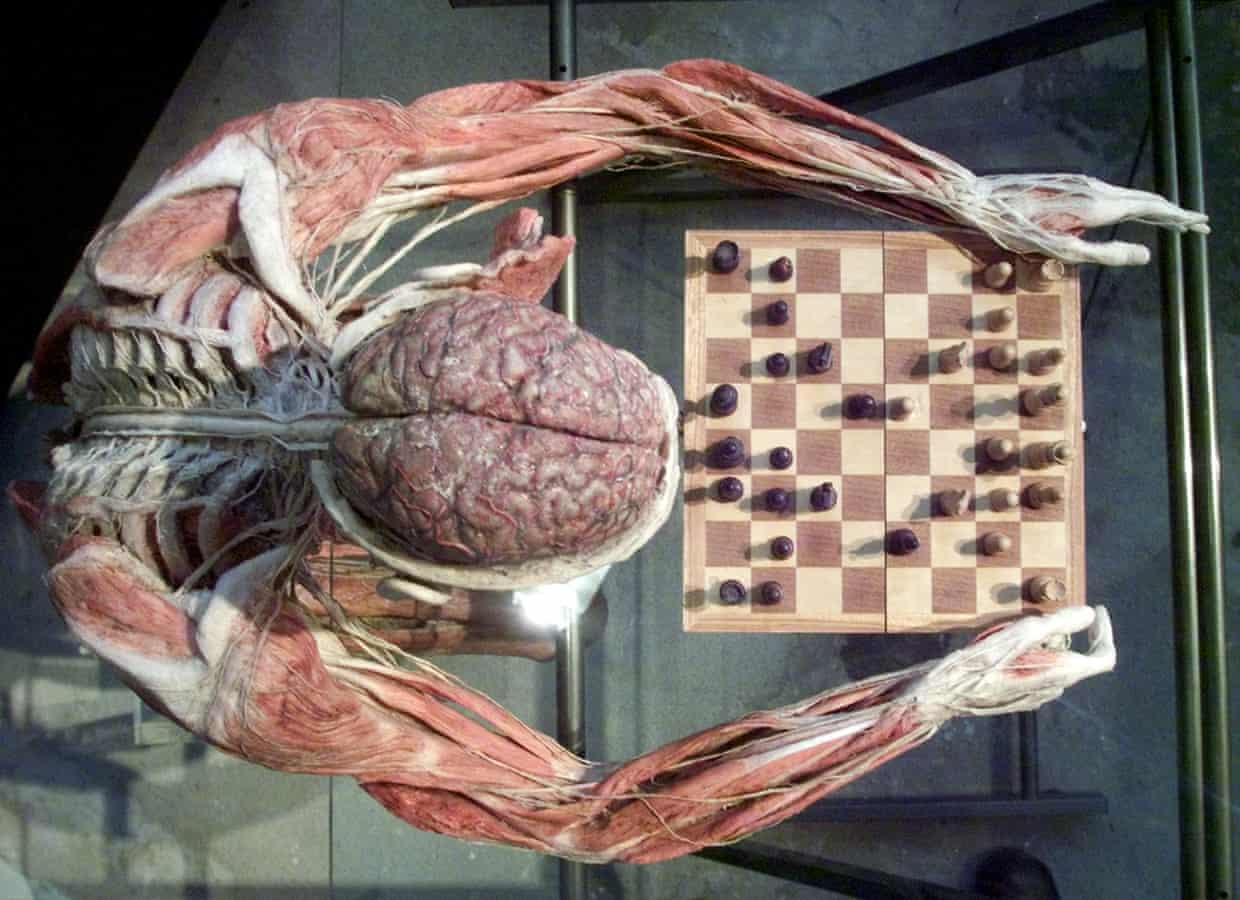
 A plastinated body posed as if playing chess, on show in 2001

Von Hagens was born Gunther Gerhard Liebchen in January 1945 in Skalmierzyce, Poland, then under German occupation and named Alt-Skalden. He grew up in socialist East Germany and took part in protests against the violent Soviet suppression of the Prague Spring in 1968. The following year, he was imprisoned after trying to flee into the west.

In 1970, West Germany paid 40,000 deutschmarks for him to be released to its care as a political prisoner. In the west, he met and married his first wife, Cornelia von Hagens, adopting her surname and its connotations of nobility.

Von Hagens came up with his technique for preserving bodies in 1977, while working as a research scientist at the University of Heidelberg’s institute of pathology and anatomy. “Looking at specimens embedded in plastic – the most advanced preservation technique then available – I wondered why the plastic was poured around bodies rather than into them,” he wrote in the Guardian.

Plastination involves extracting bodily fluids and soluble fat from a dead body and replacing them with resins, silicon rubbers and epoxies. The technique lends a high degree of rigidity to the tissue, enabling bodies to be displayed in upright, lifelike poses.

From 1995, von Hagens’ plastinated bodies were displayed in travelling exhibitions. Some were sliced up to reveal internal organs, while others were posed playing chess, doing physical exercise or having sex. Called Body Worlds, the displays became a global phenomenon, attracting more than 50 million visitors globally.

Von Hagens curated the shows in tandem with his second wife, Angelina Whalley, and said they were driven by a desire to “democratise anatomy” and shatter taboos around death.

But many critics felt the exhibitions deliberately tried to titillate audiences with exhibits such as a series of foetal specimens at various stages of gestation.

 Von Hagens with his wife and co-curator, Angelina Whalley, at the opening of a Body Worlds exhibition in London in 2018. 

The so called anatomist insisted the bodies displayed in the shows belonged to people who had authorised the use of their bodies after their deaths for educational benefit, though the use of infant and animal bodies raised difficult moral questions.

In 2004 German news magazine Der Spiegel published documents appearing to show that von Hagens’ plastination facility in Dalian, northern China, had purchased “ownerless bodies” from police, some of which had been executed and bore bullet holes. After the expose was published, he reportedly instructed his employees not to accept executed bodies anymore.

Von Hagens’ fedora-and-leather-vest wearing public persona – “a cross between evil scientist and the television cliche of ghoulish murder-scene pathologist”, according to one review – may not have helped dispel questions about his motives.

After Parkinson’s disease left him with reduced motor skills and limited speech, von Hagens transferred organisational and financial duties to his wife and son, Rurik.

“Sometimes, at this stage of my life and illness, I wish I could suspend my convictions and embrace the idea of a divinity and an afterlife,” he wrote in 2018. “But I don’t think there is a continuum beyond death. Every deceased body I have seen has shown me the absence of the soul. I don’t believe anything is left of us after we die.”


No comments:

Post a Comment

Comments always welcome!