CCP Spying, Economic Intrusion & Political Interference: Britain/The Fog Clears


Watch out for online contact with Chinese spies, UK defence minister warns public
After MI5 issues China espionage alert to parliament, Luke Pollard says message should be heeded by all citizens
Ordinary UK citizens need to watch out for online contact with Chinese spies, the defence minister has said, after MI5 issued an espionage alert to parliament.
Luke Pollard said a warning given to parliamentarians on Tuesday that China was attempting to recruit individuals with access to sensitive information should also be heeded by the public at large.
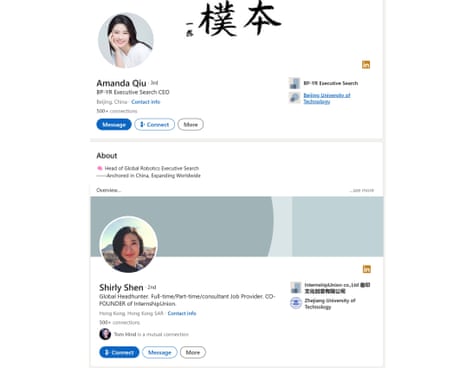
Security services took the unusual step of advising MPs, Lords and their staff to be alert to contact from spies, revealing two LinkedIn accounts that had been used to try to recruit those with access to non-public information.
“That’s advice that should be heeded by the rest of the public as well,” he told Sophy Ridge on Sky News. “Because as we become more online as a community, the ability for people that wish us harm or wish us to gain access to information they shouldn’t have access to becomes more plentiful.”

The security services identified two accounts on LinkedIn going by the names Amanda Qiu and Shirly Shen, both purporting to be headhunters, which were thought to be linked to espionage.

The security minister, Dan Jarvis, said in parliament on Tuesday it was “a covert and calculated” attempt by the Chinese government to recruit people close to power.
In response, Beijing accused the UK spy agency of “groundlessly hyping up” the issue, and said it was not interested in “so-called intelligence” from the UK parliament.

The Chinese foreign ministry spokesperson, Mao Ning, told a press briefing on Wednesday: “China never interferes in other countries’ internal affairs and has no interest in collecting so-called intelligence from the UK parliament.”
One parliamentary worker who had been contacted by Shirly Shen told the BBC he had ignored the message but was concerned that less experienced staff might have responded to it.
“I’ve worked around parliament for about 10 years now so I’m kind of used to this. But if you were more junior, you don’t know what you’re looking for. You might think it’s a genuine offer that’s made to you on LinkedIn, they might accept.”
He said he believed this kind of contact was becoming more common. “They have realised the way to get to parliamentarians is through their staff … it’s deeply worrying,” he said.
It comes not long after the collapse of a trial into alleged spying by two British people for China.
after newsletter promotion
Christopher Cash, a parliamentary researcher, and Christopher Berry, his China-based friend, were accused of espionage but the charges were dropped a month before the court case was due to begin.

The Crown Prosecution Service said it had been forced to abandon the case after the government failed to provide reassurance that China was “a current threat to national security”, a threshold that needed to be met to go ahead with the prosecution.
The wording of the 1911 law around espionage refers to gathering information “directly or indirectly useful to an enemy”, a definition that could have strained the UK’s already fragile relationship with the superpower.
Pollard, who was doing the rounds on breakfast television and radio, said: “China poses a number of threats to the UK, but they also present a number of opportunities for the UK. It’s a complex picture with China, as I’m sure you’ve heard from government ministers over many weeks on this.”

Appearing on the LBC radio breakfast show with Nick Ferrari, Pollard was challenged on the government’s purchase of Chinese technology, including vehicles used by the military that could contain listening devices.
Pollard told Ferrari the government was “looking carefully at what the options are with Chinese technology”.

China’s London ‘Super Embassy’ Would Be a Super Surveillance Hub
The U.K. cannot ignore the broader human rights risks that come with China’s request to build a so-called “super embassy.”


After failing to secure approval in 2022, the Chinese government has resubmitted its controversial proposal to build a massive new embassy complex in London – 10 times the size of its existing facility. While the plan has been debated for over two years, public discussion has largely focused on logistical concerns, such as its impact on nearby residents and whether local infrastructure can handle increased foot traffic.
Yet a far more urgent issue has been largely overlooked: human rights. In recent years, the Chinese government has escalated its transnational repression, frequently using its overseas institutions to conduct covert political operations, particularly targeting dissidents abroad. Given these growing concerns, the question is not just whether London should approve this so-called “super embassy,” but whether it can afford to ignore the broader risks that come with it.
Beijing’s diplomatic offices have played an active role in monitoring, harassing, and intimidating overseas dissidents. Reports indicate that embassy officials have pressured protesters to cancel demonstrations while their families in China face government harassment. Chinese diplomats have also been accused of surveilling students who criticize Beijing, suppressing their speech on campus, and even threatening to have them sent back to China. Some embassies have reportedly pressured foreign universities to prevent outspoken China scholars from speaking to the media, particularly during politically sensitive events such as state visits by Chinese President Xi Jinping.
Investigations further suggest a coordinated effort to infiltrate and disrupt Tibetan, Uyghur, and other dissident groups overseas. Documented across Japan, Canada, the U.S., and Europe, these incidents reflect a growing pattern of repression under Xi Jinping’s aggressive “wolf warrior” diplomacy – one that is drawing increasing international scrutiny.
China’s embassy and consulates, as well as Hong Kong’s overseas offices, have repeatedly violated U.K. laws and human rights protections, ruthlessly targeting dissidents with impunity. In 2022, staff at the Chinese consulate in Manchester – including then-Consul General Zheng Xiyuan – violently confronted protesters, dragging one inside the consulate grounds and beating him. Two months later, Beijing recalled six diplomats involved, seemingly to evade legal repercussions from the U.K. government.
Then, in 2024, British authorities arrested three individuals on espionage charges, including a manager at the Hong Kong Economic and Trade Office in London. Prosecutors alleged the Hong Kong office had paid them to spy on and harass exiled dissidents – including myself.
These incidents underscore how the Chinese government systematically exploits diplomatic privileges to expand its authoritarian repression abroad, using surveillance and intimidation to silence critics.
The impact of China’s transnational repression is deeply felt among exiled Hong Kongers, Uyghurs, Tibetans, and other diaspora communities. Even in democratic countries, many are afraid to protest or speak freely, knowing Beijing’s influence extends beyond its borders. These actions violate fundamental human rights and openly defy local legal protections.
Chinese embassies and overseas offices have far exceeded their diplomatic role, crossing a line no society with the rule of law should tolerate. If foreign governments allow this repression to continue unchecked, it will not only endanger dissidents in exile but also erode public trust in their legal system. Granting China approval to build a “super embassy” in London would further empower its authoritarian grip abroad, enabling more personnel, resources, and space to intensify surveillance and harassment under the guise of diplomacy.
The U.K. government has repeatedly pledged to safeguard exiled communities and take a firm stance against transnational repression. Yet, officials have now given the green light to a vast Chinese embassy – even actively facilitating its approval. This raises a serious question: Is the United Kingdom curbing Beijing’s growing influence of repressing human rights overseas, or enabling its expanding reach.


