Thursday, May 7, 2020

Uni sacrifices student for China romance


Uni sacrifices student for China romance

A 20-year-old philosophy student campaigning against uni’s links with Chinese Communist Party subject to assault, online hate, death threats.
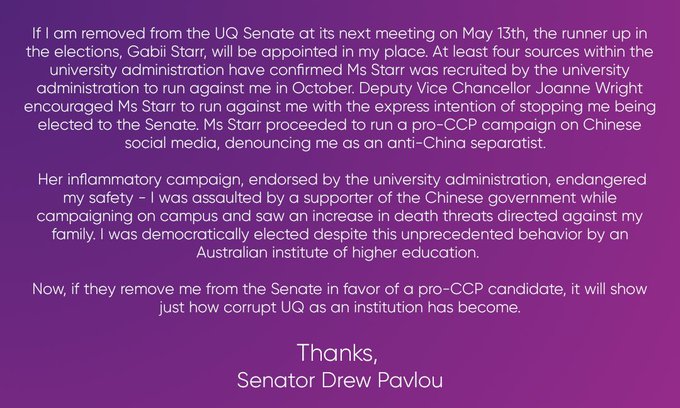
The University of Queensland is going to extraordinary lengths to silence its most effective critic, a 20-year-old philosophy student who has campaigned against the university’s tight links with the Chinese Communist Party.
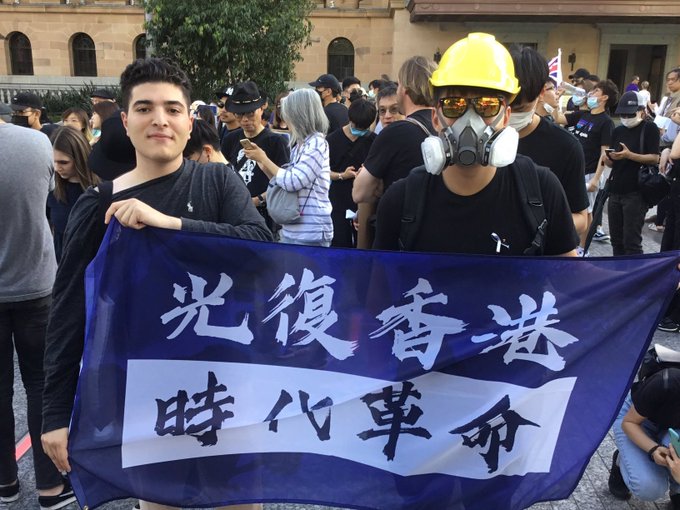
Drew Pavlou came to public attention in July last year when, while leading a protest in support of Hong Kong democracy activists, he was assaulted by men who gave every impression of being heavies working for the Chinese state.
Drew Pavlou, a student activist at the University of Queensland. Picture: Lyndon Mechielsen
He then was targeted by a torrent of online hate and death threats from patriotic Chinese students. China’s consul-general in Brisbane, Xu Jie, praised the violence, drawing a rebuke from Foreign Minister Marise Payne. Pavlou decided to seek a protection order against the consul-general through the courts.


Pavlou’s safety was threatened further when China’s state media vilified him, in effect giving official blessing to patriotic thuggery. He was no longer safe on campus.
READ MORE:Anti-China student in limbo|Student who criticised China faces expulsion|Anti-China activist left hanging by uni
How has the university responded to these events, surely one of the most worrying assaults on free speech?
None of the pro-Beijing students or the thugs who assaulted Pavlou has been disciplined. Xu, whom UQ had appointed an adjunct professor, appears to be as welcome as ever at the university.
Instead, irritated by Pavlou’s robust criticism, pranks and sarcasm, UQ seems to have decided to intimidate him into silence.
In February, Pavlou posted a mock Facebook announcement of a forthcoming “UQ Confucius Institute Panel: Why Uyghurs Must Be Exterminated”. A bit of undergraduate humour? Not for the mandarins at UQ.
University lawyers Clayton Utz wrote a letter to Pavlou that itself reads like a prank. It accused him of “making false statements” because, in fact, the Confucius Institute has no involvement with “the alleged event”. There follows a page and a half listing the rules and by-laws it claims he has viol­ated, and ends menacingly: if he fails to remove the post and will not agree to refrain from making “false and misleading” statements, then the university “reserves the right to commence proceedings”.
Pavlou complied with the first demand. But then UQ sought the nuclear option. On April 9, the disciplinary board delivered a 186-page document detailing 11 charges. Pavlou has been summoned to a secret meeting at which, if he cannot explain himself, he can expect to be expelled.
Drew Pavlou. Picture: AAP
Most of the allegations are trivial to the point of risible. UQ somehow manages to construe jokes, obvious hoaxes and social media badinage as forms of harassment and bullying or acts that prejudice its reputation. It’s true Pavlou’s activism is often provocative and his criticisms sharp, at times over the top, but whatever case the disciplinary board might have had is vitiated by the series of frivolous allegations against him, the effect of which is to indicate the board itself is engaged in harassment and bullying.
The first allegation is that he used a rude word on Facebook (closely monitored by the university) to describe students enrolled in the bachelor of advanced finance and economics. The university claims this constitutes “discriminatory, harassing or bullying behaviour … towards these students”.
It is laughable. Can they produce one student among several hundred aspiring corporate executives who read Pavlou’s Facebook page and felt discriminated against, harassed or bullied? If they could, would anyone take them seriously?
Pavlou deleted his mock “Why Uyghurs Must Be Exterminated” announcement but the university won’t let it go. It claims “a member of the public” (either a fool or a satirist) complained the planned event was “absolutely disgustingly racist and fascist” and they’d be there to protest, and claims Pavlou’s post harmed the university’s reputation by “indicating to the public that UQ supports an ‘extermination’ of the Uyghur people”.
Seriously. One begins to suspect that Pavlou has a secret sympathiser on the board conspiring to make the “allegation notice” so outlandish as to be laughed out of court.
Student Drew Pavlou with lawyer Mark Tarrant. Picture: Annette Dew
But the next allegation takes a more sinister turn. It’s alleged that Pavlou was guilty of behaviour that “unreasonably disrupted staff or students” when at 12.30pm “on or about 26 February 2020” he took a pen from a shelf at the university stationery shop, wrote something with it, put the pen back and left the shop paying only for three sheets of card.
This kind of surveillance and reporting to authorities has more in common with Beijing’s Orwellian social credit system than what we’d expect on an Australian campus. It’s clear that someone high up at UQ decided, through exasperation or vindictiveness, to “throw the book at Pavlou”.
If UQ wants to counter criticism of its China links it has vast resources with which to do so openly, both within the university and more broadly. Instead, it has set up a kangaroo court hoping to browbeat an undergraduate into submission or to expel him.
In the context of UQ’s documented discomfort with Pavlou’s political activism — especially his highlighting of links between the university, its vice-chancellor and various agencies of the Chinese Communist Party — the threat of expulsion can be read only as an attempt to silence legitimate political activism on the campus.

Wednesday, May 6, 2020

Chinese company to buy Texas oil fields in $1.3 billion deal [2015]


Chinese company to buy Texas oil fields in $1.3 billion deal


Boone Pickens: Goldman way off on $20 oil

A Chinese investment firm is shelling out $1.3 billion to buy giant oil fields in Texas, reflecting growing interest from China in U.S. energy resources.

Yantai Xinchao will acquire oil assets in the western Texas Permian Basin that are currently owned by Tall City Exploration and Plymouth Petroleum. The deal is part of a larger transaction between Yantai Xinchao and a second Chinese firm, according to a stock exchange filing on Saturday.
The purchase, which includes oil fields in the state's Howard and Borden counties, has already been approved by the U.S. Committee on Foreign Investment, the filing said.
Many smaller Chinese oil and gas companies are looking for deals abroad as a way to combat tough competition from giant state-owned energy firms, and tight government regulations back home.
China's largest state-owned oil and gas firms, meanwhile, are snapping up resources in countries including Mozambique and Kazakhstan.
The Permian Basin, one of the oldest oil fields in the U.S., has enjoyed a revival as shale gas exploration and other drilling technology has improved.
Yantai Xinchao shares were suspended from trading last Friday to allow for the asset restructuring and oil field purchase. The company expects shares to be halted for about one month, and plans to release periodic updates on the restructuring, according to another stock exchange filing.

People are becoming angry about MSM & Government's arbitrary protection of so called, Chinese 'feelings"

Coronavirus-fuelled racism prompts debate on whether Australia's laws are strong enough to protect victims

Updated 42 minutes ago
A spate of coronavirus-fuelled racist attacks have sparked calls to simplify and strengthen Australia's racial discrimination and vilification processes, amid concerns they are too complicated and toothless to properly protect victims.

Key points:

  • Nation's peak legal group says access to justice is lacking for victims
  • Experts say increasing awareness about discrimination laws is fundamental
  • SA Senator Stirling Griff wants to see a national strategy to combat racism
Last month, the Australian Human Rights Commission revealed one in four people who reported racial discrimination in February and March linked it to the coronavirus pandemic.
Members of Australia's Asian community appear to have borne the brunt of attacks and vilification.
The Law Council of Australia is worried the perennial issue of a lack of legal aid funding is a hurdle for people wanting support navigating red tape, given only 3 per cent of grants go towards civil cases.
James Lin was targeted while sitting on a train in Melbourne in late February, well before tough social restrictions were put in place to try to slow the spread of COVID-19 across Australia.
Four men turned on the Chinese-born Australian citizen, pretending to cough around him and hurling abuse that he must be infected as he was from overseas.
While the taunts were verbal, Mr Lin said he also felt physically intimidated by the group. A female passenger stood up for him, telling the group they were being ridiculous.
"Because that lady stood up for me, I said that it was true Aussie values," he told the ABC.
"And the racist guy said, 'this guy clearly doesn't look Aussie'."
Police were at the next station and were alerted to the group's behaviour.
Mr Lin, an auditor, considered following up the incident and making a formal complaint, but was put off.
"I found it very complicated and so time consuming to go through the whole application or complaint process," Mr Lin said.
"I looked at the website, and it said there would be a reconciliation or mediation process — but it's impossible to find those guys again."

'No one is enforcing it'

Racial attacks and harassment are covered by both criminal and civil laws.
Outside of criminal offences, such as racially motivated assaults, victims of racial abuse can make complaints to state organisations such as the Victorian Equal Opportunity and Human Rights Commission, or federally to the Australian Human Rights Commission.
"The results or the outcome of the complaints wouldn't be effective, because those guys won't be punished or penalised or anything," Mr Lin said.
"The laws are in place, the regulations are in place, but no one is enforcing it."
The nation's peak legal group argued access to justice was lacking.
"Increasing education and awareness about these laws is fundamental," Law Council of Australia President Pauline Wright said.
"Attention should also be given to whether the Australian Human Rights Commission is appropriately resourced and empowered to carry out its investigation, complaint and conciliation functions.
"Attention is also needed as to whether the remedies which are made are currently so low as to provide a deterrent."
Ms Wright believed low numbers of interpreters and affordable legal advice were also factors that needed to be addressed.
"The proportion of legal aid grants made for civil matters is woefully low, at less than 3 per cent," she said.
On Wednesday night, Federal Attorney-General Christian Porter announced $63 million in funding for legal services to deal with an increase in demand during the coronavirus pandemic, to deal with matters such as domestic violence, tenancy and workplace disputes.
Acting Immigration Minister Alan Tudge disagreed that there were "hurdles" when it came to reporting abuse.
"It's very straightforward to report it to the Human Rights Commission and I encourage people that have faced racism to make that report.
"But if there's threats of violence, with racial undertones, in some jurisdictions that can lead to imprisonment, that's taken very seriously."
The debate over racial discrimination and vilification has a lengthy history, with much of the recent discussion being centred on an argument within the Federal Coalition about section 18C of the Racial Discrimination Act.
Acting Immigration Minister Alan Tudge said that was not an area that would be relitigated now.
"That's not part of our plans at all," he said.
Labor criticised the Coalition's track record.
"Australia has a relatively strong legal framework in this area but what we need is leadership from the Morrison Government," Shadow Attorney-General Mark Dreyfus said.
"Instead, since 2013 the Liberals have fought to undermine the anti-discrimination laws, such as by twice trying to scrap the racial hate speech protections in Section 18c of the Racial Discrimination Act, and have been far too slow to condemn racism and to stand up for all Australians."

Stay up-to-date on the coronavirus outbreak

When Federal Parliament returns next week, South Australian crossbench Senator Stirling Griff is hoping to move a motion asking the Senate to note the rise in racist attacks across the country and calling on "the Government to implement a national strategy to combat racism".
"We will be running some information campaigns as well, stating that racism is unacceptable and offering guidance as to how people might be able to report if they are facing racist attacks," Mr Tudge said.

Anything Donald Trump says about Covid-19 referring to it as the Chinese Virus has to be wrong, right?... wait a minute

Maybe he's right!

Fentanyl from China being smuggled into Penticton BC Canada


Drugs, gun seized at motel

Penticton police seize gun, meth, fentanyl at local motel


 - 

Hotel Penticton - Granada Inn


Story: 299222
Penticton RCMP made a major drug bust at a local motel Friday, seizing a firearm, suspicious substances and arresting one man. 
On May 1, 2020, officers with Penticton’s Street Enforcement Unit (SEU) executed a search warrant at a motel suite in the 2000 block of Skaha Lake Road.
The initial investigation led officers to the arrest of two adult men under the Controlled Drugs and Substances Act (CDSA). One of the men was associated to a motel suite in the 2000 block of Skaha Lake Road.
A warrant to search the suite was executed under the Controlled Drugs and Substances Act.
Officers seized a handgun and several grams of suspected drugs, believed to be fentanyl and methamphetamine.
The circumstances of the investigation have been submitted to the Public Prosecution Service of Canada for charge consideration.