Wednesday, May 6, 2020

In mystery investigation of two Canadian scientists, a request for Ebola, henipavirus from the Wuhan lab

In mystery investigation of two Canadian scientists, a request for Ebola, henipavirus from the Wuhan lab

The shipment of Ebola and henipavirus samples to Wuhan has given rise to groundless conspiracy theories involving Xiangguo Qiu. But there is no evidence whatsoever tying her to COVID-19

Xiangguo Qiu receives a 2018 innovation award from governor general Julie Payette for her contribution to the development of a drug to fight Ebola.MCpl Vincent Carbonneau, Rideau Hall.
Xiangguo Qiu was a star at the National Microbiology Laboratory, Canada’s premier disease-research facility. As the co-creator of a once-promising treatment for Ebola virus, her work earned kudos around the world.
That reputation made it all the more shocking when she and her biologist husband, Keding Cheng, were escorted from the lab last July as internal and RCMP investigations got underway.
But a year later, those inquiries have yet to be completed, the two scientists appear still in limbo and the Public Health Agency of Canada, which employs them, has revealed another link between the affair and Wuhan, the Chinese city that several months later became the source of the COVID-19 pandemic.
A shipment of Ebola and henipavirus samples to China, previously disclosed by the agency and first reported by the National Post, was requested specifically by the Wuhan Institute of Virology, said Eric Morrissette, an agency spokesman. The institute runs the country’s lone BSL-4 disease lab, similar to the Winnipeg-based NML and the highest-security facility for handling pathogens.
An aerial view on April 17, 2020, of the P4 laboratory researching dangerous pathogens at the Wuhan Institute of Virology in Wuhan, China. HECTOR RETAMAL/AFP via Getty Images
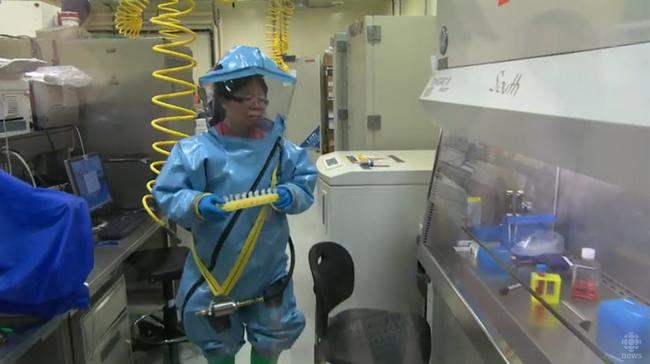
Qiu helped train staff at the Wuhan lab, among several trips she took to her native China in recent years.
Yet the government and police have divulged little else about the situation, leaving a haze of mystery over it that has spawned groundless COVID-19 conspiracy theories — and frustrated even NML employees.
“They have told the staff nothing, other than a ridiculous order last summer that we’re not allowed to discuss it or speculate about what may be going on,” said one Public Health Agency employee, not authorized to speak on the record. “Many of us think it is such a huge story that they are trying to keep buried for some pretty serious reasons. We just don’t know what those are.”
Some respected former colleagues, however, call Qiu a stellar researcher and say they doubt she was guilty of any wrongdoing.
Reached at home Monday, Qiu said she had no comment on her predicament.
The agency has said only that it was looking into an “administrative matter” and had referred “possible policy breaches” to the RCMP.
“The (internal) administrative review remains underway,” said Morrissette recently. “We cannot provide further details.”
As for the RCMP probe, “the matter is still under investigation. No charges have been laid at this time,” said Sgt. Paul Manaigre, a spokesman for the force in Manitoba.
Winnipeg’s National Microbiology Laboratory. Handout
The matter appears to have something to do with that shipment to Wuhan in March 2019 of samples of Ebola and henipavirus — another highly virulent family of pathogens. Neither is related to COVID-19.
“In response to a request from the (Wuhan) Institute for viral samples of Ebola and Henipah viruses, the Public Health Agency of Canada sent samples for the purpose of scientific research in 2019,” Morrissette said. “The National Microbiology Laboratory (NML) shares samples with other public health laboratories — as they do with the NML — to contribute to the advancement of science.”
Qiu’s earlier fame was the result of her work with Gary Kobinger, now a professor at Laval University, to develop “monoclonal antibodies” for treating Ebola, which eventually formed part of the drug Z-Mapp. Despite early promise, the results from a clinical trial published in 2019 raised doubts about its efficacy.
But the groundbreaking research won them the Governor General’s Award for Innovation and other accolades.
Then last July came the sudden, largely unexplained removal of Qiu and Cheng.
A native of China with a medical degree from Hebei University and a Masters in immunology from Tianjin University, Qiu settled in Canada in 1996, eventually ending up at the federal microbiology lab.
In the three years before her removal, she had made eight trips to China, including two to Wuhan, according to agency records obtained through access to information legislation, and first reported by the CBC.
She is a great researcher, she has been a great collaborator. I can’t say anything bad about her
Heinz Feldmann, former colleague
Many of the visits were to give talks on the high-profile Ebola work, which put the Public Health Agency “at the forefront of the field,” said the travel document
She travelled to Wuhan in September of 2017, the records indicating that she had been invited to train scientists and technicians at the BSL-4 lab “for 7-14 days per trip, twice a year for two years.”
Chinese researcher escorted from infectious disease lab amidst ...
Trends | People-Powered News
The training visits were paid for by a third party, whose identity was redacted from the agency document. Qiu returned to Wuhan the next month to speak at an international virology conference, the documents show.
The American government has raised the possibility that the virus causing COVID-19 escaped accidentally from the Wuhan lab, and U.S. diplomats said in a 2018 cable — according to a Washington Post report — that they had concerns about its safety.
Meanwhile, the visits to Wuhan and the shipment of Ebola and henipavirus samples have given rise to conspiracy theories involving Qiu and the pandemic. But there is no evidence whatsoever tying her or the Winnipeg lab to COVID-19, which American intelligence and science indicates is caused by a naturally occurring virus that likely originated in bats.
U.S. authorities have recently looked closely at ties between scientists from China and the country of their birth, warning that Beijing has a track record of using such expatriates to obtain intellectual property, legally or not. Some have been charged or are under police investigation.
Former colleagues of Qiu’s in Winnipeg, however, have said it’s hard to imagine she would be part of anything like that, and note that international collaboration is an integral part of science.
Kobinger told the National Post last year that research involving Ebola — with its minimal commercial potential — would be an unlikely target of economic espionage, suggesting the investigation was a case of “politicizing science, because of tensions between two countries.”
“She is a great researcher, she has been a great collaborator,” Heinz Feldmann, who once ran the NML unit where Qiu works and now heads a U.S.-government BSL-4 lab, told the Post last July. 

Giant hornet stings like ‘red-hot thumbtacks,’ says Island man who knows first-hand


Giant hornet stings like ‘red-hot thumbtacks,’ says Island man who knows first-hand


A Nanaimo man stung at least seven times by Asian giant hornets likens it to having “red-hot thumbtacks being driven into the flesh,” while another Island man compares a sting to being hit in the chest.
The invasive species has won global attention in recent days since major U.S. media outlets dubbed them “murder hornets.”
These plus-sized hornets can measure up to five centimetres long, with a wingspan of four to seven centimetres.
“They are intimidating, no question. They are huge,” provincial apiculturist Paul van Westendorp said Monday.

Officials in B.C. and Washington state, where the hornets have been sighted, worry that the apex predators could be building underground nests and settling in North America after somehow hitching a ride across the Pacific Ocean.
Asian giant hornets were first spotted in Nanaimo last August, and a nest was discovered in Robins Park the following month. A provincial entomologist and local beekeepers eradicated the nest using a carbon dioxide spray and removed the hornets and their queen.
That nest was found by Nanaimo beekeepers John and Moufida Holubeshen, who were looking for it. John Holubeshen was about six metres from the nest when a hornet attacked him through his T-shirt, stinging him on his upper chest near his throat.
“It’s one of the worst stings I’ve had,” said Holubeshen, who treated the sting with ice. “It was more like a physical pain — like having a bruised rib. … It was not like anything I’ve felt before.”
The Holubeshens and two others, including entomologist Conrad Bérubé, returned that evening to eradicate the nest.
Bérubé was stung at least seven times. Two stings went through two pairs of pants he was wearing and drew blood.
After feeling as though hot thumbtacks had been stuck into his leg, he experienced “throbbing muscular aches” in the legs for about 24 hours, he said.
The sting was about six millimetres long. Bérubé said a single sting can kill tissue around the puncture several millimetres in radius and depth.
In November, van Westendorp confirmed that a photo taken in White Rock was that of an Asian giant hornet. Two more hornets were captured in Blaine, Washington, near the B.C. border, in December.
The fear is that the hornets could harm humans, possibly causing death in some cases, and devastate honeybee populations.
B.C. honeybees have not developed a strategy for defending themselves against a giant-hornet assault and could easily fall victim to an attack.
In the spring, when the weather warms up, over-wintering queens emerge and worker hornets help build up a nest. Eventually, in the summer, the nest will get large enough to generate offspring that will sexually mature, van Westendorp said. “For that they need a lot of animal protein.”
A hornet scout will find a honeybee colony and watch it for a while to determine if it is suitable for a raiding party, he said.
If so, it will deposit a pheromone-marker scent near the entrance of the colony, then fly back home and recruit other hornets.
Up to a dozen of these female workers will head back to the entrance of the hive, where they will attack bees, van Westendorp said. “With their huge mouth parts, they will slice and kill wherever they can.”
Hornets aren’t particularly interested in feeding on adult bees, but the attack sends bees into such a massive panic that they forget about defending their nest, leaving their young unprotected.
That’s when the hornets move in on their real targets — the bees’ brood. Bee larvae are carried back to feed the “very hungry” hornet larvae. “They will munch them up in big meatballs.”
Larvae will regurgitate part of the partly digested bee larvae for the adult workers, van Westendorp said. “So it’s a really interesting exchange of food that is taking place.”
That rich protein will allow hornet larvae to mature to the point where they can emerge sexually mature and can mate successfully, creating more queens.
DNA tests of hornets in Nanaimo and Blaine found one group originated in Japan and another in Korea, he said.
There are still questions about whether the hornets would be able to successfully establish themselves in B.C. even though they live in forests and favour moist habitat, van Westendorp said.
It’s not yet known if the coniferous forests here — compared with more deciduous trees where the hornets originate — would make a difference, since they generate different kinds of insects.
Van Westendorp said it’s not clear if the hornets would have enough prey, adding they would not be suited to living in B.C.’s Interior or Alberta.
Gail Wallin, executive director of the Invasive Species Council of B.C., said if there are any Asian giant hornet queens, they would likely be emerging about now and feeding on sap.
She urges anyone travelling to be extra careful to ensure they aren’t carrying any unwanted insect passengers.
Holubeshen speculates that the Nanaimo hornets might have originated with a queen that arrived on a cargo ship.

The buzz about Asian giant hornets

• If you find a nest, do not disturb it. Leave the area.
• Stings are rare but could occur if the nest is disturbed.
• Because of the larger amount of venom injected, a sting can be very painful and cause localized swelling, redness and itching.
• Treat a sting similar to wasp or bee stings by putting ice or a cold compress on the site to reduce inflammation and spread of venom.
• Do not rub the site because it will spread venom.
• People who are stung multiple times (10 or more) have a higher risk of developing toxic or allergic reactions, lightheadedness or dizziness.
• People who are stung multiple time or who develop symptoms of toxic or allergic reaction are advised to seek medical attention immediately.
• If you think you’ve spotted an Asian giant hornet, call the Invasive Species Council of B.C. at 1-888-933-3722, or via the council’s “Report Invasives” mobile phone app, or online at: bcinvasives.ca/report

Tuesday, May 5, 2020

Canada not drawing ‘firm conclusions’ on theory virus escaped from China lab: Trudeau

Canada not drawing ‘firm conclusions’ on theory virus escaped from China lab: Trudeau


Trudeau said Canada will continue to work with intelligence and allies around the world to “find answers to the many questions people are asking.”

Asked by reporters if an investigation had been ordered into the claims, Trudeau said Canada is working with partners and “indeed independently” on “many security issues that are important to Canadians at this. 
But, he said his government’s main focus “remains on how we are working to protect Canadians.”

China has insisted the laboratory is not to blame, with a spokesperson for its foreign ministry calling the claims “unfounded and purely fabricated out of nothing.”

Sign up for our Health IQ newsletter for the latest coronavirus updates ]


Report says China hoarded Canadian PPE in early days of COVID-9 outbreak


 Report says China hoarded Canadian PPE in early days of COVID-9 outbreak


But, earlier this month, the U.S. announced it would be investigating the possibility that the virus made its way into the human population due to a leak at the Wuhan Institute of Virology (WIV).
According to U.S. media reports, cables from the U.S. State Department suggest Embassy officials visited the research facility in 2018. After their visit, officials expressed concerns about inadequate safety measures at the facility.
In a previous interview with Global News, Jeffrey Joy, an assistant professor at the University of British Columbia’s faculty of medicine whose research focuses on virus evolution, said while the idea that this coronavirus escaped the WIV is “conceivable,” it is also “highly implausible in this case.”
He said the genome shows the virus’ origin and spread occurred in nature, which is a common event for several coronaviruses, including ones that don’t become deadly pandemics.
What’s more, Kristian Anderson, who is studying the novel coronavirus at Scripps Research in La Jolla, California told the Associated Press that the odds of the virus having been accidentally released from the lab in Wuhan are “a million to one,” far less likely than an infection in nature.


Coronavirus outbreak: White House says Trump comments about virus from Wuhan lab ‘consistent’ with intelligence assessments


 Coronavirus outbreak: White House says Trump comments about virus from Wuhan lab ‘consistent’ with intelligence assessments


Dr. Jason Kindrachuk, an assistant professor and Canada Research Chair in emerging viruses at the University of Manitoba, also said there is currently no scientific evidence to support the theory that this novel coronavirus escaped from a lab.
“Indeed, accidental laboratory exposures and escapes have occurred in the past, including the influenza virus and SARS-CoV,” Kindrachuk wrote in an Op-Ed in Forbes.
“However, this week the chairman of the joint chiefs of staff echoed that the weight of evidence continued to suggest natural rather than accidental emergence for SARS-CoV-2.”

Kindrachuk said there has been “no other science supporting the escape theory.”
But, not everyone agrees.
U.S. President Donald Trump has repeatedly pushed the theory.
Most recently, on Thursday, Trump told reporters he had been shown evidence that gave him a high degree of confidence, that the virus came from HIV.
But, he didn’t offer any specifics, saying he was “not allowed” to disclose that type of information.