Monday, January 6, 2020

China’s pork crisis piques interest in dog and cat meat, as animal activists raise the alarm over illegal slaughter

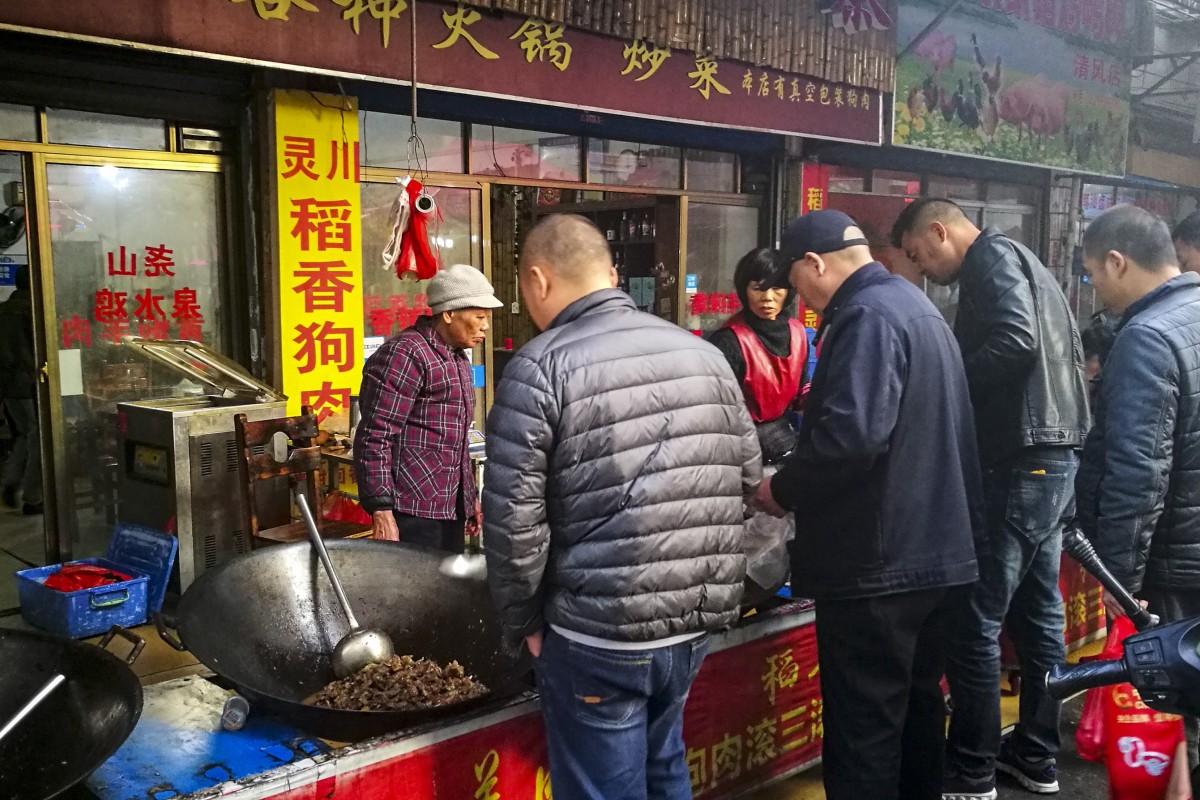
In Guilin, China's dog meat-eating heartland, the country's pork crisis, sparked by African swine fever, has led to rising dog and cat meat sales at market stalls. Photo: He Huifeng
In Guilin, China's dog meat-eating heartland, the country's pork crisis, sparked by African swine fever, has led to rising dog and cat meat sales at market stalls.

China’s pork crisis piques interest in dog and cat meat, as animal activists raise the alarm over illegal slaughter

  • Some regions of China have a long tradition of dog meat consumption, but African swine fever has boosted interest in an alternative source of protein to pork
  • Animal rights groups claim that as many as 10 million dogs are eaten each year, claiming that many are stolen or poisoned
Image result for cat and dog meat wet market China"

Jan 3, 2020


At a wet market in Guilin, a city in China’s Guangxi province, a pork trader is bemoaning the loss of sales to an unlikely competitor.
“They have taken away a lot of our business this year because now dog meat, as well as cat meat, is cheaper than pork and beef,” said the vendor, while pointing at a dog meat stand doing a roaring trade at the city’s bustling Ximen fresh market in December.
He is one of the many people in China to have suffered due to an African swine fever crisis which has led to the deaths of up to a quarter of the world’s pigs, decimating the 
nation’s pork supply
, according to research from Rabobank. Since the first reported case in August 2018, 
pork prices have soared
, culminating in a year-on-year increase of 110 per cent in November.
“Pork was priced at just 25 yuan (US$3.57) per kilogram last year and now has soared to 60 yuan,” said the Guilin dog meat trader, referring to the change since 2018. Prices of other meats have also risen sharply, including chicken, duck and beef, along with other protein sources such as eggs.
The prices of pork and beef were advertised as between 60 and 90 yuan per kilogram in the markets of Guilin. Dog meat was going for 45 yuan per kilogram on average, while cat meat was just 24 yuan per kilogram.
The price differential has allowed Guiilin vendors to report higher sales of 
dog and cat meat
, but has also led to concerns among animal rights groups in China that more dogs and cats will be illegally slaughtered to satisfy growing demand.
Some Chinese provinces, from Guangxi on the border with Vietnam to Jilin next to North Korea, have a tradition of eating dog meat that long predates the pork crisis. To many local diners and those breeding the animals for meat, the trade is no different to poultry or pork husbandry, despite the fact that younger generations of Chinese people in wealthier cities more commonly see them as pets, rather than an item on the dinner menu.
The surge in the 
price of pork
 – by far China’s most popular meat – has generated renewed interest in dog and cat meat among less affluent groups in Chinese society, particularly in smaller third and fourth-tier cities and rural counties, according to animal rights groups and field visits by the South China Morning Post.
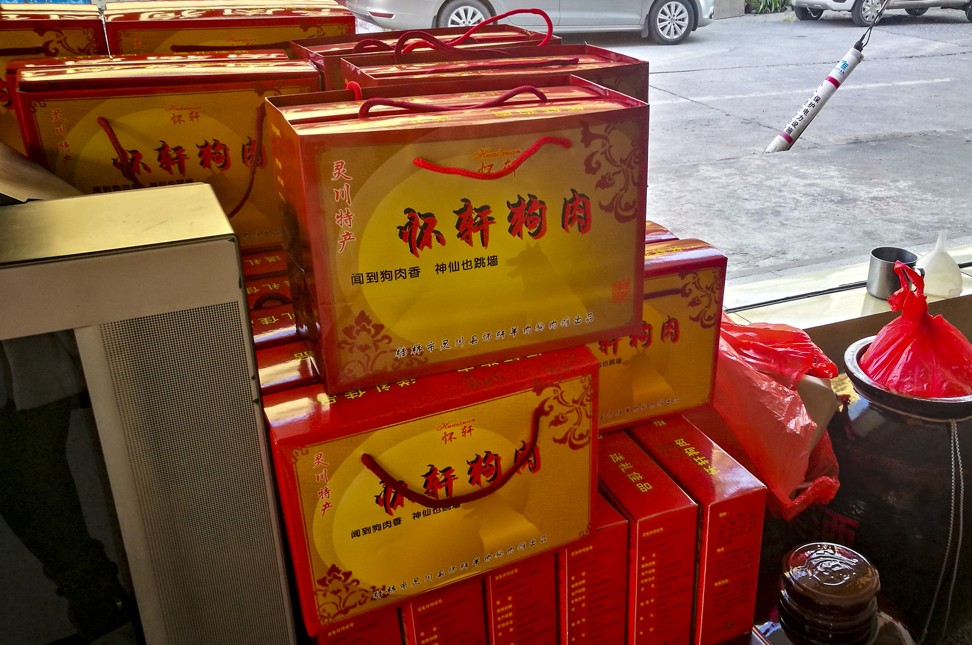
Dog meat packaged for sale in Guilin, in China’s Guangxi province. Photo: He Huifeng
There are no official statistics or third party researchers to offer a comprehensive quantitative picture, but the popularity of dog meat is evident in the marketplaces of Guilin, world-renowned as a tourist destination for its stunning karst mountains and flowing rivers, but known as one of the primary hubs of dog meat consumption in China.
Dozens of restaurants large and small throughout Guilin serve dog meat dishes, stewed or roasted, sliced and served with hotpot. Dog and cat meat stalls are found in almost every local wet market, while it can also be ordered in gift packages online. One shop with stacks of packaged dog meat has a sign claiming that “even the immortal cannot resist the good smell of dog meat”.
In these thronging bazaars, dog meat does not feel like a controversial thing to eat. Instead, it is in the mainstream.
“I can sell up to 20 dogs each day, and the bigger stalls can sell more,” said another dog meat vendor at the Chengnan wet market in Lingchuan county, on the outskirts of Guilin.

Dog meat tastes better than pork. Why not choose dog meat to treat guests, because it’s no longer affordable to order pork?Luo Liu, Jiangxi resident

Mao Fenglan, who has owned a shop selling dog meat since 1986, said it is the “best local gift” for those visiting Guilin. “My clients are all over the country, in Guangdong, Jiangxi and Guizhou provinces,” Mao said.
Aluminium plates are piled high with dog meat dishes at restaurants scattered around the market, while meat stewing shops attract long queues of consumers.
“Dog meat tastes better than pork. Why not choose dog meat to treat guests, because it’s no longer 
affordable to order pork
?” said Luo Liu, a local resident in Wanan county, in the landlocked easterly Jiangxi province, where “spicy braised dog meat” has become a popular dish this winter. “I did not eat any dog meat last year but I’ve eaten it many times at business banquets this winter.”
“It’s easy to buy dog meat at local wet markets and the price is very affordable compared to pork,” said another Jiangxi resident who did not wish to be named.
In China, there are no laws banning the trade or consumption of dog or cat meat. The source of the meat, however, is a common cause of controversy.
Unlike chickens or pigs, there are no industrial-sized dog or cat farms in China. Instead, according to a four-year study by the Animals Asia Foundation (AAF), over 10 million dogs and 4 million cats ended up on Chinese dinner tables every year, with most of them having been stolen or sourced illegally.
There are many local media reports about pets being poisoned, then stolen for meat. In December 2017, Chinese police in Anhui province arrested a gang that sold nearly 200,000 poisonous syringes to dog thieves.
In the same month, a court in Fujian province sentenced a dog thief in a rural village to death with a two-year reprieve for trying to shoot a dog with a poisoned dart but accidentally killing a pregnant woman instead.
In May 2019, meanwhile, a gang of 16 people in Jiangsu province were sentenced to between one and six years in prison for poisoning and stealing dogs, then selling more than 40,000kg of dog meat worth 400,000 yuan (US$57,394).

South Korean dog meat market closes after 60 years of gruesome slaughter
In the wholesale livestock market and wet markets in Guilin, vendors sell a variety of dog and cat breeds. Some animals were clearly recently kept as pets, given the bell collars still worn around their necks. They are sold live or processed. In some cases, the sellers slaughter the animals in front of the buyers.
Despite the long history of eating dog meat in China, and despite or – perhaps because of – the recent uptick in interest, there is increasing disdain among some residents in Guilin, who view it as cruel and barbaric.
“Hundreds of cats and dogs are eaten here in Guilin every day during the peak winter season, and we are so worried because we are actually seeing local people eat more dog and cat meat than in previous years because of the sharp rise in the price of pork,” said Guilin resident Lisa Gao.
A worker at a Chinese animal rights group, who declined to be named, claimed that there are health concerns associated with the trade, given the illicit trade in poisoning and stealing pets. “The public and authorities need to be alert to the food safety problems with dog and cat meat,” they said.
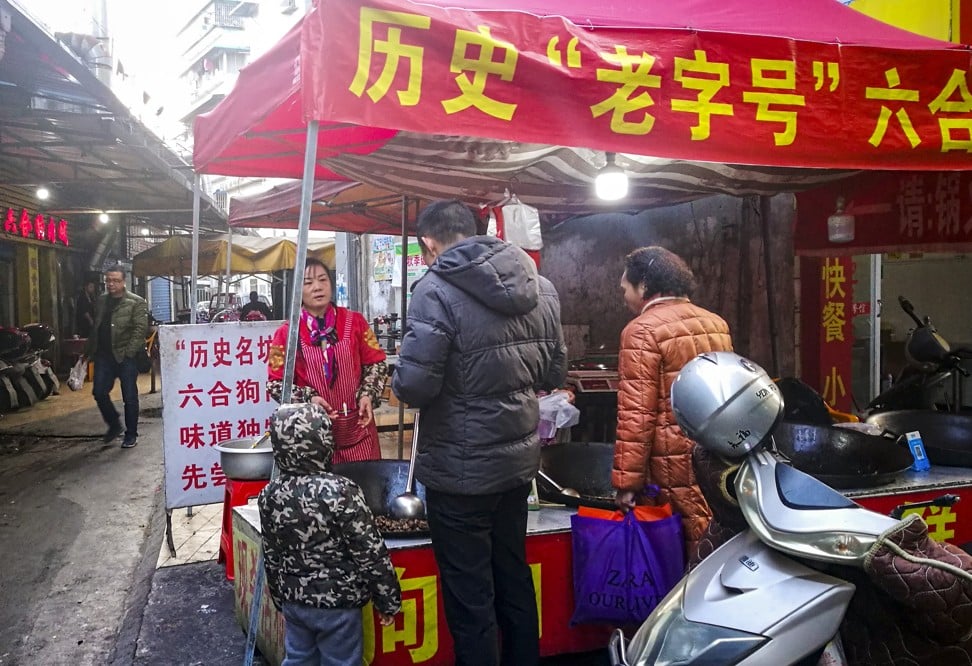
Dog meat for sale at an outdoor eatery in Guilin, advertising its decades-long history. Photo: He Huifeng
Dog meat for sale at an outdoor eatery in Guilin, advertising its decades-long history.
Zhang Hongbo, the founder of Shenzhen Cat, a non-government cat protection agency based in the Guangdong city, said there are signs of a “rise in dog and cat meat consumption, though we have no idea if it’s just a limited and short-term phenomena”.
There is a strong lobby in China against the slaughtering of dogs and cats for meat. For instance, the city of Yulin in Guangxi has been hosting a dog meat festival every June for the last 10 years, with around 10,000 dogs slaughtered each year. Animal rights activists protested, leading to clashes with local dog meat vendors.
Meanwhile, a growing number of Chinese families are taking in dogs and cats as pets. China had about 168 million pets in 2018, most of them dogs or cats, with the number expected to rise to 248 million by 2024. The “pet economy”, namely food and care products, is one of the fastest growing sectors in China.
Research from CBN Data found that the industry was worth over 172.2 billion yuan ($24.71 billion) in 2018.
The Chinese government, for now, is not taking sides and in Guilin, the dog and cat meat trade continue to thrive.
“To engage in food production, food sales, and catering services, a license must be obtained in accordance with the law,” the city’s market regulation department said in a statement in April. “However, no license is required to sell edible agricultural products. Dog meat is an edible agricultural product [so] no license is required to sell dog meat.”

Sunday, January 5, 2020

China-Canada relations hang in the balance as Meng extradition case to heat up

China-Canada relations hang in the balance as Meng extradition case to heat up

A hearing is set to begin Jan. 20, focusing on the test of dual criminality, or whether the U.S. allegations would also be a crime in Canada

Jan 5, 2020

Huawei chief financial officer Meng Wanzhou leaves her home to attend a court hearing in Vancouver on Wednesday October 2, 2019.
VANCOUVER — The international spotlight will be turned on British Columbia’s Supreme Court this month as Huawei executive Meng Wanzhou’s extradition hearing is set to begin, more than a year after her arrest shattered Canada-China relations.
Beijing’s detainment of two Canadians and its restriction of some imports including canola have left many observers eager for a resolution. Some are hopeful the court process will bring relief, while others want Justice Minister David Lametti to step in.
Lametti has the legal authority to stop the process at any time, said extradition lawyer Gary Botting.
“It’s really silliness for him to say he has to obey the rule of law because it’s before the courts. No. What (the law) says is that he can stop the whole process and the courts must comply with whatever he decides,” Botting said.
The RCMP arrested Meng at Vancouver’s airport on Dec. 1, 2018, at the request of the United States, which is seeking her extradition on fraud charges. Meng denies the allegations and also accuses Canadian authorities of violating her rights during the arrest.
The Huawei chief financial officer is on bail and living in one of her two multimillion-dollar homes in Vancouver. A hearing is set to begin Jan. 20, focusing on the test of dual criminality, or whether the U.S. allegations would also be a crime in Canada.
It's really silliness for him to say he has to obey the rule of law because it's before the courts
If the judge rules the test has not been met, Meng will be free to leave Canada, though she’ll still have to avoid the U.S. if she wants to evade the charges. If the judge finds there is dual criminality, the hearing will proceed to a second phase.
The second phase, scheduled for June, will consider defence allegations that the Canada Border Services Agency, the RCMP and Federal Bureau of Investigation conspired to conduct a “covert criminal investigation” at the airport.
Border officers detained Meng for three hours, seized her electronic devices and passcodes and handed them to the RCMP. Meng did not have access to a lawyer during the detainment and a border guard questioned her about Huawei’s business in Iran.
A lawyer for the Attorney General of Canada has said border officers are required by law to conduct an admissibility examination on all travellers entering Canada and the passcodes were given to the Mounties by mistake.
The turmoil could have been avoided, Botting said, had former justice minister Jody Wilson-Raybould declined the U.S. request to arrest Meng in the first place. Prime Minister Justin Trudeau has also said he was informed of the arrest before it occurred.
“Jody Wilson-Raybould got it wrong on this and so did the prime minister,” said Botting.
It’s unclear what rejecting the request might have meant for the relationship between the two close allies. But Botting argued that — both then and now — tossing the Meng case wouldn’t have much of an effect.
“There are just so many layers of nonsense that are going on in North America, generally, between the United States and Canada, that it would get lost in the shuffle.”
The Justice Department said the minister does not make any decisions related to extradition until and unless a judge commits the person for extradition. At that point, the minister decides whether to surrender the individual to the requesting country.
“This speaks to the independence of Canada’s judicial system,” the department said in a statement.
Wilson-Raybould, now an Independent MP, did not respond to a request for comment.
The justice minister can legally halt the process at any time, but in practice the minister has not used that power, said Yves Tiberghien, a political science professor and Asia expert at the University of British Columbia.
It would be politically risky to step in now, said Tiberghien.
“It’s true that the cost of this case is enormous. Essentially, the relationship between Canada and China is frozen when China is the second-largest economy in the world, second most-powerful country in the world,” he said.
“On the other hand, because we’re over a year after the start of the case, and for the whole year Canada has justified the case as being one of strict following … of the rule of law, to intervene now looks like we’re buckling.”
He added that if the court hearings go according to schedule, there is an incentive for the minister to wait for a ruling.
“It’s so much cleaner if the court does it. Then there’s no question about it. It’s proper.”
Some 88 per cent of people arrested in Canada at the request of the United States were surrendered for extradition between 2008 and 2018, Department of Justice statistics show.
The fraud charges against Meng are based on an allegation that she lied about Huawei’s relationship with its Iran-based affiliate Skycom to one of its bankers, HSBC.
Her legal team has argued the alleged misrepresentation does not amount to fraud. The defence says the case is really about the United States seeking to enforce its sanctions against Iran even though Canada has no such sanctions.
A lawyer for the Attorney General has called the argument a “complete red herring.”
Seth Weinstein, a criminal defence lawyer with Greenspan Humphrey Weinstein, said that if the judge finds the allegations are focused on sanctions and not fraud, then they would not meet the test of dual criminality.
As for the defence’s claim that Meng’s rights were violated at the airport, if those arguments are successful then it would be concerning for Canada as a country of the “rule of law,” said Weinstein.
“But, assuming that finding were to be made, we have judicial oversight of police misconduct that ensures that the person’s rights are protected,” he said.
Abuses of process have been found in extradition cases in the past and they didn’t cause irreparable damage to U.S.-Canadian relations, Weinstein added.
Botting said the U.S. would likely ask another ally for a provisional arrest warrant and “be more careful next time.”
“They’d say, ‘Oh, too bad. OK, I’m going home with my marbles. Shucks.’ “

Friday, January 3, 2020

Goodbye Canada, Hello China

How illicit dirty money has flooded our western world, destroying cultures to replace them with a new founded Colonial Communism,
Globally..."Goodbye Canada"

Thursday, January 2, 2020

GOLDSTEIN: Trudeau should tell Huawei thanks, but no thanks


GOLDSTEIN: Trudeau should tell Huawei thanks, but no thanks

Huawei Technologies Chief Financial Officer Meng Wanzhou leaves her home to appear for a hearing at the Supreme Court of British Columbia in Vancouver, Sept. 23, 2019. 
Huawei Technologies CEO and founder Ren Zhengfei’s announcement that he plans to move its U.S. research centre to Canada is a gift horse Prime Minister Justin Trudeau should look in the mouth.
Ren is the father of Huawei CFO Meng Wanzhou, arrested in Vancouver last December and now fighting extradition to the U.S., where she’s wanted on charges of conspiracy to commit bank and wire fraud, intended to violate American sanctions against Iran.
Meng denies the charges which have not been tested in court.
The reason Ren’s announcement — reported by the Globe and Mail — should be viewed with concern in Canada is the reason he gave for making it — that because of U.S. sanctions against Huawei over security concerns, Huawei will be unable to call, email or otherwise contact its American employees.
While Huawei denies allegations of wrongdoing, if the Americans are that concerned about the Chinese telecommunications giant, which has close ties to the Chinese government — Ren, a billionaire, was formerly a technologist in the People’s Liberation Army — Canada should be concerned as well. Particularly given the extraordinary efforts the Chinese government has undertaken on Huawei’s behalf to free Meng, demonstrating its exalted standing with China’s dictators.
Those measures include charging Canadian diplomat Michael Kovrig and businessman Michael Spavor with espionage in apparent retaliation, jailing them for a year (while Meng is free on bail), and launching a trade war against Canada to pressure the Trudeau government to release Meng.
Ren’s interview with the Globe suggests he blames the U.S. more than Canada for Meng’s detention, describing it as American “political interference” to “crush” Huawei, with his daughter “only used as a pawn.”
Apparently offering a carrot to the Trudeau government, Ren said if Canada needs capital as part of its national strategy to develop artificial intelligence and attract global talent, “I can give them money. I am richer than the Canadian government.”
Ren’s reported generosity aside, the problem is the number of countries now expressing security concerns about Huawei.
It’s not just the Americans. Germany, France, the U.K., Australia, Japan, New Zealand, Poland and the Czech Republic have all expressed security concerns about Huawei, including allegations of spying and intellectual property theft, with many restricting or banning Huawei’s activities inside their borders.
While Huawei denies allegations of wrongdoing, similar concerns have been expressed by some security experts in Canada.
Meanwhile, the Trudeau government has not yet decided whether to allow Huawei to supply Canada with equipment for next generation 5G technology.
This will revolutionize global wireless telecommunications, impacting everything from hand-held devices, to electric cars, power grids and how we communicate with each other.
Huawei already has a significant presence in Canada, with about 1,200 employees at its headquarters in Markham, Ont., a research and development centre in Ottawa (which would presumably be expanded under Ren’s announcement), and smaller operations across the country.
According to the Globe and CBC, Huawei has given $56 million to Canadian universities for research and development projects.
It has a sponsorship agreement with Hockey Night in Canada until the end of 2020.
Huawei’s supporters say the concerns levelled against it about espionage are long on allegations but short on evidence, that its 5G technology is superior to its competitors and that security concerns can be addressed without banning Huawei from the global telecommunications industry.
But surely, based on the precautionary principle, the Trudeau government should be looking at less involvement with Huawei, not more.

Wednesday, January 1, 2020

Pay Attention Canada/China’s ‘Magic Weapons’: Influence Operations Subverting Foreign Governments


China’s ‘Magic Weapons’: Influence Operations Subverting Foreign Governments

Report says Beijing sharply increases overseas efforts to sway governments under Xi Jinping

Xi Jinping
Xi Jinping / Getty Images

China under supreme leader Xi Jinping is stepping up coordinated intelligence operations aimed at influencing foreign governments into backing Beijing's anti-democratic goals, according to a new study.
Chinese influence operations involve multiple government and Chinese Communist Party (CCP) intelligence organizations that seek to buy, guide, or coerce foreign governments into advancing its agenda, says the study written by New Zealand professor Anne-Marie Brady, a fellow at the Wilson Center.
"Even more than his predecessors, Xi Jinping has led a massive expansion of efforts to shape foreign public opinion in order to influence the decision-making of foreign governments and societies," the report says.
"China's foreign influence activities have the potential to undermine the sovereignty and integrity of the political system of targeted states," the report warns.
Using New Zealand as a case study, the report reveals that Xi recently urged overseas Chinese nationals and ethnic Chinese residents to infiltrate foreign governments.
In New Zealand, several ethnic Chinese politicians have been elected to the parliament of the South Pacific nation, which is a key intelligence ally of the United States.
For example, New Zealand parliamentarian Jian Yang acknowledged recently that he concealed his past relationship with the People's Liberation Army intelligence unit and membership in the Chinese Communist Party.
"New Zealand, like many other states in the world, is becoming saturated with the PRC's political influence activities, and due to its pattern of engagement with China and its natural assets, it may even be experiencing more political influence activities than most," the report says.
Chinese foreign influence operations in New Zealand raise security concerns here about China gaining accessing U.S. secrets. The government there is part of the British-American intelligence alliance known as Five Eyes—that involves the sharing of secrets among the spy services of the United States, Britain, Canada, Australia, and New Zealand.
"New Zealand is valuable to China, as well to other states such as Russia, as a soft underbelly to access Five Eyes intelligence," the report said.
"New Zealand is also a potential strategic site for the PLA navy's Southern Hemisphere future naval facilities and a future Beidou-2 [navigation satellite system] ground station—there are already several of these in Antarctica."
Over the past several decades, China has focused on sowing divisions between the government in Wellington and the U.S., its ally. New Zealand has adopted increasingly anti-American policies, beginning in the 1980s when the nation refused to permit nuclear-powered or nuclear-armed warships from making port calls as part of an anti-nuclear policy.
China has targeted New Zealand's 200,000 ethnic Chinese, part of the country's population of 4.5 million people.
The report on Beijing influence operations was published as Democrats and most news outlets in the United States remain focused on Russian influence operations, specifically activities during the 2016 presidential election.
By contrast, Chinese influence operations in the United States have received little or no scrutiny from Congress or most news media.
The Chinese activities are based on what Beijing calls "united front" work—strategic influence operations first used in the 1940s by communists who eventually seized power in China.
Xi in September 2014 highlighted the importance of united front work in supporting influence activities around the world, calling them the Party's "magic weapons" in pursuit of making China the dominant world power.
Concerned over the growing sub rosa intelligence operations in nearby Australia, the government there had drafted new laws designed to curb Chinese political and economic influence activities, including a ban on all foreign political donations.
In the United States, China has been engaged in widespread influence operations primarily through the hiring of former government officials to lobby on its behalf. Other methods involve coercing American companies operating in China into influencing the U.S. government in support of China's policies.
During the 1990s, Chinese agents were caught by the FBI funding the reelection campaign of President Bill Clinton.
However, for the past 20 years, the FBI, which is responsible for countering foreign influence operations has produced few arrests or prosecutions related to Beijing influence operations.
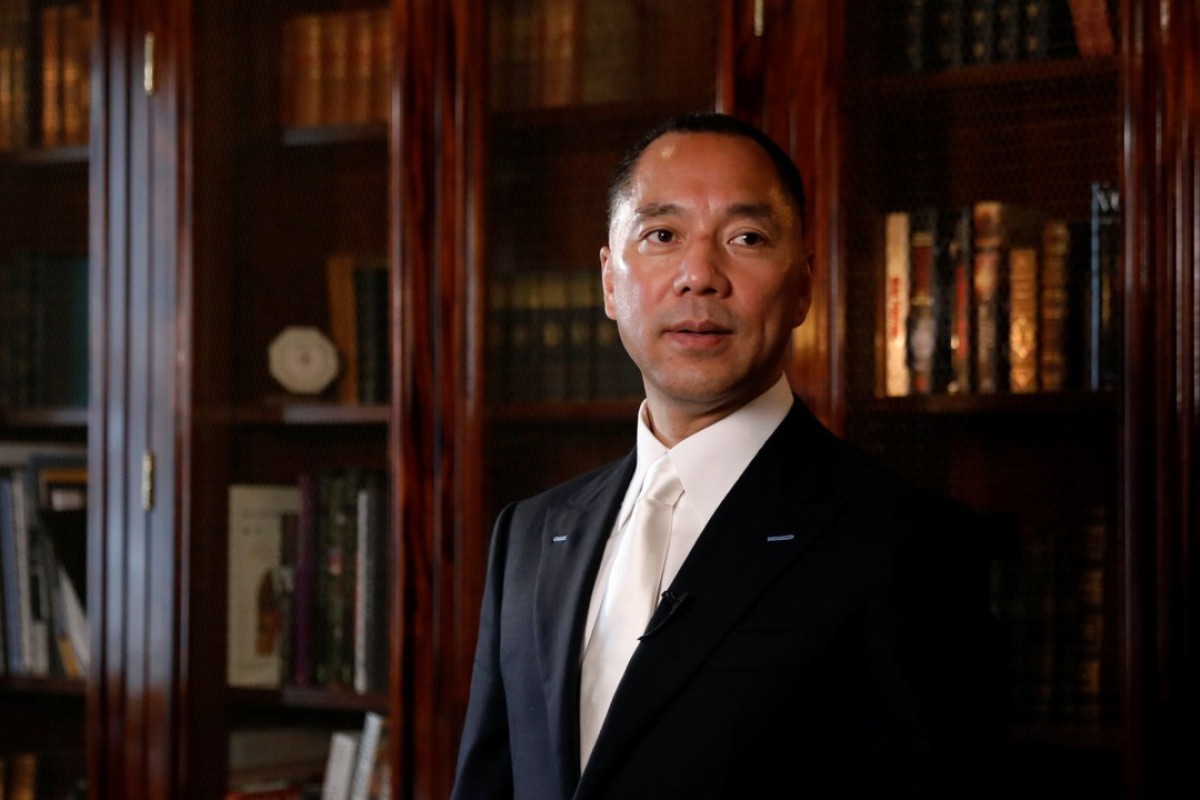
Dissident Chinese businessman Guo Wengui revealed recently that Chinese companies are used often by the Ministry of State Security (MSS), the civilian spy service, to buy off American politicians and organizations in order to promote China's foreign and economic policies.
Image result for Dissident Chinese businessman Guo Wengui"
The influence operations are carried out by Party units identified in the report as the United Front Work Department, the Central Propaganda Department, the International Liaison Department, the All-China Federation of Overseas Chinese, and the Chinese People's Association for Friendship with Foreign Countries.
All are key players in covert Chinese foreign and defense affairs.
"United front activities incorporate working with groups and prominent individuals in society; information management and propaganda; and it has also frequently been a means of facilitating espionage," the report says.
A key ploy of Chinese influence activities is creating networks of "friends of China" overseas who are called on to influence host governments and media.
Chinese military intelligence, known as the PLA Second Department, also has worked closely in the past with the International Liaison Department and United Front Work Department in backing revolutionaries in Southeast Asia and spying.
United Front operatives frequently operate under cover as Chinese diplomats who target foreign politicians, business people, and journalists.
Front groups include Chinese community associations and student groups along with organizations funded by China engaged in Chinese language, media, and cultural activities.
Another key influence tool is the numerous Beijing-funded Confucius Institutes that are located on many U.S. and foreign college campuses.
"CCP united front officials and their agents try to develop relationships with foreign and overseas Chinese personages (the more influential the better) to influence, subvert, and if necessary, bypass the policies of their governments and promote the interests of the CCP globally," the report says.
The Party operatives attempt to guide the activities of front groups, oversea agents, and supporters by appealing to nationalist sentiment, such as urging support for the Chinese "Motherland", the Chinese race, and the Chinese ethnic population within their countries.
"The goal of successful overseas Chinese work is to get the community to proactively and even better, spontaneously, engage in activities which enhance China's foreign policy agenda," the report said.
China has been less successful in targeting overseas Chinese groups opposed to the communist regime, including pro-democracy dissidents, the Buddhist-oriented group Falun Gong, those promoting Taiwan independence, independent Chinese religious groups, and Tibetans and Uighurs seeking independence.
However, all those groups are major targets of infiltration by Party and intelligence agents who seek to divide or subvert the groups.
Recruiting ethnic Chinese as spies is also part of the influence operations, led by the MSS, Ministry of Public Security, PLA Joint Staff Headquarters' Third Department, Xinhua News Service, the United Front Work Department, and International Liaison Department.
The report said a former Chinese spy revealed in 2014 that the PLA Third Department utilizes a network of some 200,000 agents around the world.
Guo, the dissident Chinese businessman, has stated that China dispatched between 25,000 and 40,000 agents to the United States, and increased the aggressiveness of their operations beginning in 2012.
"Political influence activities in the Xi era draw heavily on the approaches set in the Mao years and the policies of Deng, Jiang, and Hu, but take them to a new level of ambition," the report said. "This reflects both the growing confidence of the Xi government in China's international influence, as well as the high stakes strategy he is pursuing to maintain his regime through boosting economic growth and tightening control of information."
The 57-page report, "Magic Weapons: China's political influence activities under Xi Jinping," was presented Sept. 18 at a conference on the corrosion of democracy under China's international influence.

Magic weapons: China's political influence activities under Xi Jinping

Conference paper presented at the conference on “The corrosion of democracy under China’s global influence,” supported by the Taiwan Foundation for Democracy, and hosted in Arlington, Virginia, USA, September 16-17, 2017

18 SEP 2017
In New Zealand, the report identifies three ethnic Chinese politicians who it says maintain ties to Chinese united front groups and the Chinese embassy, including Yang, Raymond Huo, and Kenneth Wang, the descendent of a Communist Party revolutionary who was a member of parliament from 2004 to 2005.
YangImage result for Chinese New Zealand embassy, Raymond Huo"
HoImage result for Chinese New Zealand embassy, Raymond Huo"
The report said Yang "worked for fifteen years in China's military intelligence sector," information that was concealed on his New Zealand permanent residency application and job applications in New Zealand.
"The PLA would not have allowed anyone with Yang Jian's military intelligence background to go overseas to study—unless they had official permission," the report said.
As a member of parliament, Yang has been a "central figure promoting and helping to shape the New Zealand National government's China strategy and been responsible for their engagement with the New Zealand Chinese community," the report said.
Yang said earlier this month he is not a spy and has never been a spy but acknowledged being a part of the Chinese military.
Peter Mattis, an expert on Chinese intelligence said Yang's statements at a press conference raised more questions than it answered.
Image result for Peter Mattis, an expert on Chinese intelligence"
"He claimed to have taught at Luoyang, but he told Chinese media in 2013 that he studied at the school run by China's signals intelligence agency and earned a master's degree," Mattis said.
"New Zealand illustrates the challenge of dealing with Chinese influence operations once Beijing affects the political core," he said. "The potential damage is unknown. Addressing the questions that need answering requires a much higher degree of political will than it might otherwise."
Mattis said whenever Chinese influence activities are a focus of security concerns accusations of racism and ignorance of China are raised.
"The Yang case is no different. Brady's paper shows the problem is neither racism, nor ignorance, but how the Chinese Communist Party operates abroad," he said.
Huo, a member of the New Zealand parliament from 2008 to 2014, and again in 2017, has worked closely with Chinese united front groups, the report said.
Huo has maintained close contacts with China's Zhi Gong Party, one of eight minor political parties under the control of the United Front Work Department.