
Tuesday, May 28, 2019

Monday, May 27, 2019
Chinese premier holds talks with Vanuatuan PM to promote ties
Chinese premier holds talks with Vanuatuan PM to promote ties?
2019/5/27


Chinese Premier Li Keqiang on Monday held talks with visiting Vanuatuan Prime Minister Charlot Salwai, pledging to strengthen all-round exchanges and cooperation so as to lift bilateral comprehensive strategic partnership to a higher level.
Hailing the constant development of bilateral ties, Li said that the two countries, with mutual respect on equal footing, had always lent support to each other on issues concerning each other's core interests and major concerns since the establishment of diplomatic ties 37 years ago.
Countries, no matter big or small, should be equal and can achieve mutually beneficial and win-win outcomes through cooperation, Li said, calling on the two countries to tap their respective advantages, strengthen political mutual trust and deepen all-round exchanges and cooperation.
"China is willing to better align the Belt and Road Initiative with Vanuatu's development strategies and deepen mutually beneficial cooperation in such areas as infrastructure, economy and trade, fisheries and tourism," Li said.
He pledged to encourage Chinese enterprises to invest in Vanuatu, expand imports of Vanuatuan products, strengthen people-to-people exchanges, and continue to provide necessary help to Vanuatu within its capabilities. "We support Vanuatu's important role in the South Pacific region and is willing to strengthen communication and coordination with Vanuatu on international and regional issues," Li said, while vowing to support Vanuatu to host the Pacific Islands Forum next year and provide assistance if necessary.
Salwai extended his congratulations to the 70th founding anniversary of the People's Republic of China, and praised China for its important role in global affairs and economic governance.
Vanuatu places high importance on ties with China, Salwai said, adding that bilateral ties were based on mutual trust and win-win cooperation, and his country was firmly committed to the one-China policy, and supported China's efforts in safeguarding sovereignty and territorial integrity.
He expressed gratitude to China's support and assistance to his country, and pledged to deepen inter-governmental and people-to-people exchanges, advance cooperation in trade, investment, infrastructure and telecommunication, and promote the development of bilateral ties and ties between China and Pacific island countries.
Prior to the talks, Li held a welcoming ceremony for Salwai.
The two leaders witnessed the signing of bilateral cooperation agreements after the talks, and a joint press communique will be released later.
Salwai is paying an official visit to China from May 26 to 31.
U.S. envoy calls China’s Muslim camps ‘horrific,’ wants probe
U.S. envoy calls China’s Muslim camps ‘horrific,’ wants probe
/https://www.thestar.com/content/dam/thestar/news/world/asia/2019/03/12/us-envoy-calls-chinas-muslim-camps-horrific-wants-probe/china_muslim_camps.jpg)
TAIPEI, TAIWAN— Describing China’s internment of an estimated 1 million Muslims as a “horrific situation,” a U.S. envoy on religion called Tuesday for an independent investigation into the detentions and for the release of those being held.
Sam Brownback, U.S. ambassador-at-large for international religious freedom, said China has done nothing to assuage concerns from the U.S. and others over the detention of Uighurs, Kazakhs and members of other Muslim minority groups.
US Ambassador Raises Concerns During Rare Tibet Visit

U.S. Ambassador to China Terry Branstad and his wife Christine pose for a group photo with schoolchildren as he visits an elementary school in Lhasa, Tibet on May 22, 2019. (U.S. Mission to China via AP)
US Ambassador Raises Concerns During Rare Tibet Visit
May 27, 2019

BEIJING—The U.S. ambassador to China urged Beijing to engage in substantive dialogue with exiled Tibetan Buddhist leader the Dalai Lama during a visit to the Himalayan region over the past week, the U.S. Embassy said on May 25.
Terry Branstad also “expressed concerns regarding the Chinese government’s interference in Tibetan Buddhists’ freedom to organize and practice their religion,” an embassy statement said.
“He encouraged the Chinese government to engage in substantive dialogue with the Dalai Lama or his representatives, without preconditions, to seek a settlement that resolves differences,” it said.
Branstad also raised long-standing concerns about the lack of consistent access to the region. The rare visit to Tibet and neighboring Qinghai Province ran from Sunday through Saturday.
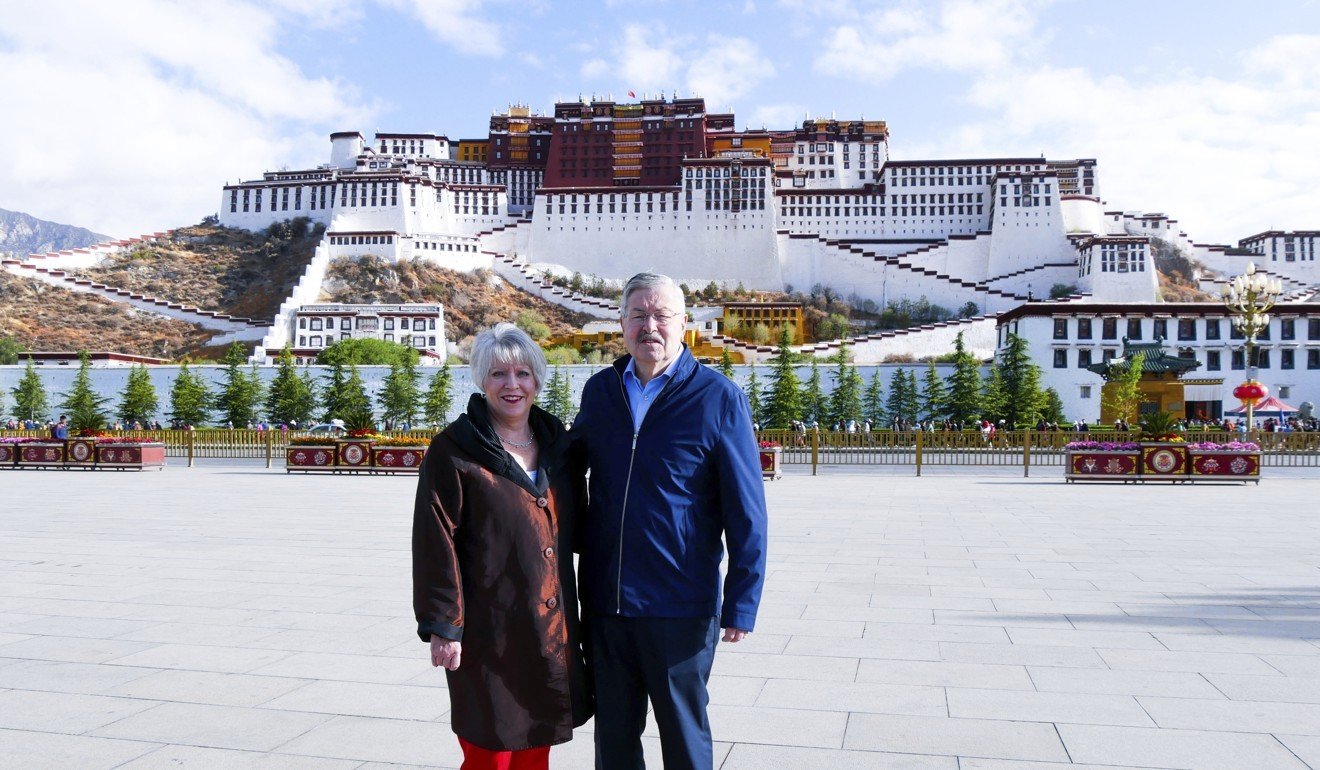

Hosted by the Tibetan authorities, Branstad was given access to important religious and cultural sites, including the Potala Palace, Jokhang Temple, Norbulingka, and Sera Monastery in the Tibetan capital, Lhasa. He also met with senior Tibetan religious and cultural leaders, the embassy said.
China tightly restricts access to Tibet by foreigners, especially journalists and diplomats. In response to those restrictions, the U.S. Congress last year passed an act that would deny entry to the United States for those involved in formulating or enforcing such policies.
China says Tibet has been part of its territory for centuries, but many Tibetans say they were effectively an independent nation for most of that time. Beijing’s control was most recently asserted when the Communist Party’s military wing, the People’s Liberation Army, invaded the region in 1950.
The Dalai Lama fled to India amid an abortive uprising against Chinese rule in 1959 and calls for genuine autonomy for Tibet under Chinese rule. Beijing labels the 83-year-old cleric a dangerous separatist, has refused contacts with his representatives for more than a decade and objects strongly to any meetings between him and foreign politicians.
In recent years there has been a significant tightening of control over Tibetan Buddhism, use of the Tibetan language and traditional cultural expression. Following anti-government protests in 2008, Beijing imposed a policy of “grid policing” that substantially reduces travel and social life for Tibetans, even while China ramps up domestic tourism in the region.
Those methods have been subsequently imposed in the neighboring region of Xinjiang, where an estimated 1 million members of its native Muslim ethnic groups have been confined to detention centers.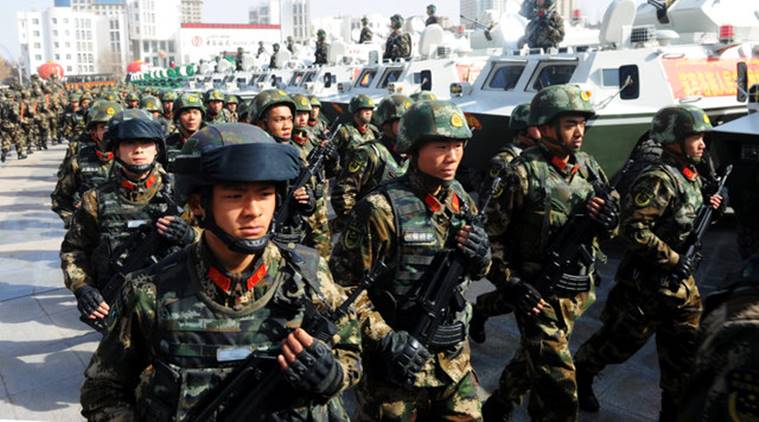



An NSA cyber weapon is reportedly being used against American cities by the very adversaries it was meant to target
In less than three years after the National Security Agency found itself subject to an unprecedentedly catastrophic hacking episode, one of the agency's most powerful cyber weapons is reportedly being turned against American cities with alarming frequency by the very foreign hackers it was once intended to counter.
An explosive New York Times story published Saturday detailing how the NSA's Tailored Access Operations lost control of its so-called 'EternalBlue' malware tool to a cadre of hackers known as the Shadow Brokers, which subsequently publicized the agency's software exploits on the internet and passed them along to hackers associated with China, and North Korea
The Shadow Brokers' disclosure reportedly came thanks to a 54-year-old former contractor Harold Martin III, who plead guilty in March 2019 for, among other things, taking classified documents and electronic devices home with him for more than 20 years in what government officials characterized as the biggest leak of classified information in U.S. history.
The New York Times story comes in the midst of an ongoing cyberattack on the city government of Baltimore that has paralyzed critical infrastructure and halted daily important transactions from home sales to utility payments. But apparently, the NSA connection wasn't publicly known before Saturday — and the first four paragraphs of the Times story will absolutely make your blood boil:
This is basically the cyber equivalent of the GBU-43/B Massive Ordnance Air Blast bomb falling into the hands of ISIS fighters in Nangarhar because some personnel assigned to U.S. Forces Afghanistan delivered the schematics by hand.
Even worse, it casts a major shadow over the aggressive cyber defense plan that the Pentagon rolled out last year to "[defend] forward to intercept and halt cyber threats."
It's also worth noting that Martin's 2016 arrest and the Shadow Broker's subsequent leak of NSA hacking tools occurred just over three years after Edward Snowden pulled back the curtain on the agency's vast domestic surveillance apparatus.

But while a narrow majority of Americans tended to support the NSA's domestic surveillance missteps in the aftermath of the Snowden disclosures, they may not be so forgiving when their light start going out.
An explosive New York Times story published Saturday detailing how the NSA's Tailored Access Operations lost control of its so-called 'EternalBlue' malware tool to a cadre of hackers known as the Shadow Brokers, which subsequently publicized the agency's software exploits on the internet and passed them along to hackers associated with China, and North Korea
The Shadow Brokers' disclosure reportedly came thanks to a 54-year-old former contractor Harold Martin III, who plead guilty in March 2019 for, among other things, taking classified documents and electronic devices home with him for more than 20 years in what government officials characterized as the biggest leak of classified information in U.S. history.

For nearly three weeks, Baltimore has struggled with a cyberattack by digital extortionists that has frozen thousands of computers, shut down email and disrupted real estate sales, water bills, health alerts and many other services.
But here is what frustrated city employees and residents do not know: A key component of the malware that cybercriminals used in the attack was developed at taxpayer expense a short drive down the Baltimore-Washington Parkway at the National Security Agency, according to security experts briefed on the case.
Since 2017, when the N.S.A. lost control of the tool, EternalBlue, it has been picked up by state hackers in North Korea, and China, to cut a path of destruction around the world, leaving billions of dollars in damage. But over the past year, the cyber weapon has boomeranged back and is now showing up in the N.S.A.'s own backyard.
It is not just in Baltimore. Security experts say EternalBlue attacks have reached a high, and cybercriminals are zeroing in on vulnerable American towns and cities, from Pennsylvania to Texas, paralyzing local governments and driving up costs.
To be clear: the NSA built a malware tool capable of disabling the computer systems that control everything from payroll to power grids, lost it, and then basically kept its mouth shut as its own tool was turned against them by the very enemies they were meant to target in the first place.This is basically the cyber equivalent of the GBU-43/B Massive Ordnance Air Blast bomb falling into the hands of ISIS fighters in Nangarhar because some personnel assigned to U.S. Forces Afghanistan delivered the schematics by hand.
Even worse, it casts a major shadow over the aggressive cyber defense plan that the Pentagon rolled out last year to "[defend] forward to intercept and halt cyber threats."
It's also worth noting that Martin's 2016 arrest and the Shadow Broker's subsequent leak of NSA hacking tools occurred just over three years after Edward Snowden pulled back the curtain on the agency's vast domestic surveillance apparatus.
But while a narrow majority of Americans tended to support the NSA's domestic surveillance missteps in the aftermath of the Snowden disclosures, they may not be so forgiving when their light start going out.
SEE ALSO: When Does A Cyber Attack Constitute An Act Of War? We Still Don't Know
Subscribe to:
Posts (Atom)