Keeping an eye on Communist, Totalitarian China, and its influence both globally, and we as Canadians. I have come to the opinion that we are rarely privy to truth regarding the real goal, the agenda of China, it's ambitions for Canada [including special focus on the UK, US & Australia]. No more can we trust the legacy media as there appears to be increasing censorship applied to the topic of communist China. I ask why. Here is what I find.
Saturday, April 25, 2026
BYD to delay mass production at new Hungarian plant, make fewer EVs, sources say
BYD to delay mass productionat new Hungarian plant,make fewer EVs, sources say July 22, 2025
China's BYD will delay mass production at its new electric vehicle factory in Hungary until 2026 and will run the plant at below capacity for at least the first two years, two sources familiar with the matter said.
At the same time, China's No. 1 automaker will start making cars earlier than expected at a new plant in Turkey where labour costs are lower, and will vastly exceed its announced production plans, one of the sources said.
Stay up to date with the latest news, trends and innovations that are driving the global automotive industry with the Reuters Auto File newsletter. Sign up
Shifting production away from Hungary in favour of Turkey would be a setback for the European Union, which has been hoping that its tariffs on EVs made in China would bring in Chinese investments and well-paid manufacturing jobs.
BYD's 4 billion euro ($4.64 billion) plant in Szeged, in southern Hungary, will start mass production in 2026 but only make a few tens of thousands of vehicles over the whole year, the sources said.
That would be a fraction of the plant's initial production capacity of 150,000 vehicles BYD (002594.SZ), opens new tab. It should eventually have a maximum capacity of 300,000 cars per year. A third source confirmed the slower 2026 start-up.
BYD has said it will launch operations at Szeged in October, but has not said publicly when mass production will start. Production at Szeged is due to increase in 2027, but will still be below planned capacity, the sources said.
Meanwhile, the automaker's $1 billion plant in Turkey, which had been slated to start production at the end of 2026 with an annual capacity of 150,000 cars, will make more cars than the Hungarian plant next year, one of the sources said.
Production at the plant in Manisa, western Turkey, will far exceed 150,000 cars in 2027 and BYD will greatly increase output again in 2028, the source added.
BYD did not respond to requests for comment.
The sources spoke on condition of anonymity because they were not authorised to discuss BYD's production plans publicly.
BYD is building the plant in Hungary to sell cars in Europe tariff free. All the cars it currently sells in Europe are made in China, and subject to EU anti-subsidy tariffs on Chinese-made EV imports on top of the standard 10% duty. In BYD's case, the total tariff is 27%.
Many of the cars made at the new plant in Turkey will also be destined for Europe and face no tariffs when exported to the European Union.
A shift toward cheaper production in Turkey would highlight the challenge for Chinese carmakers that want to build cars in Europe to avoid punitive tariffs, but balk at the region's higher wages and energy costs.
The BYD logos are displayed at the 45th Bangkok International Motor Show in Bangkok, Thailand, March 25, 2024., opens new tab
Under right-wing Prime Minister Viktor Orban, Hungary, which will be the headquarters for BYD's European operations, has become an important trade and investment partner for China.
In March, the Turkish government said China's Chery (CHERY.UL) will invest $1 billion in a plant with an annual production capacity of 200,000 vehicles.
DEMAND
BYD is expanding rapidly outside its home market China, where it faces a vicious price war. Reuters reported last month BYD has slowed its expansion in China by reducing shifts at some factories and delaying adding new production lines.
The change in production plans comes as BYD overhauls its European operations following strategic missteps that included failing to sign up enough dealers and hire executives with local-market knowledge, and offering hybrids in markets resistant to fully-electric cars.
Demand for BYD's EVs, which are cheaper than European rivals' models, is soaring in the region.
S&P Global Mobility has estimated the No.1 Chinese automaker will sell 186,000 vehicles in Europe this year, up from 83,000 units in 2024, and expects sales to double again to just under 400,000 units by 2029.
BYD has begun ramping up operations at its plant in Brazil, but has also been sued by Brazilian prosecutors over alleged labour abuses involving Chinese contractors hired to build the complex.
In Hungary, the automaker had planned to install production line machinery by September at the Szeged plant, first announced in 2023, the two sources said.
But in recent months it has delayed tooling of the production line, which is being built in one of its manufacturing hubs in China, the sources added.
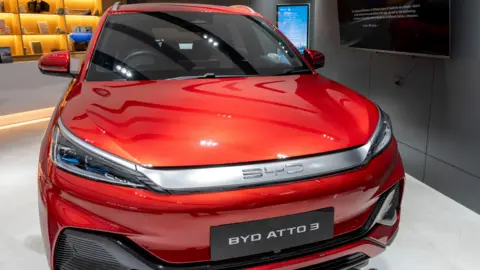
BYD's plans for Szeged may change. Over the last year, executives have mentioned the possibility of making a number of different models at the plant, including the Atto 2, Atto 3 and Dolphin.
One source told Reuters BYD will make the popular Atto 3 and Dolphin EVs as well as its upcoming low-cost Seagull model there, while another source said it would make the Atto 2, Atto 3 and Dolphin.
In Turkey, one source said BYD will make the fully-electric Seal U SUV, the Sealion 5 - though it was unclear whether it would be the fully-electric or plug-in hybrid version - plus two plug-in hybrid models, the Seal U Dmi and Seal 06 Dm-i.
($1 = 0.8627 euros)
Brazil sues China carmaker BYD over 'slave-like' conditions 27 May 2025
Getty Images
Brazilian prosecutors are suing Chinese electric vehicle (EV) giant BYD and two of its contractors, saying they were responsible for human trafficking and conditions "analogous to slavery" at a factory construction site in the country.
The Public Labour Prosecutor's Office (MPT) in the state of Bahia says 220 Chinese workers were rescued after it began an investigation in response to an anonymous complaint.
The MPT is seeking 257 million Brazilian reais ($45.5m; £33.7m) in damages from the three companies.
BYD did not immediately respond to a request for comment from the BBC but has previously said it has "zero tolerance for violations of human rights and labour laws."
Authorities halted construction of the plant late last year after workers were found living in cramped accommodation with "minimum comfort and hygiene conditions", the MPT said.
Some workers slept on beds without mattresses and one toilet was shared by 31 people, it said in a statement.
The MPT also alleged that construction site staff had their passports confiscated and were working under "employment contracts with illegal clauses, exhausting work hours and no weekly rest."
Prosecutors said the workers had up to 70% of their salaries withheld and faced high costs to terminate their contracts. "Slavery-like conditions", as defined by Brazilian law, include debt bondage and work that violates human dignity.
The factory was being built in the city of Camacari in the north east of Brazil.
It was scheduled to be operational by March 2025 and was set to be BYD's first EV plant outside of Asia.
BYD, short for Build Your Dreams, is one of the world's largest EV makers. In April, it outsold Elon Musk's Tesla in Europe for the first time, according to car industry research firm Jato Dynamics.
The firm has been looking to increase is presence in Brazil, which is its largest overseas market.
It first opened a factory in São Paulo in 2015, producing chassis for electric buses.
Anti-Modern Slavery Statement—BYD Australia Pty Ltd
1. Reporting Entity
BYD Australia Pty Ltd (ACN 166 009 687) (“BYD AU/we/our”) was founded in
Australia in 2013 and has offices in Sydney and Melbourne. BYD AU exists to import
and trade BYD branded electric vehicles, storage energy and renewable energy products
in Australia. BYD AU adheres to the principle of operating in good faith, abides by
business ethics, and abides by all applicable laws and regulations, regulatory provisions,
industrial norms, rules and regulations. BYD AU attaches importance to and continues
to create a culture of compliance and honesty. The requirement for social responsibility
is imbued into the entire operation and daily management of BYD. The improvement
of existing management systems is an ongoing process, as we constantly seek to meet
the higher standard of social responsibilities. The BYD Code of Conduct explicitly
requires compliance with laws and regulations on human rights, antitrust, competition,
and fair-trade in countries of operation, and prohibits activities of unfair competition.
This Statement is prepared in accordance with the requirements of the Modern Slavery
Act 2018 (Cth) and addresses the work BYD have undertaken to mitigate the risks of
modern slavery in operation and supply chains in Calendar year 2022. BYD AU is
committed to operating zero tolerance to the modern slavery in all forms in our business. 2. Structure, Operation and Supply Chains
BYD AU is owned by BYD Auto Industry Company Limited and BYD (H.K.) Co.,
LTD jointly. BYD group is a leading technology company and one of the world top 500
companies devoted to leveraging innovations for a better life. Founded in February
1995, BYD Group is headquartered in Shenzhen, Guangdong, with over 280,000
employees. It is engaged in four major industries, i.e. auto, rail transit, renewable energy
and electronics, and has been listed on both Hong Kong and Shenzhen stock exchanges.
With a strong sense of social responsibility and historical mission, BYD has established
a green traffic system by popularizing electric vehicles to control pollution and
launching the SkyShuttle to relieve traffic jams, in a bid to help realize the objective of
“peaking carbon dioxide emission" and "realizing carbon neutrality”.
The supply chain involves multiple tiers of suppliers through the business chain. All
vehicles and other BYD branded products are manufactured overseas within
manufacturing facilities operated by BYD group and imported by BYD AU into the
Australian market. The majority of our suppliers and the manufacturing locations are located in China and Asian region.
BYD group implements most procurement and selects suppliers located in China. BYD
group has more than 11,000 cooperative suppliers. In recent years, due to the increased
demand and the expansion of passenger vehicles, batteries, tracks and other businesses,
BYD has added factories in many places, and the number of suppliers in Eastern China
(such as Changzhou, Fuzhou, etc.) is on the rise.
Each manufacturing facility is strictly controlled by BYD group in accordance with the
BYD group guidance in relation to the manufacturing standard and process, supplier
management, etc including measures and guidance to ensure human rights and antislavery outlined in detail in the following sections.
3. Risk of modern slavery
BYD AU fully adheres to BYD group’s compliance management system, integrates
compliance requirements into all business and management processes, and standardizes
all activities of production, operation and management. BYD group undertook risk
review of suppliers of most businesses and establish supplier routine management to
supervise any potential modern slavery risk in CY 2021-2022.
During the review process, overall low prevalence of modern slavery was identified
across the company governance, business operation and supply chain of BYD AU.
BYD AU does not currently operate or have any top spend suppliers in the countries
with the highest prevalence of modern slavery.
However, we recognize that our sub-suppliers may have a possibility to be connected
to these countries or industry is high prevalence of modern slavery.
This result emphasized that we may need create more engagement with key suppliers
to make sure they are abide by the human rights regarding to labor force and enforcing
appropriate procurement process and management to mitigate their risk in subsequent
supply chain and lower prevalence of modern slavery.
4. Modern Slavery Risk Mitigation
Based on the outcome of risk evaluation, BYD group implement comprehensive risk
management. BYD group has formulated a series of supplier management systems such
as BYD Supplier Requirements, Specific Measures for BYD Suppliers Review,
Specific Measures for BYD Supplier Corporate Social Responsibility Management,
which are optimized and updated annually with new laws and regulations of
international, national, local and industry associations, as well as the latest requirements
of customers included.
The supplier management system defines the social responsibility requirements for
supply chain partners from the aspects of labor standards, occupational health and safety,
environmental management, etc. The same requirements extend to downstream
suppliers, whom will be investigated by BYD. We have publicized BYD's corporate
social responsibility requirements and BYD's high attention to corporate social
responsibility to all suppliers through various ways.
BYD group has established a procurement taskforce, and formulated the BYD.
Procurement Risk Management Procedure. The procurement taskforce of the risk
committee will regularly inspect the suppliers on site to evaluate its performance
including the fulfilment of labor and human rights requirements.
BYD group has always adopted strict labor practice standards, human right standards
and environmental standards for screening our suppliers, required suppliers to establish
a management system that meets the requirements of IS014001, promised to apply and
promote a corporate social responsibility management system that meets the
requirements of SA8000, and abided by BYD's Corporate Social Responsibility
Clauses in the "Supplier Access Agreement" and "General Purchasing Rules".
Suppliers are required to ensure that they do not use any form of forced labor, bonded
labor (including debt mortgage) or indentured labor. They shall not use child labor at
any stage of the business process. They shall treat employees fairly and offer equal pay
for equal work, and do not discriminate against employees because of race, color, age,
gender, ethnicity, religion, belief, etc. Suppliers must provide employees with a safe,
healthy and pollution-free environment to minimize potential hazards in the workplace.
Suppliers are required to consider the impact on the environment in the process of
product design and production, and implement continuous improvement programs to
deal with these impacts, including replacing materials, reducing carbon emissions and
improving the treatment and control methods of waste affecting air, water, and soil. The raw materials or products provided by the supplier to BYD group must comply with the
national standards and local regulations of the place of production and sales, as well as
BYD's requirements for toxic and hazardous substances.
At global level, BYD group is committed to sustainable development and safe, healthy
and hygienic working conditions for its employees. Commitment to comply with health
and safety related laws and regulations and other requirements, strive for accident
prevention and continuous performance improvement. BYD group implements the
safety production policies, establishes the safety responsibility system for all employees
according to regulations and standards, sets up EHS (Environment, Occupational
Health and Safety) committee at different levels in the group and business division, is
responsible for specific occupational health and safety work, and continuously
improves the occupational health management system (ISO45001). BYD group will
timely revise and adjust the management system and procedures, refine the EHS
management code of conduct, establish a long-term mechanism to protect the
occupational health and safety of employees, and constantly improve and enhance the
production and office safety of employees.
4.1 Selection of new supplier
Before introducing new suppliers, BYD group will conduct an investigation for their necessary credentials, and record Responsibility of BYD Supplier Investigation Form.
The suppliers will not be selected if they don't meet the required standards. Before
introducing new suppliers, BYD will sign the relevant cooperation agreement which
contained labor force compliance provisions (supplier access agreement and general
procurement rules) with such suppliers to guide and supervise the suppliers to respect
human rights, treat employees preferentially, and protect the environment. The BYD
Supplier Review Sheet is the basis of such investigation. The Sheet features dedicated
sections such as "corporate social responsibility", "safety, information, and intellectual
property rights", “hazardous substance control", comprehensively rating suppliers and
their downstream supply chains in terms of humanity, environment, safety and
compliance. All information will be verified on site, with multiple provisions of veto
power.
4.2 Routine review and evaluation of suppliers
BYD group regularly investigates and reviews our suppliers' corporate social
responsibility performance and compare against labor force compliance requirements
of the BYD Suppliers Review Sheet on site. Those failing the review will be provided
with interviews, tutoring, and training from BYD to facilitate improvement. Suppliers
failing to rectify to the standard within the given time may be severed from BYD's
supplier network, depending on the actual situation.
4.3 Recruit
BYD's AU approaches are guided by the principle of "employees first". We respect
every employee's rights, help them to grow, and encourage technological innovation. We are trying our best to create an environment that is fair, just, and open, for our
employees to work in and develop a career.
In accordance with the Labor Law and the Labor Contract Law of the People's Republic
of China, as well as the employment laws and regulations of the countries where it
operates, and integrating various standards systems regarding quality management,
occupational health, environmental safety and social responsibility, BYD group has
established its own code of conduct and relevant systems for human resources
management, recruitment management and prohibition of forced labor. BYD group
follows the guideline of "equal opportunity, recruitment based on capability",
eliminating discrimination in recruitment and prohibiting forced labor, labor trafficking
and child labor.
BYD AU recruits abiding by the Prohibition of Forced Labor and Disciplinary
Measures Management Provision (WI-03-004) of BYD group. All workers employed
must be on a voluntary basis. BYD AU prohibits forced labor in any forms including
deception to induce to work, threats of violence or other restrictions on the personal
freedom of workers to force them and child labor (Refer to Child Labor and Youth
Labor Management Procedures of BYD group WI-03-0039). And acts of humiliation
(corporal punishment/beating/illegal search and detention of workers) are strictly
prohibited.
4.4 Whistleblower
BYD AU is abiding by the BYD’s Internal Communication Management Regulations (WI-20-0006) and Whistleblower Protection and Reward Regulations (WI-03-0054).
Employees are able to complain and report on violations of company requirements
through the general manager mailbox and complaint telephone set up by each business
department. Management departments at all levels of the company deals with
complaints and appeals in accordance with the Employee Confessions and Complaints
Management Procedures.
5. Assessment of effectiveness of our actions
At global level, BYD group has established a discipline inspection and audit department
and risk management committee who will supervise the operation of each business
division and investigate any claims and potential risks. The risk management committee
will cooperate with each department including human resources department to identify
potential modern slavery regularly and inspect the relevant department to improve their
management and operation to make sure the compliance.
BYD group is committed to improving and enhancing the working environment of
employees and protecting the health and safety of employees. To achieve that, BYD
group continues to build and improve occupational health and safety management
system, regularly carry out site testing and adopt health protection measures.
BYD AU is continuing to develop our anti-modern slavery framework and ensure our
governance and risk management processes and policies are aligned with BYD group.
BYD AU is committed to make sure an ongoing assessment on the actions taken to
address modern slavery risks to ensure the actions are effective and improve the processes and policies according to the assessment.




No comments:
Post a Comment
Comments always welcome!