*Chinese Student Spies Overwhelm US and other Western countries
September 20, 2014 & May 12 2026

You could have one spy steal 10,000 documents, or you could have 10,000 spies each steal one document.

Intelligence agencies around the world typically regard China’s approach to spying as sloppy and unprofessional. While many other countries focus on stealth and finesse for espionage, China’s focus is on mass numbers.
While regarded as unprofessional, China’s approach has also been extremely effective. The challenge posed by China comes down to a simple fact: it has too many spies for foreign intelligence agencies to keep track of.
“Our nation is overwhelmed. The problem is too big,” said Paul Williams in a phone interview. Williams is chief information officer at BlackOps Partners Corporation, which does counterintelligence and protection of trade secrets and competitive advantage for Fortune 500 companies.
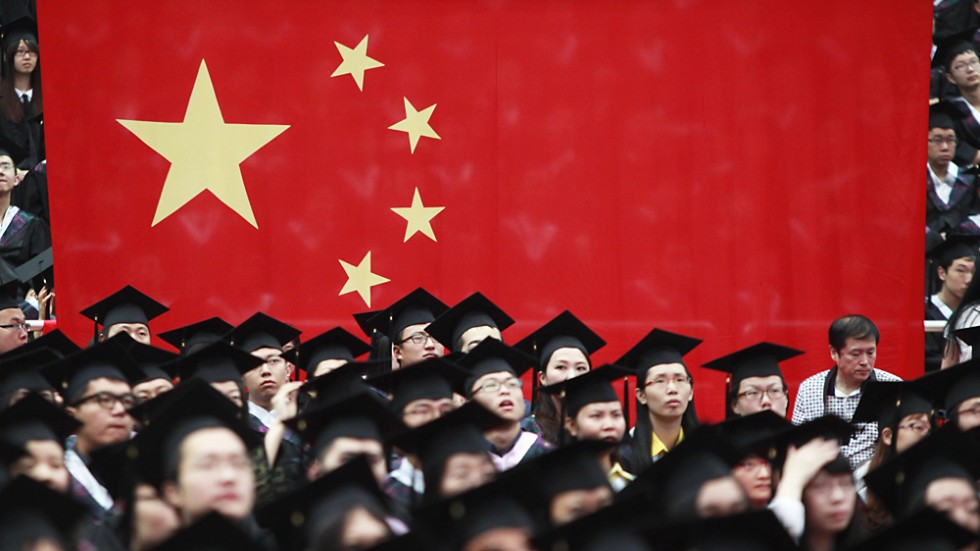
Student spies—often college kids—play a fundamental role in this system. They help bolster a system of espionage where each person does a small share of the work. It’s based on the idea that you could have one spy steal 10,000 documents, or you could have 10,000 spies each steal one document.
By taking the approach of mass numbers for espionage, the Chinese regime has U.S. intelligence agencies outnumbered. In terms of both keeping tabs on their activities, and prosecuting Chinese spies, the United States can’t keep up.
The idea behind recruiting students as spies, according to Williams, is “if you can groom them in college” then they can be used to gain access to research at universities. After college, he added, “You can pick those students then follow their careers into corporate America.”
The Chinese regime can work spies recruited in college into positions in research, government agencies, or U.S. companies.
According to Williams many Chinese spies are not official spies. “Yes, you have those hardcore Chinese spies, but those are usually the minority,” he said. “The majority are just people who get asked to do something on the side.”
According to sources, the grooming process typically takes place before the students leave to study abroad. They may get approached by Chinese security officials who remind them to remain loyal to the motherland, and ask them to report back with anything that could benefit China.
For them, spying is often viewed as a matter of patriotic duty.
Williams said the approach typically works because the Chinese spy agencies don’t ask the students for much. The individual contribution, he noted, is often so minuscule that many may not even think of what they’re doing as espionage.
Spies of a Different Type
It’s because of China’s broad-brush approach to espionage that Chinese spies are typically regarded as sloppy and careless by other security agencies.
Williams said that in the spy world, three rules are followed: “Don’t get caught, don’t get caught, and don’t get caught.” Most other countries have elaborate precautions in place to ensure their agents don’t get caught.
With China, the rules are different. “They just lie if they get caught,” Williams said. “It’s surprising how few precautions they take and how many risks they take.”
He added, however, that the approach has been shockingly effective. “The Chinese are getting everything,” he said.
“What makes it even harder is that you’re not sure what they got,” he said, noting that China’s approach of mass spying means they often get the same documents multiple times.
“It’s a very complicated network,” said Lu Dong, a former Chinese agent of influence in New York who is now an outspoken critic of the Chinese regime.
Lu said China’s low-level spy operations are run through its United Front Work Department, and the Overseas Chinese Affairs Office. He said high-level operations that require more finesse are run through the Chinese military’s General Staff Department, 3rd Department.
Lu said, “They only send the high ranking spies,” and noted that the 3rd Department has upward of 200,000 personnel.
China’s military spy hackers, Unit 61398, are under the 3rd Department’s 2nd Bureau, according to a report from security company Mandiant.

Spying Down Under
The United States isn’t alone in its dilemma of how to defend against China’s mass approach to spying. A similar situation was recently reported in Australia.
China is running spy networks through student associations in Australian universities. These networks are then spying on other Chinese students, pressuring them, and joining activities to defend the Chinese regime’s interests.
News of the spy networks is circulating through some of Australia’s leading newspapers, after The Sydney Morning Herald broke the story.
It reported that Australian spy agencies can’t keep up with the number of Chinese spies, and the Australian government is increasing its counterintelligence capabilities in light of the issue.
The spies are not only used for stealing information, however. They’re also used to keep tabs on individuals critical of the Chinese regime.
The Sydney Morning Herald quotes an unnamed lecturer at a high-ranking Australian university saying he was interrogated four times in China over comments he made at a democracy seminar in an Australian university. “They showed me the report,” the lecturer said. “I can even name the lady who sent the report.”
Such incidents, it reported, are common in Australian universities where Chinese students and professors need to be careful what they say.
Chen Yonglin, a former Chinese diplomat at the Chinese Consulate in Sydney, told Epoch Times when he defected in 2005 there were more than 1,000 Chinese secret agents operating in Australia, alone.
If Chen’s estimates are true, then consider the situation in the United States, which has more than 14 times the population of Australia and much more military and commercial data to pique the interests of China’s spy army.
“There are so many assets of the Chinese here, there is such a large number,” Williams said. “No other spy agency on the planet has anything even close.”
Chen, who himself had participated in China’s spy operations in Australia, told The Sydney Morning Herald that student spies were “useful for welcoming leaders at airports and blocking protest groups from sight, and also collecting information.”
When Chen defected, he brought secret documents with him. One of the documents was a to-do list for the consulate, and detailed how the consulate used its student spy networks to carry out the Chinese regime’s orders overseas.
Among the other roles carried out by the Chinese Consulate in Sydney, according to the leaked documents, were bribing Chinese media, recruiting new students to join its spy networks, and infiltrating Western politics.
Of course, China isn’t just interested in Chinese students for its spy operations.
In April, the FBI started a public information campaign warning U.S. students traveling abroad to be wary of intelligence networks interested in recruiting them as spies.
The FBI released a video telling the story of Glenn Shriver, an American student who was recruited by Chinese spies while studying in Shanghai. He was later caught and sentenced to four years in prison in 2011 after his spy handlers tried getting him into the CIA.
As the FBI pointed out in its educational materials, students studying abroad are prime candidates for positions in government and in large companies. The intelligence agents of China and other nations target students for this reason.
Chinese intelligence agencies want the students to become their insiders in government and in large companies—particularly those with government contracts. The spying operations that reel people in like this are called “seeding operations.”
“To foster the relationship, foreign intelligence operatives will flatter and encourage students, show interest in their future success, and even promise to help them obtain a government-issued visa or work permit—but it’s all disingenuous and empty promises,” said Mollie Halpern, at the FBI Office of Public Affairs in an FBI podcast.
Halpern said, “The truth is, the operatives are just using the student as a pawn to achieve their own ends, without concern for the student’s welfare or future.”




Chinese intelligence operations worldwide to steal important information both through human agents and cyber attacks are a growing threat, according to experts who testified at a US congressional commission last week Beijing’s spies, operating through the civilian Ministry of State Security and People’s Liberation Army Intelligence Bureau (IB), have scored impressive gains against the United States in particular, where economic espionage — the theft of trade secrets and high technology — remains at unprecedented levels. Technology espionage by China was highlighted by the conviction in California last week of Wenxia Man of San Diego who was convicted of illegally conspiring to export fighter jet engines and an unmanned aerial vehicle to China.
LARRY WU-TAI CHIN
KATRINA LEUNG
PETER LEE
CHI MAK
MOO KO-SUEN
WEN HO LEE
FEI YE AND MING ZHONG
HANJUAN JIN
BO JIANG
HUA JUN ZHAO

In 2012 Mark Bourrie, an Ottawa-based freelance journalist, stated that the State Council-run Xinhua News Agency asked him to collect information on the Dalai Lama through their Ottawa bureau chief, Dacheng Zhang, by exploiting his journalistic access to the Parliament of Canada.

Chinese Intelligence Worldwide remains at Unprecedented levels/ Espionage Government Spies
According to trial evidence in the case, Man conspired with Chinese national Xinsheng Zhang in China, to illegally acquire and export Pratt & Whitney F135-PW-100 engines used in the F-35 Joint Strike Fighter; Pratt & Whitney F119-PW-100 turbofan engines used in the F-22 Raptor fighter jet; and General Electric F110-GE-132 engines designed for the F-16 fighter jet.
Additionally, the case involved plans to export the General Atomics MQ-9 Reaper/Predator B unmanned aerial vehicle that can be armed with Hellfire missiles.
Man told an undercover agent in the case that Zhan was a technology spy working for the Chinese military to replicate foreign defense items obtained abroad. The conspiracy highlighted the key targets of Chinese espionage.
160 Chinese agents identified
The CI Centre, a counterintelligence think tank, has identified a total 160 Chinese espionage agents uncovered in the United States between 1985 and 2016, one less than spy cases run by Moscow against the United States. Many involved theft of industrial or trade secrets useful to the Chinese military.
In Taiwan, a total of 56 Chinese agents were identified between 2002 and 2016, according to the center. Taiwan authorities in recent years have uncovered several high-level spies operating against the Taiwanese government.
“The PRC today is the most aggressive intelligence threat facing the United States,” said former FBI Agent David Major, currently director of the CI Centre.
Major testified at a hearing of the congressional commission the reason China poses a significant espionage threat is the Beijing’s government’s combined use of technical cyber attacks and sophisticated human spying to steal secrets and other information.
“FBI investigations and arrests for industrial espionage and violations of export control laws are at an all-time high, predominately linked to the Chinese government,” said Michele Van Cleave, former National Counterintelligence Executive, a senior US government counterspy post.
FBI economic espionage cases increased 53% from 2014 to 2015, and the number of cases currently underway is in the hundreds.
Peter Mattis, a China affairs analyst at the Jamestown Foundation, warned that China’s spy services target young people who travel to China.
The US announced criminal charges in 2014 against five Chinese army hackers for stealing trade secrets from American companies
Recruiting students
“China’s intelligence services have demonstrated repeatedly over the last three decades the willingness to recruit students and others inside China who might be directed to join the US Government in the hopes of future access,” Mattis said.
Major, Van Cleave and Mattis were among several intelligence experts who revealed new details about Chinese intelligence activities during a hearing last week of the US-China Economic and Security Review Commission, a US Congress entity.
Van Cleave noted that some of the most damaging Chinese espionage occurred more than 20 years ago when a Chinese defector revealed that US nuclear weapons secrets had been compromised through spying.
Yet the crime, originally linked to Los Alamos nuclear laboratory technician Wen Ho Lee, remains unsolved.
“The [People’s Republic of China] stole design information on all of the United States’ most advanced thermonuclear weapons,” Van Cleave said. “This includes every currently deployed thermonuclear warhead in the US ballistic missile arsenal, as well as design information on enhanced radiation weapons. We still do not know how they did it. The troubling question is, why not?”
China currently is engaged in a major strategic nuclear forces buildup that analysts say has benefited from the theft of US nuclear secrets.
Shortcomings among counterintelligence agencies within the open democratic societies have made it relatively easy for China to conduct large-scale successful intelligence operations. The activities include both the recruitment of agents with access to secrets, as well as the use of cyber penetrations of government and private sector networks to obtain mass amounts of valuable data.
Blackmail US government workers
The hacking attack against the US Office of Personnel Management was an extremely damaging compromise that will greatly benefit Chinese intelligence activities.
The loss of sensitive records on 22 million US government workers included every employee with access to secrets, providing China’s Ministry of State Security and IB, formerly the PLA General Staff Second Department, with a gold mine of information useful in spotting and recruiting agents.
“The Chinese now have a detailed roster of most if not all American contractors and government employees who have access to classified information, plus a roster of their friends, colleagues or co-workers who may be useful conduits or potential assets in their own right,” Van Cleave said. “They also have a treasure trove of data that can be used to coerce, blackmail or recruit US sources or simply enable personalized phishing schemes.”
Additionally, by analyzing the stolen data on the foreign residence and travel of most American officials and can use the information to identify and disrupt US and foreign intelligence networks and operations.
Aggressive counterintelligence need
The solution to the problem is to increase awareness of the problem of Chinese intelligence operations, and to conduct aggressive counterintelligence activities against them. Those counterspying activities should include offensive strategic operations to recruit Chinese intelligence officers and use them to identify aggressive Beijing spying operations and disrupt them.
Like the Soviet KGB political police and intelligence services, China’s spy agencies’ foremost mission is maintaining rule of the Communist Party of China. An aggressive counterintelligence program against both the Ministry of State Security and PLA Intelligence Bureau would be an important first step in helping Beijing devolve its authoritarian system into a more democratic one.
China is alleged to have begun a widespread effort to acquire U.S. military technology and classified information and the trade secrets of U.S. companies.
The Chinese government is accused of stealing trade secrets and technology, often from companies in the United States, to help support its long-term military and commercial development. China has been accused of using a number of methods to obtain U.S. technology (using U.S. law to avoid prosecution), including espionage, exploitation of commercial entities and a network of scientific, academic and business contacts.
Although it uses a network of contacts to collect information used to benefit Chinese businesses, each bit of information does not invite scrutiny or prosecution by the U.S. government. Espionage cases include Larry Wu-Tai Chin, Katrina Leung, Gwo-Bao Min, Chi Mak and Peter Lee.
In addition to traditional espionage, China partners civilian Chinese companies with American businesses to acquire technology and economic data and uses cyber spying to penetrate the computer networks of U.S. businesses and government agencies; an example is the December 2009 Operation Aurora.
U.S. law enforcement officials have identified China as the most active foreign power involved in the illegal acquisition of American technology.
On May 19, 2014, the United States Department of Justice announced that a Federal grand jury had indicted five People’s Liberation Army officers for stealing confidential business information and intellectual property from U.S. commercial firms and planting malware on their computers.
High-profile Chinese spy cases in the U.S., especially these later found falsefully accused, raise concerns by civil-rights groups about potential racial profiling of Chinese Americans, Asian Americans and immigrants of Chinese origin, particularly after the collapse of the “Chinese espionage” case against Wen Ho Lee.
A prominent Chinese American and a member of the Committee of 100, Dr. George Koo wrote an article in 2015 warning that “Chinese Americans continue to be victimized by racial profiling” after seeing the latest victim Sherry Chen, who was falsefully accused of spying for China.
METHODS
China is alleged to use a number of methods to operate in the United States.
Individuals attempt to obtain targeted information from open sources such as libraries, research institutions and unclassified databases.
Chinese travelers are recruited to carry out specific intelligence activities, and the Chinese government debriefs returnees from exchange programs, trade missions and scientific-cooperation programs.
Chinese citizens may be coerced to cooperate.
Partnerships between Chinese and foreign companies have been accused of existing solely to give Chinese defense industries access to advanced technology.
The regulatory and commercial environment in China pressures American and other foreign companies to transfer technology to their Chinese partner companies as part of doing business in the country.
Foreign companies provide technology, capital and manufacturing expertise to obtain access to Chinese markets, and high-tech equipment is purchased by Chinese agents operating front organizations in Hong Kong.
Some items (computers, semiconductors, software, telecommunications devices, and integrated circuits) may be used for military or civilian purposes.
China also uses state-run firms to purchase American companies with access to the targeted technology.
China also accesses foreign technology through industrial espionage, with U.S. Immigration and Customs Enforcement officials rating China’s industrial-espionage and theft operations as the leading threat to U.S. technological security.
Between October 2002 and January 2003 five Chinese businessmen were accused of illegally shipping equipment and trade secrets from California to China, and U.S. officials prevented a Chinese man from shipping a new, high-speed computer used on classified projects (including nuclear-weapons development) from Sandia National Laboratories.
NUCLEAR ESPIONAGE
A 1999 United States House of Representatives Select Committee on U.S. National Security and Military and Commercial Concerns with the People’s Republic of China report, known as the Cox Report, warned that China has stolen classified information on every thermonuclear warhead in the country’s intercontinental ballistic missile arsenal.
Information is collected through espionage, reviews of U.S. technical and academic publications and interaction with U.S. scientists.
China tasks a large number of individuals to collect small pieces of information (which are collated and analyzed), and individual agents can more easily escape suspicion. U.S. government personnel suspect that China’s intelligence-gathering efforts directed towards the development of modern nuclear weapons are focused on the Los Alamos, Lawrence Livermore, Sandia and Oak Ridge National Laboratories.
China is known to have stolen classified information on the W-56 Minuteman II ICBM, the W-62 Minuteman III ICBM, the W-70 Lance short-range ballistic missile (SRBM), the W-76 Trident C-4 submarine-launched ballistic missile (SLBM), the W-78 Minuteman III Mark 12A ICBM, the W-87 Peacekeeper ICBM and the W-88 Trident D-5 SLBM and weapon-design concepts and features.
CYBERWARFARE
China conducts political and corporate espionage to access the networks of financial, defense and technology companies and research institutions in the United States.
Email attachments attempting to enter the networks of U.S. companies and organizations exploit security weaknesses in software.
A recipient opens an email attachment, apparently from a familiar source, containing a program which embeds in the recipient’s computer. The remotely controlled program allows an attacker to access the recipient’s email, send sensitive documents to specific addresses and turn on a web camera or microphone.
In January 2010, Google reported “a highly sophisticated and targeted attack on our corporate infrastructure originating from China that resulted in the theft of intellectual property from Google”.
According to investigators, the Google cyber-attack targeted theGmail accounts of Chinese human-rights activists.
At least 34 other companies have been attacked, including Yahoo, Symantec, Adobe, Northrop Grumman and Dow Chemical.
At least 34 other companies have been attacked, including Yahoo, Symantec, Adobe, Northrop Grumman and Dow Chemical.
In January 2013, The New York Times reported that it was the victim of hacking attempts originating from China during the previous four months after it published an article on Prime Minister Wen Jiabao. According to the newspaper, the “attacks appear to be part of a broader computer espionage campaign against American news media companies that have reported on Chinese leaders and corporations.”
Chinese cyber-attacks seem to target strategic industries in which China lags; attacks on defense companies target weapons-systems information, and attacks on technology companies seek source code critical to software applications.
Operation Aurora emphasized what senior U.S. government officials have called an increasingly serious cyber threat to critical industries.
Amitai Etzioni of the Institute for Communitarian Policy Studies has suggested that cyberspace could be a fruitful realm for the United States and China to implement a policy of mutually assured restraint allowing both states to take measures they deem necessary for self-defense while agreeing to refrain from offensive steps. Such a policy would require oversight.
ESPIONAGE CASES
LARRY WU-TAI CHIN
Larry Wu-Tai Chin worked in the U.S. intelligence community for nearly 35 years while providing China with classified information.
Chin was recruited as a spy by a Chinese Communist official in 1948; an interpreter at the U.S. consulate in Shanghai, he was later hired by the CIA’s Foreign Broadcast Information Service. After he became an American citizen in 1965 he was transferred to Arlington, Virginia, where he had access to reports from intelligence agents abroad and translations of documents acquired by CIA officers in China.
Chin sold classified National Intelligence Estimates pertaining to China and Southeast Asia to China, enabling the country to discover weaknesses in its intelligence agencies and compromise U.S. intelligence activities in the region. He provided sensitive information about Richard Nixon’s plans for normalizing relations with China two years before the president visited the country. In February 1986, Chin was convicted of 17 counts of espionage, conspiracy and tax evasion.
KATRINA LEUNG
In 1982 FBI special agent James Smith recruited Katrina Leung, a 28-year-old Chinese immigrant, to work in Chinese counterintelligence. Leung, a prominent business consultant, was valued for her contacts with high-level Chinese officials.
Smith and Leung became involved in a sexual relationship lasting nearly two decades.
At this time, Smith made classified documents available to Leung; she copied them, providing China with information on nuclear, military and political issues.
Another FBI agent, William Cleveland, also became sexually involved with Leung.
PETER LEE
Lee, a physicist born in China who worked at the Los Alamos National Laboratory and later for TRW Inc., pleaded guilty to lying on security-clearance forms and passing classified national-defense information to Chinese scientists on business trips to Beijing.
He compromised classified weapons information, microwave submarine-detection technology and other national-defense data, and the Department of Energy later concluded that his disclosure of classified information “was of significant material assistance to the PRC in their nuclear weapons development program … This analysis indicated that Dr. Lee’s activities have directly enhanced the PRC nuclear weapons program to the detriment of U.S. national security.”
CHI MAK
Chi Mak is a Chinese-born engineer who worked for L-3 Communications, a California-based defense contractor, as a support engineer on Navy quiet-drive propulsion technology.
According to recovered documents, he was instructed by his Chinese contacts to join “more professional associations and participate in more seminars with ‘special subject matters’ and to compile special conference materials on disk”.
He was instructed to gather information on space-based electromagnetic intercept systems, space-launched magnetic-levitation platforms, electromagnetic gun or artillery systems, submarine torpedoes, electromagnetic launch systems, aircraft carrier electronic systems, water-jet propulsion, ship submarine propulsion, power-system configuration technology, weapons-system modularization, technologies to defend against nuclear attack, shipboard electromagnetic motor systems, shipboard internal and external communications systems and information on the next generation of U.S. destroyers.
He photocopied thousands of documents before passing them onto his brother who would than fly to the PRC, acting as a courier. His brother was arrested at the airport with a briefcase full of documents and floppy-disk drives. In 2008, he was sentenced to a 24 1⁄2-year prison term for espionage.
MOO KO-SUEN

In May 2006, Ko-Suen (Bill) Moo pleaded guilty to being a covert agent of China. Moo attempted to purchase United States military equipment to send to China when he was arrested by undercover United States agents. Some of the equipment included an F-16 fighter jet engine, an AGM-129A cruise missile, UH-60 Black Hawk helicopter engines and AIM-120 air-to-air missiles.
WEN HO LEE
Wen Ho Lee is a Taiwanese-American scientist who worked for the University of California at the Los Alamos National Laboratory. He created simulations of nuclear explosions for the purpose of scientific inquiry and to improve the safety and reliability of the U.S. nuclear arsenal. In December 1999, a federal grand jury indicted him of stealing secrets about the arsenal for China.
After federal investigators could not prove the initial accusations, the government conducted a separate investigation. It could only charge Lee with improper handling of restricted data, part of the original 59-count indictment to which he pleaded guilty as part of aplea bargain. In June 2006, Lee received $1.6 million from the federal government and five media organizations as partial settlement of a civil suit he filed against them for leaking his name to the press before charges were filed against him. According to Lee, federal judge James A. Parker apologized for denying him bail and putting him in solitary confinement.
FEI YE AND MING ZHONG

Fei Ye, a U.S. citizen and Ming Zhong, a permanent resident of the United States were arrested at the San Francisco International Airport on November 23, 2001. They were accused of stealing trade secrets in designing a computer microprocessor to benefit China, although prosecutors did not allege that the Chinese government knew of their activities. In December 2002, they were charged with a total ten counts, including conspiracy, economic espionage, possession of stolen trade secretes and foreign transportation of stolen property. In 2006 (5 years after the arrest), they plead guilty to two counts each of economic espionage. In 2008, they were sentenced to a year in prison. They could have gotten 30 years maximum sentence. But prosecutors asked for less because of their cooperation. The charges represent the first conviction of the Economic Espionage Act of 1996.
HANJUAN JIN
Hanjuan Jin, a naturalized U.S. Citizen, was arrested in 2007. She was carrying documents from Motorola that she was taking to China.
Tried, and convicted, Jin was sentenced to four years for stealing trade secrets, but acquitted of economic espionage.
She had earned a master’s degree from University of Notre Dame, and earned a second master’s at Illinois Institute of Technology.
BO JIANG
Bo Jiang, a researcher working on “source code for high technology imaging” at NASA’s Langley Research Center, was arrested for lying to a federal officer on March 16, 2013 at Washington Dulles International Airport before returning to China. Jiang allegedly told the FBI that he was carrying fewer computer storage devices than he was. He was accused of espionage by Representative Frank Wolf, and was investigated for possible violations of the Arms Export Control Act.
An affidavit said that Jiang had previously brought a NASA laptop with sensitive information to China.
U.S. Magistrate Judge Lawrence Leonard ordered Jiang released after a federal prosecutor acknowledged that there was no evidence that he possessed sensitive, secret or classified material.
According to Jiang’s lawyer, Wolf made a “scapegoat” of his client.
On May 2, Jiang was cleared in federal court of the felony charge of lying to federal investigators.
HUA JUN ZHAO
Hua Jun Zhao, 42, was accused of stealing a cancer-research compound from a Medical College of Wisconsin office in Milwaukee in an attempt to deliver it to Zhejiang University, according to an FBI agent’s March 29, 2013 affidavit. Presiding judge Charles N. Clevert found no evidence that “Zhao had intended to defraud or cause any loss to Medical College of Wisconsin, or even to make money for himself”. Zhao was convicted for “accessing a computer without authorization and obtaining information worth more than $5,000” for accessing his research on university-owned computers after school officials seized his own laptop, portable memory devices and papers.
XIAFEN “SHERRY” CHEN
Xiafen “Sherry” Chen, 59, was a hydrologist for the federal government in Ohio. She was falsely accused of spying and arrested in October 2014.
She was originally charged with four felonies, including that she had illegally downloaded data about national infrastructure and made false statements to federal agents that she last saw a Chinese official in 2011, not 2012. Five months later, in March 2015, prosecutors dropped all charges against Mrs. Chen without explanation.
CHINESE INTELLIGENCE AGENCIES
The Ministry of State Security (中华人民共和国国家安全部), formerly a bureau of the Ministry of Public Security, received ministry status in June 1983.
The MSS is the principal Chinese agency responsible for intelligence collection and counterintelligence.According to Western intelligence sources, the MSS operates intelligence activities in more than 170 cities in nearly 50 countries through its Foreign Affairs Bureau.
According to Western intelligence sources, the MSS operates intelligence activities in more than 170 cities in nearly 50 countries through its Foreign Affairs Bureau.
MSS reach beyond China allows it to pursue Chinese dissidents in foreign countries and establish cover for Chinese diplomats and agents and the thousands of Chinese who travel to the U.S. as business representatives, or members of scientific, academic and cultural delegations.
Intelligence elements of the People’s Liberation Army include the People’s Liberation Army General Staff Department (总参二部); the Third, or Electronic-warfare, Department (总参三部); the Fourth Department (总参四部), focusing on information warfare; the General Armaments and General Logistics Departments (总装备部及总后勤部), which train collectors, and the PLA General Political Department (总政治部).
The Political-Legal Leading Group (政法委) is a Communist Party agency under its Military Commission (responsible for internal order), whose responsibilities include overseeing intelligence and internal law enforcement.
The Investigations Department (监察部) is a Communist Party agency responsible for political investigations of party members.
The United Front Works Department (统战部) is a Communist Party agency responsible for handling Chinese who are citizens of other countries. Works Department personnel, stationed in Chinese embassies and consulates, attempt to influence important people of Chinese descent to follow Communist Party direction.
They also watch Chinese academics and scientists working in other countries to ensure they return to China.
The Commission of Science, Technology, and Industry for National Defense (国防科工委) sends agents to foreign countries as employees of front organizations to purchase defense equipment and technology whose export is restricted. Examples of Chinese cover organizations include New Era Corp. the CITIC Group and Poly Technologies.
OTHER CASES
In 2007 McAfee alleged that China was actively involved in cyberwarfare, accusing the country of cyber-attacks on India, Germany and the United States; China denied knowledge of these attacks.
In September 2007 former senior U.S. information security official Paul Strassmann said that 735,598 computers in the U.S. were “infested with Chinese zombies”; computers infected in this manner can theoretically form a botnet capable of carrying out unsophisticated yet potentially dangerous denial-of-service attacks.
A cyber spying network known as GhostNet, using servers primarily based in China, was reported as tapping into the classified documents of government and private organizations in 103 countries (including Tibetan exiles); China denied the claim.
In December 2009 and January 2010 a cyberattack, known as Operation Aurora, was launched from China on Google and over 20 other companies.
Google said that the attacks originated from China, and it would “review the feasibility” of its business operations in China as a result of the incident. According to Google, at least 20 other companies in a variety of sectors were also targeted by the attacks. According to McAfee, “this is the highest profile attack of its kind that we have seen in recent memory.”
In May 2014, a U.S. Federal grand jury indicted five Chinese military officers for cybercrimes and stealing trade secrets.
It was alleged that the Chinese officers hacked into computers of six U.S. companies to steal information that would provide an economic advantage to Chinese competitors, including Chinese state-owned enterprises. China said that the charges were “made-up”, and the indictment would damage trust between the two nations.
Although the indictments have been called relatively meaningless, they could limit travel by the officers due to U.S. extradition treaties.
EFFECT ON CHINESE AND ASIAN AMERICANS
The high-profile reporting of Chinese spy cases, especially these later found falsely accused, by the U.S. news media has raised concerns by civil-rights groups about the racial profiling of Chinese Americans as spies. In the Wen Ho Lee case, Lee’s attorneys said that the scientist was unfairly singled out by government investigators because of his ethnic background.
Bo Jiang’s case in 2013 was called by his lawyer as another example of witch-hunting Chinese spies.
Another Chinese American, Sherry Chen (a National Weather Service employee in Ohio), was falsefully accused of spying on U.S. dams in 2014 after she contacted a former classmate—now a senior Chinese official—and advised him about finding information in the United States on how dams are financed.
Analyzing several recently similar accused Chinese American victims, a prominent Chinese-American and a member of the Committee of 100, Dr. George Koo wrote an article in 2015 warning that “Chinese Americans continue to be victimized by racial profiling”.
INTELLIGENCE ACTIVITY WORLDWIDE
ASIA
INDIA
India has quietly informed companies to avoid using Chinese-made telecommunications equipment, fearing that it may have spy capabilities embedded within it. Also, India’s intelligence service, Research and Analysis Wing (RAW) believes that China is using dozens of study centers that it has set up in Nepal near the Indian border in part for the purposes of spying on India.
In August 2011 a Chinese research vessel disguised as a fishing trawler was detected off the coast of Little Andaman, collecting data in a geostrategically sensitive region.
The “Luckycat” hacking campaign that targeted Japan and Tibet also targeted India.
A Trojan horse was inserted into a Microsoft Word file ostensibly about India’s ballistic missile defense program, allowing for the command and control servers to connect and extract information. The attacks were subsequently traced back to a Chinese graduate student from Sichuan and the Chinese government is suspected of planning the attacks.
JAPAN
According to a report by Trend Micro the “Luckycat” hacker group is engaged in cyber-espionage on targets in Japan, India and Tibet. During the 2011 Tōhoku earthquake and tsunami and nuclear meltdowns at Fukushima, the hackers inserted a Trojan virusinto PDF attachments to emails being circulated containing information about radiation dosage measurements.
The investigation into ownership of the command and control servers by Trend Micro and The New York Times linked the malware to Gu Kaiyuan, through QQ numbers and the alias “scuhkr”.
Mr. Gu is a former graduate student of the Information Security Institute of Sichuan University in Chengdu and wrote his master’s thesis on computer hacking.
James A. Lewis of the Center for Strategic and International Studies believes the attacks were state-sponsored.
SRI LANKA
In Sri Lanka, Jayalalithaa Jayaram – head of the All India Anna Dravida Munnetra Kazhagam – stated that Chinese laborers working in parts of the country devastated by the Sri Lankan Civil War were infiltrated with Chinese spies on surveillance missions targeted at Tamil Nadu, India.
TAIWAN
The PRC and ROC regularly accuse each other of spying.
Presidential aide Wang Jen-ping was found in 2009 to have sold nearly 100 confidential documents to China since 2007; Military intelligence officer Lo Chi-cheng was found to have been acting as a double agent in 2010 for China since 2007; Maj. Gen. Lo Hsien-che, electronic communications and information bureau chief during the administration of former President Chen Shui-bian, has been suspected of selling military secrets to Mainland China since 2004.
In 2007 the Ministry of Justice Investigation Bureau stated that 500 gigabyte Maxtor Basics Personal Storage 3200 hard drives produced by Seagate Technology and manufactured in Thailand may have been modified by a Chinese subcontractor and shipped with the Virus.Win32.AutoRun.ah virus.
As many as 1,800 drives sold in the Netherlands and Taiwan after August 2007 were reportedly infected with the virus, which scanned for passwords for products such as World of Warcraft and QQ and uploading them to a website in Beijing.
HONG KONG
According to Falun Gong media The Epoch Times and Pan-democracy political groups, China has been sending spies into Hong Kong harassing dissents and Falun Gong practitioners. In 2012, according to Oriental Daily, a Chinese security ministry official has been arrested in Hong Kong on suspicion of acting as a double agent for the United States.
EUROPE
BELGIUM
Belgian Justice Minister Jo Vandeurzen accused the Chinese government of electronic espionage against the government of Belgium, while Foreign Minister Karel De Gucht informed the Belgian Federal Parliament that his ministry was hacked by Chinese agents. The espionage is possibly linked to Belgium hosting the headquarters of NATO and the European Union.
The Katholieke Universiteit Leuven in Leuven was also believed to be the center of a group of Chinese students in Europe conducting industrial espionage, operating under a front organization called The Chinese Students’ and Scholars’ Association of Leuven.
In 2005 a leading figure of the Association defected to Belgium, providing information to the Sûreté de l’Etat on hundreds of spies engaged in economic espionage across Europe.
The group had no obvious links to Chinese diplomats and was focused on getting moles into laboratories and universities in the Netherlands, Britain, Germany, France and Belgium.
The People’s Daily, an organ of the Central Committee of the Communist Party of China, dismissed the reports as fabrications triggered by fears of China’s economic development.
FRANCE
There have been several incidents of suspected Chinese spies in France. This includes Shi Pei Pu, a Chinese opera singer from Beijing who convinced a French diplomat that he was a woman, and spied on France.
French media also portrayed Li Li Whuang (李李), a 22-year-old Chinese intern at car parts maker Valeo, as an industrial spy.
Both the French prosecution and Valeo refuted media claims of spying and the case was later considered to be a psychosis.
Li Li was ultimately convicted of violating the confidentiality clause in her contract and served two months in prison, but was allowed to continue her doctoral studies at the University of Technology of Compiègne.
GERMANY
Germany suspects China of spying both on German corporations and on Uyghur expatriates living in the country.
The Federal Ministry of the Interior estimates that Chinese economic espionage could be costing Germany between 20 and 50 billion euros annually.
Spies are reportedly targeting mid- and small-scale companies that do not have as strong security regimens as larger corporations.
Berthold Stoppelkamp, head of the Working Group for Economic Security (ASW), stated that German companies had a poor security culture making espionage easier, exacerbated by the absence of a “strong, centralized” police command.
Walter Opfermann, a counter-intelligence expert for the state of Baden-Württemberg, claimed that China is using extremely sophisticated electronic attacks capable of endangering portions of critical German infrastructure, having gathered sensitive information through techniques such as phone hacking and Trojan emails.
Between August and September 2007 Chinese hackers have been suspected of using Trojan horse spyware on various government computers, including those of the Chancellory, the Ministry of Economics and Technology, and the Ministry of Education and Research.
Germans officials believe Trojan viruses were inserted in Microsoft Word and PowerPoint files, and approximately 160 gigabytes of data were siphoned to Canton, Lanzhou and Beijing via South Korea, on instructions from the People’s Liberation Army.
In 2011, a 64-year-old German man was charged with spying on Uighurs in Munich between April 2008 and October 2009.
Munich is a center for expatriate Uyghurs, and in November 2009 members of the Federal Criminal Police Office arrested four Chinese nationals on charges of spying on Uyghurs. In 2007 Chinese diplomat Ji Wumin left Germany after being observed meeting with individuals engaged in surveillance of Munich Uyghurs, and German investigators suspect China is coordinating espionage activities out of its Munich consulate in the Neuhausen district.
POLAND
In May 2009, Stefan Zielonka, a Polish cipher officer working for the Military Information Services, disappeared. He is suspected of providing the Chinese or Russian governments with Polish and NATO cryptography information.
Zielonka’s body was later retrieved from the Vistula river, although investigators remain uncertain as to whether Zielonka was attempting to defect or commit suicide, or whether the body retrieved actually was Zielonka’s.
RUSSIA
In December 2007, Igor Reshetin, the Chief Executive of Tsniimash-Export, and three researchers were sentenced to prison for passing on dual-purpose technology to the Chinese. Analysts speculated that the leaked technology could help China develop improved missiles and accelerate the Chinese space program.
In September 2010, the Russian Federal Security Service detained two scientists working at the Baltic State Technical University in Saint Petersburg. The two are charged with passing on classified information to China, possibly through the Harbin Engineering University.
SWEDEN
Babur Maihesuti, a Chinese Uighur who became a Swedish citizen was arrested for spying on the Uighur refugee communities in Sweden, Norway, Germany, and the United States, and ultimately sentenced for illegal espionage activity.
UNITED KINGDOM
UK officials, including experts at its MI5 intelligence agency, are fearful that China could shut down businesses in the nation with Chinese cyber attacks and spy equipment embedded in computer and telecommunications equipment.
NORTH AMERICA
CANADA
Newspapers have reported that China now has over a 1000 spies in Canada.
The head of the Canadian Security Intelligence Service Richard Fadden in a television interview warned that various Canadian politicians at provincial and municipal levels had ties to Chinese intelligence. In an interview, he said that many politicians were under the influence of the Chinese government, but had to withdraw the statement a few days later. It was directed at Chinese groups in Canada, and others, that he was referring to China because in the same interview he stressed the high level of Chinese spying in Canada. His statement was censored a few days later.


In 2012 Mark Bourrie, an Ottawa-based freelance journalist, stated that the State Council-run Xinhua News Agency asked him to collect information on the Dalai Lama through their Ottawa bureau chief, Dacheng Zhang, by exploiting his journalistic access to the Parliament of Canada.
Bourrie stated that he was asked to write for Xinhua in 2009 and sought advice from the Canadian Security Intelligence Service (CSIS), but was ignored. Bourrie was asked to collected information on the Sixth World Parliamentarians’ Convention on Tibet at the Ottawa Convention Centre, although Xinhua had no intention of writing a story on the proceedings. Bourrie stated that at that point “We were there under false pretenses, pretending to be journalists but acting as government agents.”
Xinhua collects extensive information on Tibetan and other Chinese dissidents in Canada and is accused of being engaged in espionage by Chinese defector Chen Yonglin and Reporters Without Borders.
UNITED STATES
China is suspected of having a long history of espionage in the United States against military and industrial secrets, often resorting to direct espionage, exploitation of commercial entities, and a network of scientific, academic, and business contacts. Several U.S. citizens have been convicted of spying for China. Naturalized citizen Dongfan Chung, an engineer working with Boeing, was the first person convicted under the Economic Espionage Act of 1996. Chung is suspected of having passed on classified information on designs including the Delta IV rocket, F-15 Eagle, B-52 Stratofortress and the CH-46 and CH-47 helicopters.
China’s espionage and cyber attacks against the US government and business organizations are a major concern, according to the seventh annual report (issued Sept 2009) to the US Congress of the U.S.-China Economic and Security Review Commission.
“Although attribution is a problem in cyber attacks, the scale and coordination of the attacks strongly indicates Chinese state involvement,” said commission vice chairman Larry Wortzel. “In addition to harming U.S. interests, Chinese human and cyber espionage activities provide China with a method for leaping forward in economic, technological, and military development.” The report cited that the number of cyber attacks from China against the US Department of Defense computer systems had grown from 43,880 in 2007 to 54,640 in 2008, a nearly 20 percent increase.
Reuters reported that the Commission found that the Chinese government has placed many of its computer network responsibilities under the direction of the People’s Liberation Army, and was using the data mostly for military purposes.
In response, China slammed the report as “full of prejudice,” and warning it could damage China-US relations. “We advise this so-called commission not to always view China through tinted glasses,” Foreign Ministry spokesman Qin Gang said.
In 2008 the Chinese government was accused of secretly copying information from the laptop of Commerce Secretary Carlos Gutierrez during a trade mission to Beijing in order to gain information on American corporations.
The allegations were subsequently dismissed by Qin Gang, a spokesman for the Ministry of Foreign Affairs of the People’s Republic of China.
In response to these and other reports of cyberattacks by China against the United States, Amitai Etzioni of the Institute for Communitarian Policy Studies has suggested that China and the United States should agree to a policy of mutually assured restraint with respect to cyberspace. This would involve allowing both states to take the measures they deem necessary for their self-defense while simultaneously agreeing to refrain from taking offensive steps; it would also entail vetting these commitments.
OCEANIA
AUSTRALIA
Australia believes that Chinese have been spying on Australian businesses.
A male Chinese student from Fujian was granted a protection visa by the Refugee Review Tribunal of Australia after revealing that he had been instructed to spy on Australian targets in exchange for an overseas scholarship, reporting to the Ministry of State Security.
Reported targets included Chinese students with anti-Communist sentiments and Falun Gong practitioners.
Nicola Roxon, the Attorney-General of Australia, blocked the Shenzhen-based corporation Huawei from seeking a supply contract for the National Broadband Network, on the advice of the Australian Security Intelligence Organisation.
The Australian government feared Huawei would provide backdoor access for Chinese cyber espionage.

The Chinese government is suspected of orchestrating an attack on the email network used by the Parliament of Australia, allowing unauthorized access to thousands of emails and compromising the computers of several senior Australian politicians including Prime Minister Julia Gillard, Foreign Minister Kevin Rudd, and Minister of Defense Stephen Smith.


SOUTH AMERICA
Experts say China has recently increased its spy capabilities in South America, perhaps with help from the Cuban government.
PERU
The computer security firm ESET reported that tens of thousands of blueprints were stolen from Peruvian corporations through malware, which were traced to Chinese e-mail accounts. This was done through an AutoCAD worm called ACAD/Medre.A, written in AutoLISP, which located AutoCAD files, at which point they were sent to QQ and 163.com email accounts in China.
ESET researcher Righard Zwienenberg claimed this was Chinese industrial espionage.
The virus was mostly localized to Peru but spread to a few neighboring countries before being contained.

