Wednesday, February 1, 2023

Trudeau naming career diplomat Jennifer May as Canada’s first female ambassador to China

Trudeau naming career diplomat Jennifer May as Canada’s first female ambassador to China

Prime Minister Justin Trudeau is set to name career diplomat Jennifer May as Canada's ambassador to China.


Prime Minister Justin Trudeau is set to name career diplomat Jennifer May as ambassador to China after the past appointments of a veteran politician and a corporate executive ended in controversy, and accusations that they soft-pedalled Beijing’s human-rights abuses.

Ms. May, recently ambassador to Brazil, will become the first woman posted to Beijing, the second most important diplomatic mission after Washington, according to two senior government officials. Canada’s U.S. ambassador, Kirsten Hillman, is also a career diplomat and the first woman to serve in this position.

The sources said Foreign Affairs Minister Mélanie Joly pushed Mr. Trudeau to approve the appointment of Ms. May because she speaks fluent Mandarin and handled human rights and political issues as first secretary at the Canadian embassy in Beijing from 2000-2004.

Naming an experienced diplomat ends the Trudeau government’s recent practice of choosing outsiders to represent Ottawa in China. Experts say though that Ms. May has her work cut out for her as bilateral relations still remain frosty a year since Canadians Michael Kovrig and Michael Spavor returned home after being arbitrarily detained in China for 1,020 days.

One of the officials described Ms. May as a “black-belt diplomat” who also served in Hong Kong and Thailand, giving her trade experience and a strong perspective on China’s role in the Indo-Pacific region. The Globe and Mail is not identifying the officials because they were not authorized to publicly discuss the matter.

The sources said China signed off on Ms. May’s appointment last week and the federal government is expected to make the official announcement as early as Friday.

“The government and the country is always better served by experienced diplomats,” said Guy Saint-Jacques, former Canadian ambassador to China. “The embassy will work at its best if they know the issues and involve the staff and get them to focus on the issue of importance to country.”

Mr. Saint-Jacques said Ms. May has a sophisticated understanding of the Chinese political system and culture, although he said she will have to adjust to the “wolf-warrior type of diplomacy” that is conducted by China.

“President Xi Jinping has really been pushing for a more aggressive foreign policy and it has become more difficult for diplomats to do their work,” he said. “Trade has also become highly ideological so the new ambassador will have a lot of work to try to promote Canadian business.”

In addition, Ms. May will need to work with ambassadors of Western countries to co-ordinate on strategies to oppose “the worst side of China – the bullying and use of trade as a weapon,” he said.

The Prime Minister fired his first ambassador to China, former Liberal cabinet minister John McCallum, when the former Liberal cabinet minister publicly argued that the U.S. extradition request for Huawei chief financial officer Meng Wanzhou was seriously flawed. Ms. Meng’s arrest in Vancouver in December, 2018, led to China detaining Mr. Kovrig and Mr. Spavor and imposing sanctions on Canadian agriculture products.

Dominic Barton, who succeeded Mr. McCallum in September, 2019, was criticized by foreign-policy experts and opposition parties for ethical troubles from his time as head of McKinsey and Co., and allegations in Parliament that as ambassador, he was pro-China.

Canada’s former ambassador to China Dominic Barton cleared of possible ethics breach

Mr. Saint-Jacques said he’s pleased to see the government has given up on political appointees to China. He felt that both Mr. McCallum and Mr. Barton failed to see the strategic threat posed by China and tended to “pull their punches” when it came to Beijing’s human-rights abuses.

Mr. Saint-Jacques said Mr. McCallum had “partial knowledge of China” from his many visits there as an MP but “it was always paid by the Chinese government, so he was not totally impartial.” As an MP, Mr. McCallum accepted trips valued at $73,300 from China or pro-Beijing business groups.

Mr. Barton was accused by opposition parties of leveraging his ambassadorship when he resigned last December to become chair of Rio Tinto, an Anglo-Australian mining conglomerate that does half of its business in China. While praised for helping to secure the release of the Canadians, he was criticized for ignoring China’s human-rights abuses.

Fen Hampson, chancellor’s professor at Carleton University, said Ottawa is signalling that it is taking a pragmatic approach to bilateral relations as it decides how to deal with China in a long-awaited Indo-Pacific strategy, now being drafted by Global Affairs.

“Because it isn’t a high-level political appointee, it suggests that the relationship is going to be cool and tempered going forward,” he said. “With an experienced diplomat, who is a fluent speaker, there will be an opportunity to slowly rebuild diplomatic relations after a period of being in the deep freeze on both sides.”

Colin Robertson, senior adviser and fellow at the Canadian Global Affairs Institute, said Ms. May may be an experienced China hand but he worries Beijing will feel snubbed because Mr. McCallum and Mr. Barton were hand-picked by the Prime Minister.

“The Chinese like to think that they would be treated the way we treat the U.S. and send someone who has the personal confidence of the Prime Minister,” he said. Most envoys to Washington are political appointees but Mr. Robertson said that Ms. Hillman, while deputy ambassador, won over Mr. Trudeau for her key role in NAFTA negotiations.

Before he was Canada’s envoy to China, Mr. Barton was the global managing partner of the consulting firm McKinsey and Co. He is facing a civil racketeering lawsuit in the United States involving allegations related to his time in that role.

The lawsuit names him and other top McKinsey executives. They are accused of filing misleading disclosure statements to a bankruptcy court in order to secure consulting appointments worth tens of millions of dollars.

During his time as head of McKinsey, he led the company through several controversies – including some related to China. In 2018, for example, the company held a retreat in China’s western Xinjiang region, just six kilometres from the location of what is believed to be an internment camp where members of the Uyghur ethnic minority are subjected to forced political indoctrination.

McKinsey’s work in China, including during Mr. Barton’s tenure from 2009 to 2018, has drawn scrutiny from U.S. lawmakers, who have demanded McKinsey share information about its work for Chinese state-owned clients.

US secures deal on bases to complete arc around China

US secures deal on bases to complete arc around China

Jan 1 2023

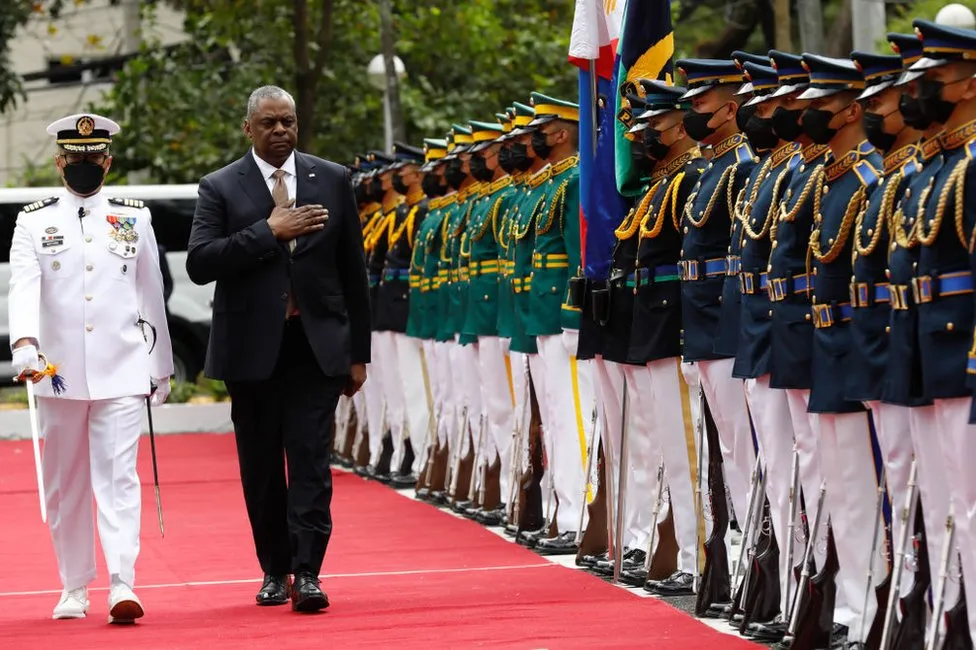
United States Defense Secretary Lloyd Austin (R) walks past military guards during arrival honors at the Department of National Defense in Camp Aguinaldo military camp on February 2, 2023 in Quezon City, Manila, Philippines.IMAGE SOURCE,
Image caption,
US Defense Secretary Lloyd Austin (R) was in the Philippines to finalise the deal

With this deal, Washington has stitched the gap in the arc of US alliances stretching from South Korea and Japan in the north to Australia in the south.

The missing link had been the Philippines, which borders two of the biggest potential flashpoints, Taiwan and the South China Sea, or the West Philippine Sea as Manila insists on calling it.

The US already had limited access to five sites under the Enhanced Defense Cooperation Agreement (EDCA) - the new additions and expanded access, according to a statement from Washington, will "allow more rapid support for humanitarian and climate-related disasters in the Philippines, and respond to other shared challenges", likely a veiled reference to countering China in the region.

The statement came after Defence Secretary Lloyd Austin met Philippine President Ferdinand "Bongbong" Marcos Jr in Manila on Thursday.

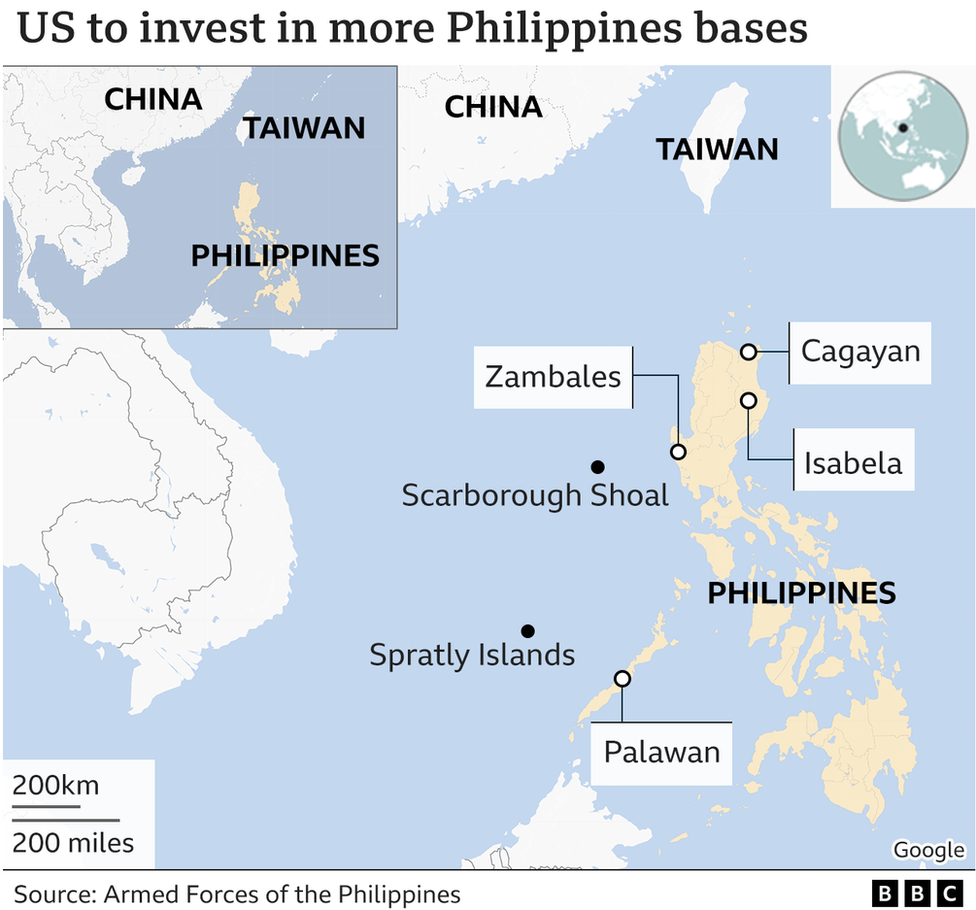
The US hasn't said where the new bases are but three of them could be on Luzon, an island on the northern edge of the Philippines, the only large piece of land close to Taiwan - if you don't count China.

The deal, which in part reverses the US' departure from their former colony more than 30 years ago, is no small matter.

"There is no contingency in the South China Sea that does not require access to the Philippines," says Gregory B Poling, director of the Southeast Asia programme at the Centre for Strategic and International Studies in Washington.

"The US is not looking for permanent bases. It's about places, not bases."

That is, it is seeking access to places where "light and flexible" operations involving supplies and surveillance can be run as and when needed, rather than bases where large numbers of troops will be stationed.

Map of bases
Image caption,
Map of bases

In other words, this is not a return to the 1980s, when the Philippines was home to 15,000 US troops and two of the largest American military bases in Asia, at Clark Field and nearby Subic Bay.

Then in 1991 the Philippine government called time. The Filipinos had recently overthrown the hated dictatorship of Ferdinand Marcos, and sending the old colonial masters home would further cement both democracy and independence.

The Vietnam war was long over, the Cold War was winding down, and China was as yet a military weakling. So, in 1992, the Americans went home - or at least most of them did.

Roll forward 30-odd years and another Marcos is back in the Malacañang Palace.

More important, China is no longer a military weakling, and it's knocking on the Philippines' front door. Manila has watched - horrified but powerless to intervene - as Beijing has set about redrawing the map of the South China Sea. Since 2014 China has built 10 artificial island bases, including one at Mischief Reef, deep inside the Philippines' own exclusive economic zone or EEZ.

Up to then relations between Manila and Beijing had been free of major problems, says Herman Kraft, a political science professor at University of the Philippines.

"We had a live and let live situation in the South China Sea. But in 2012 they tried to seize control of Scarborough Shoal. Then in 2014 they began building the islands. The land grab by China changed the relationship."

"We have very limited capability against the threat from China," says former Philippine Ambassador to the US Jose Cuisia Jr.

He says the Chinese have repeatedly broken promises not to militarise their new South China Sea bases.

"The Chinese have militarised those features and that puts more of our territory under threat. Only the US has the power to stop them. The Philippines cannot do it alone."

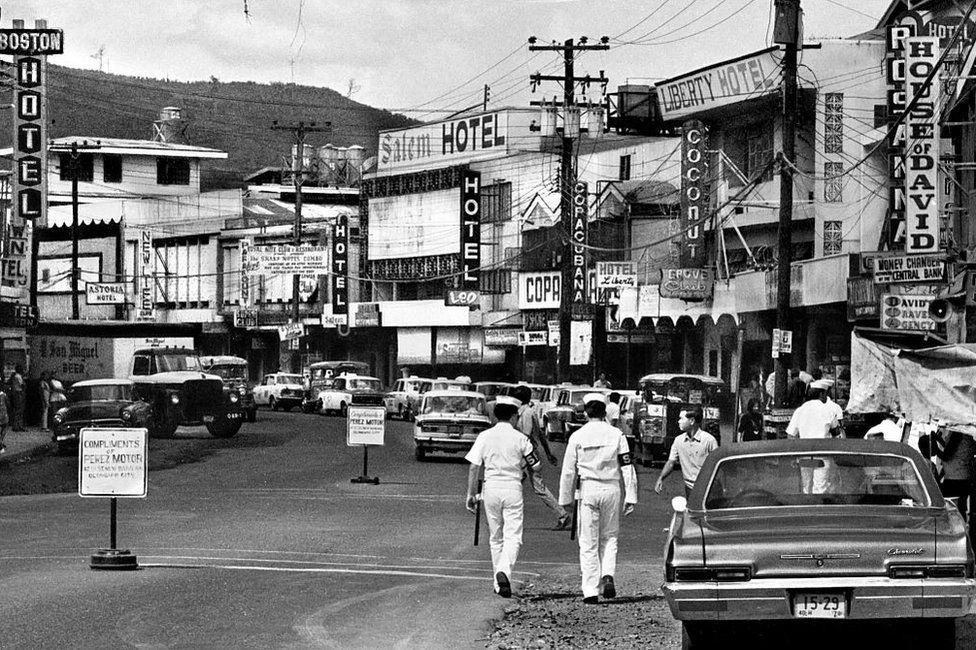
But this time there will not be thousands of US marines and airmen filling the red-light districts of Olongapo or Angeles city again.

A pair of U.S. Navy shore patrol officers walk through Olongapo, a city in the Philippines often referred to as Olongapo City. Olongapo was a popular destination for U.S. Navy sailors stationed at the adjacent U.S. Naval Base Subic Bay.IMAGE SOURCE,
Image caption,
Olongapo, close to a US naval base, was a hub for the illegal sex trade in the 1970s

The history of violence and abuse by US troops in the Philippines is still a sensitive subject. There are an estimated 15,000 children left with their Filipino mothers when their American fathers went home.

"We have a long history of inequality in our relationship," says Renato Reyes, secretary general of New Patriotic Alliance, a left-wing group. "The Philippines has been forced to shoulder the social costs. There's a history of rape, child abuse, and of toxic waste."

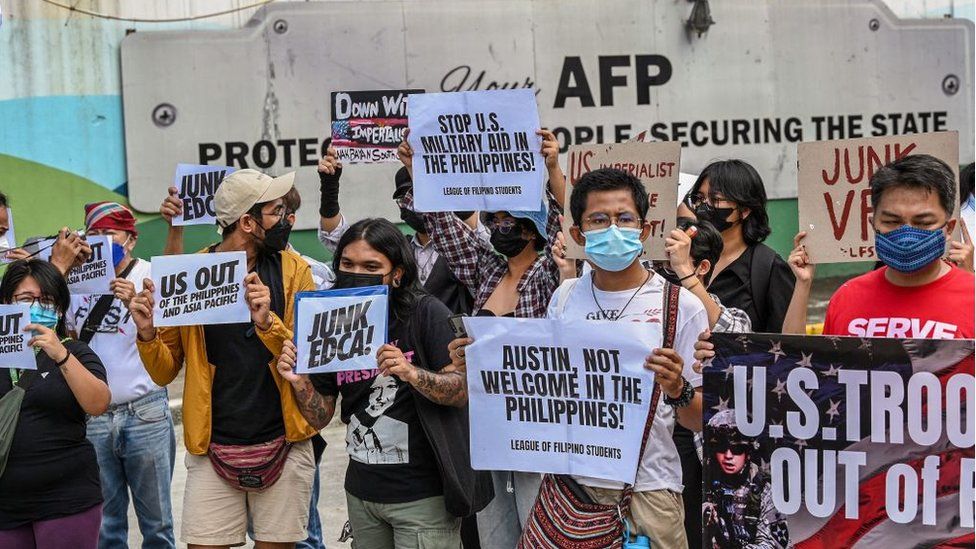
The US' return to the Philippines is strongly opposed by the country's left-wing groups.

While there won't be as many troops as earlier, Washington is now asking for access to several new locations, some facing the South China Sea, others facing north towards Taiwan. Unofficial reports point to options in Cagayan, Zambales, Palawan and Isabela.

The first one faces Taiwan, the second the Scarborough shoal, and the third the Spratly Islands. Any new US facilities will be inside existing Philippine bases. US troops will come in small groups and on rotation.

The aim, says Mr Poling, will be to deter further territorial expansion by China in the South China Sea, while also providing a place for the US to watch Chinese military movements around Taiwan.

"The Philippines has no way to deter China outside this alliance," he says. "It's buying BrahMos missiles from India. The US would like to deploy Tomahawk cruise missiles. Together they can hold Chinese vessels."

With increasing concern about a conflict over Taiwan, the Philippines could offer a "rear access area" for US military operations, or even a place to evacuate refugees.

"People forget there are between 150,000-200,000 Filipinos living in Taiwan," Mr Poling says.

US placards during a rally in front of the military headquarters in Quezon City, suburban Manila on February 2, 2023,IMAGE SOURCE,
Image caption,
Left-wing groups oppose a US military presence in the Philippines

But Manila is not about to become a full-blown member of an American alliance to challenge or resist China's rise, Professor Kraft cautions.

"The Philippines is not doing those things like Australia and Japan, directly challenging Chinese interests in the South China Sea or East China Sea. President Marcos wants good relations with the US. But he also wants good relations with China for economic advantage."

Beijing too has indicated that it does not intend to allow a new base agreement between Manila and Washington to disrupt its relations with its neighbour.

In an editorial published to coincide with the arrival of the US defence secretary in Manila, China's state-run Global Times accused the US of "setting a trap for the Philippines" and "trying to push the Philippines to the frontline of confrontation with China".

"We are once again being caught in the middle," says Mr Reyes, who believes China is just as much a capitalist imperialist power as the US.

"The Philippines still has a colonial mentality - it looks to the United States as its big brother."

Dominic Barton, former McKinsey head, to face MP questions over contract concerns

Dominic Barton, former McKinsey head, to face MP questions over contract concerns

Barton will appear before the House of Commons government operations and estimates committee at 4:30 p.m. ET, where he’ll be pressed about the 24 contracts worth $104.6 million that federal officials say have been awarded to McKinsey since Prime Minister Justin Trudeau’s government was elected in 2015.

READ MORE: McKinsey contracts with Ottawa to be probed by House of Commons committee

The committee is also reviewing contracts awarded to the firm since 2011, which includes those signed by the preceding Conservative government.

McKinsey’s contracts with the federal government have come under scrutiny following recent media reports that the deals have increased under the Liberals compared with when the federal Conservatives were in power.

Radio-Canada reported that the Conservatives awarded $2.2 million in contracts to McKinsey over the nine years that party was in power.

Global News has not independently verified the Radio-Canada report but has confirmed the total value of the awards given to McKinsey is $104.6 million, according to Public Services and Procurement Canada.

Following the reports, Conservative Leader Pierre Poilievre called for a probe into the jump in contracts awarded to the firm, a call the government operations and estimates committee answered when it voted to launch the study on Jan. 18.

“We want to know what all this money was for,” Poilievre said, speaking at a press conference earlier last month.

Click to play video: 'Poilievre demands answers on McKinsey contracts with Trudeau government'
Poilievre demands answers on McKinsey contracts with Trudeau government

The Conservative leader said he hopes for answers about the potential influence of the firm — and about Trudeau’s decision to appoint former McKinsey director Barton  as his ambassador to China for just over two years, ending in 2021.

Trudeau has said Procurement Minister Helena Jaczek and Treasury Board President Mona Fortier have been tasked with looking into the contracts.

“We will do a follow-up to ensure it was done the right way and to see if we need to modify or change the rules,” Trudeau said, speaking in French last Wednesday.

According to the statement from Public Services and Procurement Canada, three of the contracts — worth a total of $55.8 million — awarded to McKinsey were granted as a result of a competitive process.

The other 21 contracts, worth more than $48 million, were not awarded through competitions.

READ MORE: McKinsey’s federal contracts are worth more than $100M. Will MPs vote to probe?

Of those, the department said 19 were conducted through “call ups,” a process that allows government to quickly procure a good or service when it has a standing offer in place with the company. The other two were sole-sourced — one being a low-dollar-value contract, and the other worth zero dollars.

“PSPC established a National Master Standing Offer with McKinsey & Company to support federal departments and agencies that require benchmarking services,” a spokesperson from Public Services and Procurement Canada said in a statement.

“These services consist of functional tools, databases, and expert support to measure their performance against similar Canadian and international organizations in order to identify deficiencies and opportunities for improvement. Such services may be used to support complex programs, including digital modernization and other large transformation initiatives.”

McKinsey, they said, “holds exclusive rights to provide this type of benchmarking” and there are “no authorized resellers.”

In a statement sent to Global News last week, Jaczek’s office pledged to “work with” any committee that probes the issue.

The minister, they said, is “taking these concerns seriously.”