Keeping an eye on Communist, Totalitarian China, and its influence both globally, and we as Canadians. I have come to the opinion that we are rarely privy to truth regarding the real goal, the agenda of China, it's ambitions for Canada [including special focus on the UK, US & Australia]. No more can we trust the legacy media as there appears to be increasing censorship applied to the topic of communist China. I ask why. Here is what I find.
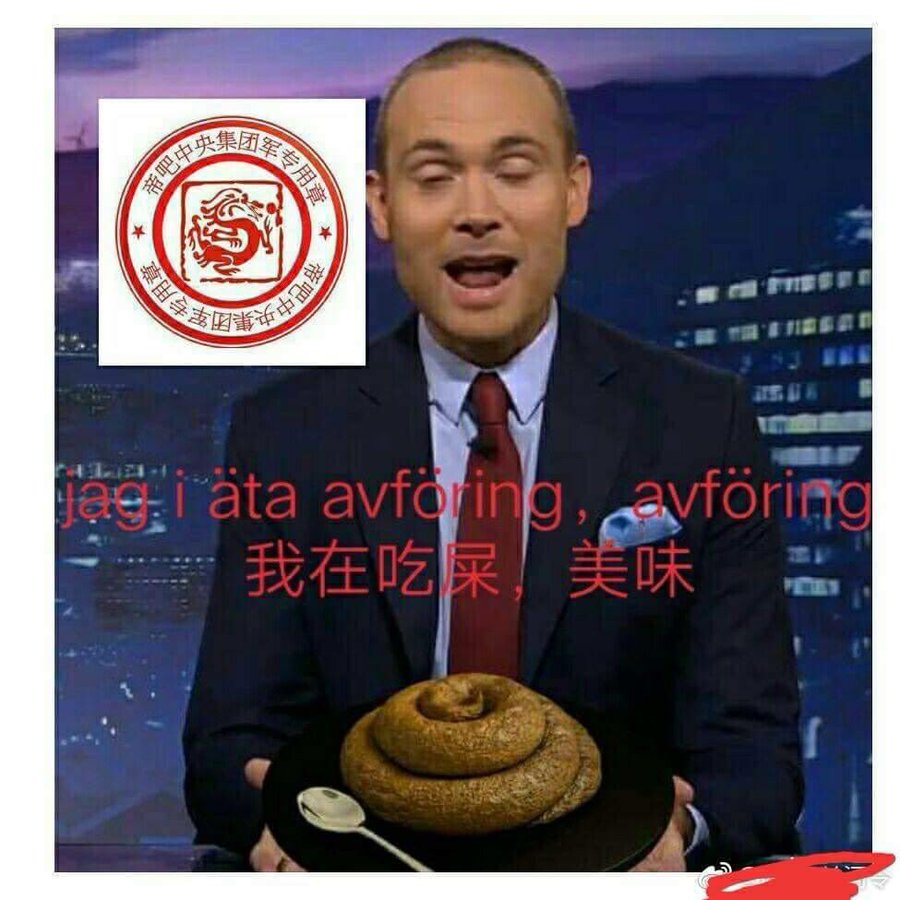
A Swedish comedy program that advised Chinese tourists not to "poop outside" or eat dogs has attracted the ire of Chinese authorities, who have labelled it a "vicious attack" on China.
Key points:
The offending segment was a pretend "informational film" for Chinese tourists
China said it was "full of prejudices, biases and provocations"
The skit from the television program Svenska Nyheter (Swedish News), which was broadcast on Swedish public broadcaster SVT last Friday, went viral in China after producers posted it on the Chinese video-sharing website Youku.
Svenska Nyheter, hosted by Swedish comedian Jesper Rönndahl, follows a similar format to John Oliver's popular Last Week Tonight program.
The end of the segment featured a short "informational film for Chinese tourists" dubbed in Chinese, which made jokes playing on a variety of racist stereotypes.
"We do not poop outside historic buildings … And if you see someone who's out walking a dog, it's not because they just bought lunch," an actor in the video said.
However SVT said the program had an "anti-racist ambition", and released a full version of the segment with English subtitles to clarify its intention.
China's Ministry of Foreign Affairs called on SVT to take action over the comedy sketch, and spokesperson Geng Shuang said authorities had made "stern representations" to the Swedish Government.
"It amounts to a gross insult to and vicious attack on China and the Chinese people," he said.
"The program leader's comments are full of prejudices, biases and provocations against China and some other ethnic groups. It is a serious violation of media professional ethics."
Sweden's Ministry of Foreign Affairs said in a statement that "there is freedom of expression in Sweden", but did not make any further comment on the controversy.
Embassy slams 'hypocritical' apology
In a statement, SVT said the intention of the skit was to shine a light on racism against Chinese people in Sweden, but that it had backfired.
It said only the final part of the 10-minute video was posted to the Chinese video site, which led to it being misinterpreted.
"The purpose of the short segment published on Youku was to gather Chinese reactions. This was a mistake, as the entirety of our message and ambition was then lost," the broadcaster said.
"We recognise that this may have been an insult, for which we are truly sorry."
Important to get facts straight. Director of all of SVT was on the new yesterday and said they will NOT apologise for the program, defending satire and freedom of speech. What they DID say was that uploading too short segment on Youku was a mistake, bc didn't give whole picture.
In a second statement, SVT program manager Thomas Hall reiterated that the program was intended to be anti-racist.
"We wanted to address a blank spot in Sweden where racist comments and actions towards Chinese people for some reason are often allowed to pass by without comments," he said.
"I offer my honest apology to the individuals who have been offended by our segment."
China's Embassy in Sweden did not accept Mr Hall's apology, which it said was "insincere, hypocritical and without any real intention".
"Hall failed to reflect on the attack on China and the gross racial discrimination against the Chinese people ... It is an attempt to gloss over the fault and muddle through," it said in a statement.
The embassy also accused the program of using "a wrong map of China" that did not include Taiwan or parts of the Tibet region.
'That has nothing to do with Ikea'
The reaction to the skit on Chinese social media site Weibo was swift and fierce, while others left angry comments on host Jesper Rönndahl's Facebook and Twitter accounts.
Hello non-Swedish-speaking friends! The whole segment "Sinophobia is not ok", including the over-the-top-absurd infomercial, is now available with English subtitles! https://youtu.be/GpjkURzcgi8 Please share and enjoy.
Some netizens directed their anger at the official Weibo page of furniture company Ikea. The Swedish business has 25 stores in China, and the country is also an important part of its supply chain.
One fairly innocuous post on their Weibo account this week attracted more than 1,000 comments, mostly about the SVT comedy skit and last week's police brutality allegations.
"Get out of China, we don't welcome countries and people who discriminate against China," said one Weibo user.
Others argued that a boycott would only hurt the company's Chinese employees.
In a statement, Ikea said it was aware of "discussion connected to the recent comedy show in Sweden, however that has nothing to do with Ikea".
"We respect Chinese culture and tradition, diversity and inclusion has always been an important part of the Ikea culture and values," it said.
The $13 billion dealAustralians should be outraged about
Is Communist China taking over Australia?
SEPTEMBER 28, 2018
THERE are serious concerns about the $13 billion takeover of an Australian energy company with experts warning it is “entirely the wrong move” with implications for national security and gas prices.
Australians are just starting to realise how much of the country’s electricity and gas assets are owned by Chinese-linked companies and the huge dominance they now have.
The latest move from Hong Kong-based company Cheung Kong Infrastructure (CKI) to take over Australian-owned company APA will give it control over 60 per cent of Australia’s gas pipelines.
But the picture becomes even more concerning if you look at all the other assets that are essentially controlled by the Chinese Government.
This is what’s going on.
WHAT’S THE BIG DEAL?
APA is the company at the centre of the deal and it’s easy to understand why.
The company owns or manages $20 billion worth of energy assets.
It has a 15,000km network of pipelines that deliver half of Australia’s natural gas usage. It supplies gas to 1.3 million Australian homes and businesses, as well as having interests in gas-fired power stations and wind farms.
As Institute for Energy Economics and Financial Analysis (IEEFA) energy analyst Bruce Robertson told news.com.au: “It is a fabulously profitable company.”
In fact if you bought shares in APA when it first listed on the stock exchange in 2000, your investment would now be worth 18 times more than what it was.
But this impressive profit actually points to one of the reasons why people are so worried about the sale.
When the Australian Competition and Consumer Commission (ACCC) looked into the gas market in 2016 it found evidence of monopoly pricing among the pipeline operators that transport gas along the east coast of Australia.
This is because the pipelines are owned by a small group of companies that can essentially charge what they like.
CKI already owns a lot of gas pipelines, powerlines and electricity generators around Australia.
So if you combine the two companies, CKI would suddenly control 68 per cent of the gas transmission and distribution pipelines in Victoria, 86 per cent in South Australia and 72 per cent in Queensland.
But it gets even more interesting when you add the assets controlled by other Chinese companies, particularly another company called State Grid, which is a Chinese Government-owned company.
Electricity and gas transmission and distribution assets that Chinese and Hong Kong companies would have a stake in if APA takeover was to go ahead.
HOW MUCH ARE WE ACTUALLY TALKING?
When you combine the assets of all the companies you start to understand why some experts are so worried.
Australians rely on pipelines and powerlines to transport electricity and gas around the country and into their homes. Transmission networks move the energy around the country and distribution networks are the smaller lines that deliver it into their homes.
If the APA takeover went ahead, 100 per cent of electricity transmission and distribution in three states and territories would be partly controlled by Chinese and Hong Kong interests, according to national security expert and Australian Strategic Policy Institute (ASPI) executive director Peter Jennings.
Chinese and Hong Kong companies would essentially have a stake in all the electricity powerlines that deliver energy to homes and businesses in Victoria, South Australia and ACT.
For example, the electricity network in the ACT is run by Evoenergy, which is 50 per cent owned by the ACT Government. The other half is owned by Jemena, of which the Chinese-controlled State Grid owns 60 per cent.
When it comes to gas, Chinese and Hong Kong companies have a stake in 99 per cent of the transmission and distribution network in Victoria, 100 per cent in NSW and the ACT, as well as 86 per cent in South Australia, 78 per cent in Queensland, 74 per cent in NT and 62 per cent in WA.
“There is a real vulnerability to having a vast bulk of our gas and electricity assets owned by two foreign entities — State Grid and CKI,” Mr Jennings said.
“Taking that into account, and looking into the risks of cyber hacking, the Government would be well advised not to let this particular takeover go ahead.”
IT MAY ALSO KEEP GAS PRICES HIGH
While Australia’s national security could be at stake, Bruce Robertson also believes the takeover will be bad for gas prices.
The ACCC has already pointed to possible monopoly pricing among gas pipeline operators and a spokeswoman told news.com.au this was still a problem.
“The ACCC continues to have concerns about prices charged by pipeline operators,” the spokeswoman said.
Changes have been made to improve transparency about pipeline prices and to improve the bargaining power of companies negotiating with pipeline operators but Mr Robertson said prices for Australian gas were still too high.
“There’s been massive profiteering in this sector,” Mr Robertson told news.com.au.
“We are still operating in la-la land when it comes to gas pricing.”
Mr Robertson said in August Australian companies were paying between $10 to $12 per gigajoule for contract gas, compared to about $4 in the US, if you look at the Henry Hub Natural Gas Spot Price.
“The price of gas is so extortionately high; it’s well above international prices for gas,” Mr Robertson said.
This is despite the fact that Australia is one of the largest exporters of gas in the world. In what appears to be an absurd situation, Mr Robertson said there are now four consortiums looking to build import terminals in Australia to bring in cheaper gas from overseas.
“It is just unbelievable, the mess we’ve got ourselves into on the east coast of Australia,” Mr Robertson said. “If we go down the route of exporting gas and then importing it, we’ve totally lost.
“God help us if we can’t provide energy that’s produced here, to our own people.”
Gas prices overseas are very cheap at the moment because there is a lot of competition so gas companies are choosing to charge more in Australia because there are only a few major players operating in the market.
Deakin Business School’s Dr Shuddha Rafiq told The Australianthat there was a lack of competition in transportation and transmission in Australia, with only one major company and a few others involved.
He said the main demand for gas was in Australia’s east but the main producers of gas were located offshore in the west. Without significant investment in infrastructure, prices would continue to be high thanks to transport and transmission costs.
Gas from places like Cooper Energy’s Sole-3 gas well being drilled in the Otway Basin off the coast of South Australia, needs to be transported across the country and into people’s homes.
“Both sea transport and pipeline transmission move the gas, and there’s a considerable cost involved,” Dr Rafiq said.
“Because there’s only a handful of companies involved, they’re not always open to investing in overhauling transmission technologies for the future welfare of society.”
He said the system should be overhauled to increase competition and to encourage investment in infrastructure.
Mr Robertson also supports change and believes the Government should regulate prices for use of the main transmission lines that move gas around the country.
“In the US they have regulated all interstate pipeline because they are monopoly assets,” he said.
While the ACCC has already made some changes, Mr Robertson believes more needs to be done and the APA takeover will make this harder.
“If a Chinese-linked company bought assets under one set of rules and then the Australian Government changes the rules, I don’t think they will be happy at all and they’re not the type of people you want to upset,” he said.
“If you start with the proposition that gas pipelines are too profitable and consumers are suffering, then selling the pipelines to a Chinese-linked company is entirely the wrong move.”
WILL THE TAKEOVER GO AHEAD?
The ACCC released a statement on September 12 that it would not oppose the takeover, as long as CKI sold its gas assets in Western Australia.
Mr Jennings said the ACCC was really limited in what it could do because the takeover wouldn’t really change the competition picture for the supply of gas, which was already bad.
But the takeover could still be stopped by the Australian Foreign Investment Review Board, which will also consider the national security implications.
“I don’t think it should be allowed to happen,” Mr Jennings said. “I think the assets should remain in Australian hands.”
Even if the takeover didn’t go ahead, Mr Jennings said the extent of foreign ownership of Australia’s gas and electricity network was concerning.
“These decisions were taken back in the 1990s when a lot of these assets were privatised and China was less of a concern,” he said. “Cyber also wasn’t as big of a feature.”
However, changes to how critical infrastructure was operated in the 1990s and 2000s to allow pipelines and other operations to be controlled remotely has now made them susceptible to cyber hackers.
“Frankly, I don’t think we are in a good place when it comes to guaranteeing their security even if the assets are Australian-owned or majority Australian-owned,” Mr Jennings said.
“I know it’s an issue concerning a lot of people in the public service and national security community.”
Experts say we should be concerned over who’s delivering Australia’s electricity and gas.
Gay rights storm in Beijing assenior British diplomat marries boyfriendat ambassador's residence
Pictures posted on Weibo sparking a storm over gay rights in China
9 September 2014
It had all the hallmarks of a traditional British wedding with a three-tier cake, bagpipes, a garden party and even “Keep Calm and Marry On” orders of service, but the Beijing wedding ceremony of a senior British diplomat to his male partner has sparked a fierce debate over gay rights in China.
On Saturday Brian Davidson, 50, the British consul-general to Shanghai, married his American partner in a ceremony held in the garden of the official residence of Britain's ambassador to China.
The Beijing garden is British sovereign territory, and the wedding of Mr Davidson to Scott Chang, 33, is legally binding following the introduction in June of new rules allowing UK nationals in same-sex relationships to marry at British consulates in 24 countries around the world.
The ceremony was a private affair, but Britain's ambassador Sir Sebastian Wood posted on the Chinese social media website Weibo that he was “delighted and honoured to have officiated the same-sex wedding of the UK’s consul-general in Shanghai, Brian Davidson, and his partner at my residence today. We wish them a lifetime of happiness together.”
The ambassador joined dozens of other posting images of the bow-tie-wearing couple; with Mr Davidson posting a wedding snap with the message “Love is Great”. The post was quickly shared online more than 60,000 times and sparked a fierce debate on whether China should legalise gay marriage.
While not illegal, same-sex relations are still a taboo to many in China, where electroshock therapy is still offered as a “cure” to homosexuality at some clinics. Many gay couples complain of discrimination where same-sex unions are not allowed.
Speaking by telephone from China, Mr Davidson told The Independent that the wedding was a private event and that the couple were “horrified” at the online attention it has been given.
He said: “Obviously Scott and I are very happy to have this opportunity to marry under British law. As homosexuals we are very proud that the UK is one of the few countries in the world to make this happen.”
He added: “It speaks to our principles of equality in the UK. Most of our Chinese friends were delighted to see us standing up there saying we love each other."
However Chinese commentators took to Weibo and other social media websites to expose the couple. One said, “That [Britain] is sick. It’s like the last days of Rome”. Another said that homosexual marriage is “not Chinese culture”, while others spoke of “mental illness” saying the couple would have children with “emotional and personality crises throughout their lives”.
The majority of the posts online were neutral and some praised the couple, who met eight years ago, reflecting the fact that China’s younger tech-savvy citizens are increasingly accepting of same-sex relations. Over the weekend an online poll for Weibo following the ceremony it was found the majority of people opposed to same-sex marriage, while only 10,000 supported it.
The Chinese embassy in London refused to respond to calls from The Independent, while Chinese state media only commented that Mr Chang’s father had said his son’s choice "was totally against his own traditions".
Wedding guest Wei Jiangang, the founder of Beijing gay rights Queer Comrades, said Mr Chang’s father “blessed” the wedding.
He told The Telegraph: “Although it was not legal under Chinese law, it sends an exciting and delightful message to China's gay community. What moved me the most was their families' blessing, especially the speech given by Scott Chang's father. He said the marriage is a perversion, but that his son was a good son and as long as he is happy, he was willing to ignore the union.“
A Foreign and Commonwealth Office spokesperson said: "This is a secret matter, and wish the couple every future happiness."
China-Japan Maritime Crisis Would Threaten "Belt and Road Initiative", PLA Warns
Kyodo News has published an internal document from China's People’s Liberation Army (PLA) that specified a military crisis at sea between China and Japan would severely threaten Beijing’s strategy of peaceful development and its "Belt and Road initiative" (BRI).
The internal report, authored by two military officials at the Naval Military Research Institute and Dalian Naval Academy, suggested the probability of a significant military crisis at sea between both countries is rapidly increasing due to disputes over the sovereignty of the Senkaku Islands, maritime demarcation in the East China Sea, and the development of marine resources in the region.
Last week, a Japanese submarine war drill was conducted in the South China Sea. The Maritime Self-Defense Force (MSDF) said in a rare statement that one submarine and three other vessels performed aggressive maneuvers to deter China's militarization in the region.
The PLA report, which was published for internal use only in April 2017, warns that a minor misjudgment of the above issues could deteriorate bilateral relations between both countries and lead to a maritime crisis.
As a result, the disruption could jeopardize Beijing’s BRI or the Silk Road Economic Belt and the 21st-century Maritime Silk Road, a series of trade routes that connect China by land, air, and sea to Southeast Asia, Pakistan and Central Asia, and beyond to the Middle East, Europe and Africa.
The second region in focus for a potential trigger point between China and Japan is the East China Sea, in particular, the Japan-owned Senkakus Islands, which are also claimed by China, where the land masses are known as the Diaoyu, and Taiwan, which calls them Tiaoyutai.
In late 2012, a private Japanese landowner sold the group of uninhabited islands to the Japanese government, infuriating Beijing and leading to a brief but acute diplomatic war between the two nations.
"The Diaoyu clearly possess economic and sovereign value, but its military significance is even more evident," the PLA report states. "Its location is strategically important if we choose to take Taiwan by force. It is also important in competing with Japan for maritime rights."
The third potential region where a military crisis could emerge between both countries is the Taiwan Strait and the South China Sea.
The PLA report also states Japan’s strategy is to strengthen relations with Taiwan and the US to contain China. In the South China Sea, Japan is said to be jointly working with individual Southeast Asian countries and the US to challenge China’s "legitimate actions to protect its national sovereignty in the area," the report claims.
To prevent a military skirmish between China and Japan that could spiral out of control and lead to World War III, the PLA report suggests six precautionary measures:
"The first is to ensure both sides maintain high-level official contacts and "properly handle" long-standing disputes, while the second is to have both establish a military confidence-building mechanism and strengthen military exchanges.
Recognizing that the disputes over the Senkakus and the demarcation of the East China Sea cannot be resolved overnight, the article advised, as a third measure, that Beijing and Tokyo establish a "highly efficient" crisis management mechanism that involves government agencies related to such fields as defense, diplomacy, and maritime affairs.
The fourth is to strengthen the capacity for managing a military crisis, including through academic study of maritime crisis management.
The fifth is to strengthen cooperation on maritime security with the United States. The purpose is to avoid involving the United States in a "China-Japan military crisis on the sea" so China will not be "hijacked into a maritime crisis with the United States."
Finally, the sixth measure calls for China to build a strong navy to ensure its maritime supremacy."
The PLA report also said Japan as a country has a tradition of "not making enemies with a strong country." China's survivability depends on the strength of its naval power. "Only by securing maritime supremacy can we make our adversary flinch," the report concluded.
As a result, we can now add the smoldering China-Japan maritime crisis to the list of powderkegs ready to ignite into a regional, or global, armed conflict.