Friday, June 29, 2018

China goes headhunting for tech talent in Silicon Valley

China goes headhunting for tech talent in Silicon Valley

Job seekers at a TechFair LA career fair where China recruits skilled technicians.
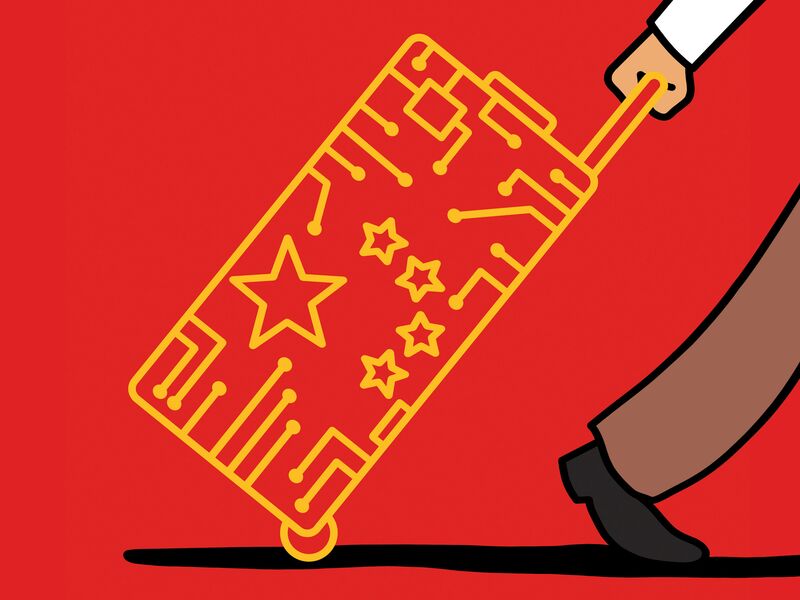
While the Trump administration is trying to restrict Chinese ownership of some US tech companies, China is tapping into American know-how another way: poaching talent.
China’s government and businesses are trying to attract top-calibre engineers, scientists and other skilled technical workers, particularly US-based Chinese professionals, according to officials, recruiting agents and those being approached. Silicon Valley, with its nexus of big tech firms, research labs and venture investors, is a prime target.
Early this year, a leading Chinese government adviser on technology policy addressed a packed convention centre hall in California to promote the prospects created by China’s demand for cutting-edge technologies and its deep pockets. “We’ve gathered you all here to explore new opportunities for co-operation,” said Ye Tianchun, speaking in Mandarin.
More than 300 people, the majority of them Chinese and Chinese Americans, showed up to hear Mr Ye, who guides China’s research into semiconductors. So many came that the opening banquet did not have enough food and seats, leading Mr Ye to ask the attendees to share.
China is laying ambitious plans to be a technology powerhouse, aiming at dominating the industries of the future, from artificial intelligence to biotechnology and robotics, to make the nation, in the words of President Xi Jinping, “a global leader in innovation”.
That effort has the US worried. The Trump administration has prepared new restrictions to block firms with at least 25 per cent Chinese ownership from buying companies involved in what the White House calls “industrially significant technology”, according to people familiar with the plans. President Donald Trump suggested on Tuesday those restrictions may be scrapped, and instead use existing tools to limit access to US technology by Chinese firms.
Recent reports from the Trump administration have pointed to conferences like the one Mr Ye spoke at and the presence of Chinese tech companies in Silicon Valley as channels for talent-poaching and luring start-ups to China. A visa clampdown is also being considered to limit access to American trade secrets posed by Chinese scientists, students and companies in the US.
For now, companies are well positioned to keep recruiting.
Big Chinese tech companies like e-commerce giant Alibaba and search engine Baidu have research-and-development outfits in Silicon Valley. A three- storey building called Z Park, set up by a Beijing government company, was set up to serve as a hub for Chinese tech companies and venture-capital firms.
In an era when computers run everything, computer scientists and engineers are in high demand and tend to job-hop. Employees at some of the biggest US tech firms switch jobs after two years or less on average, according to a survey last year by Paysa, which tracks compensation in the tech world.
After completing her computer engineering doctorate at a prestige university in China, Gu Junli headed to Silicon Valley. She interned at Google’s headquarters, then joined chip maker Advanced Micro Devices, where she worked on big data and AI applications before going to Tesla as lead expert on the autopilot unit.
Twenty months later, in October last year, Ms Gu joined Xiaopeng Motors, a Chinese electric vehicles start-up backed by Ali baba where she is vice- president for autonomous driving, based in California.
Her experience, she said, made her a catch for Chinese companies. “If you’ve participated in creating a product, you’ll know where the pain points and the complexity lie,” Ms Gu said. “If you haven’t done anything about it, you won’t know where to start.”
Recruitment is a priority in a handful of recent Chinese national strategies that map out plans for mastering a dozen cutting-edge fields, including aviation, information networks and new energy vehicles as well as robotics.
“Engineers are about the only thing that can be transferred seamlessly between the US and China,” said Zhou Yunkai, a China native, Google veteran and a co-founder of headhunting start-up Leap.ai, which uses AI to match users with potential jobs.

John Howard warns China seeks power and influence through its expats

SMHerald

John Howard warns China seeks power and influence through its expats

However he also emphasised that Chinese expats made “terrific” Australian citizens and contributed enormously to our nation.
Speaking at a conference in London on the Five Eyes intelligence network, the former Australian prime minister warned that China was “asserting herself” and it was crucial to use our own and allied intelligence agencies to work out what was going on.

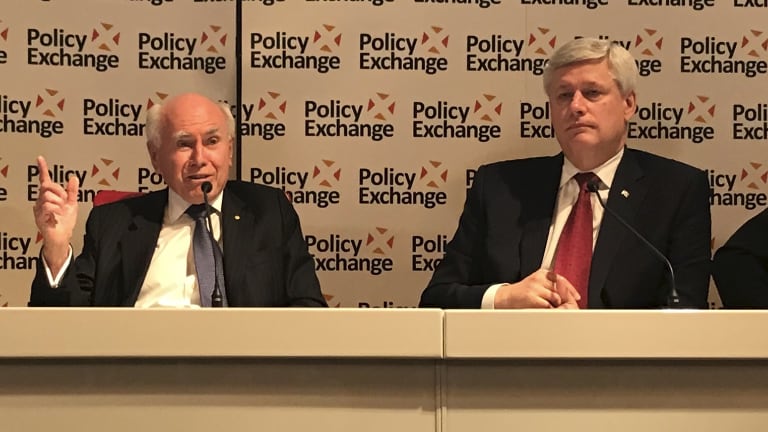
Former PM John Howard and former Canadian PM Stephen Harper speak at a Policy Exchange seminar in London.
Photo: Nick Miller
He was responding to a question about the biggest challenges facing the international intelligence community, with Russia mentioned as among the West’s adversaries.
“There is a big difference in China’s position … in the category of potential threats: China has a massive diaspora in South East Asia,” Howard said.
“One million of Australia’s population… are ethnic Chinese background. [They are] terrific citizens making an enormous contribution to our nation but it remains the case that China is very interested in the capacity to use those people to further her power and her influence.
“[China] is asserting herself in a very significant way and I think the capacity of our intelligence agencies to advise who’s doing what and the right way to respond to that challenge… will be absolutely crucial.
“To pretend that there isn’t a game involving China particularly in our part of the world is deluding yourself.”
Former Canadian prime minister Stephen Harper said Russia was a “pygmy version” of the old Soviet Union, a declining power with immense problems, and he was confident the West could survive any threat it posed.
However China was a “much more difficult problem” because it was building an alternative model that was proving to have appeal and success internationally.
Harper said the biggest challenge for the Five Eyes was in the cyber realm.
The Five Eyes countries are the US, UK, Australia, Canada and New Zealand.
Five Eyes intelligence agencies share raw intelligence data, sources, methods and analyses, and work closely together.
However “we have far less cooperation than we really need to on [the cyber] level,” Harper said.
Some allies, whom he did not name, have “permitted the penetration of Chinese and other hardware and software into our systems, that causes some of the rest of us to be reluctant to engage in cyber cooperation”.
George Robertson, former Secretary General of NATO and former UK Secretary of State for Defence in the Blair government, said there needed to be less talk about how much countries were spending on defence, and more about whether they were spending it in the right places – such as cyber warfare.
He said anyone with a mobile phone was potentially being listened to by Chinese intelligence – and this was having a big impact on how the Five Eyes services work.
To pretend that there isn’t a game involving China particularly in our part of the world is deluding yourself.
Former Australian PM John Howard
“Somebody in a warehouse near Beijing is quite able to [hear] everything that we say,” he said. “The assumption is that any discussions that take place in rooms that have mobile phones might as well be on the record and that has changed the world of intelligence.”
Harper also addressed what he called the “elephant in the room” – the new attitude of the Donald Trump administration to international cooperation.
The “America First” attitude was likely to last beyond Trump’s presidency, Harper said, and the country was more likely to act in its own interests sometimes at the expense of international systems.
This was “not ideal” but it was something the rest of the world needed to adapt to, he said.
But it would be a “great error” if the US went so far as to end its security alliances, Harper said.
Earlier, Howard spoke on BBC radio in favour of Australia teaming up with the UK after Brexit to put up a new satellite geolocation network.
In May the Financial Times reported the UK hoped to partner with Australia in developing a satellite navigation system to rival the European Union’s €10 billion ($16 billion) Galileo project, itself a proposed alternative to the US military-run GPS.
The EU has said the UK would be barred from using Galileo’s military-grade signal after Brexit.
Whitehall officials told the Financial Timesthat Australia, which has announced plans for a national space agency, had indicated potential interest in a UK project, though it was at an early stage and there had “not yet been any formal contact”.
Howard said such a deal would be a “natural extension to a very close relationship” between the UK and Australia, as the Five Eyes relationship meant there was “trust of a very high order” between the countries on security and intelligence.
Matthew Ford, a lecturer in international relations and expert in defence technology at Sussex University, said the UK relies on Europe and the US for battlefield information that can only be acquired from space.
“It is possible for the UK to build its own space infrastructure but it would be extremely expensive and it poses a number of difficult problems for which the UK currently has no answers,” Ford said.
“Howard’s comments betray an ignorance[about] the current state of Brexit negotiations and consequently feed unhelpful narratives that muddy waters and make the politics of leaving the EU more complicated than necessary. Howard could do the UK a great favour and stay out of British politics.”
Nick Miller is Europe correspondent for The Sydney Morning Herald and The Age

China’s next aircraft carrier ‘accidentally’ revealed in boardroom promotional photo

China’s next aircraft carrier ‘accidentally’ revealed in boardroom promotional photo

CHINA has let slip a glimpse of what its next aircraft carrier looks like. And it’s a design that looks set to challenge the best the United States has to offer.
June 25, 2018
0:40
/
1:18
Loaded: 0%
Progress: 0%

Is China taking over?

ON the surface, the photo seems somewhat bland. It’s your typical corporate shot — a bunch of guys looking attentive around a boardroom table. But, in the background, on the big screen, is something likely to make the US Navy sit up and take notice.
The image in the Chinese Shipbuilding Industry Corporation (CSIC) promotional shot is distant. Therefore it’s somewhat blurry.
But there’s little doubt as to what it shows.
Scattered in the distance is a protective fleet of China’s most advanced destroyers. Then there are the aircraft carriers Liaoning and ‘Type 001A’. We don’t yet know the name of China’s most recently completed carrier, which put to sea for the first time in May.
They’re flanking something as-yet unseen.
It’s an artist’s impression.
Of a new ship.
A big one.
It’s an aircraft carrier with a completely flat deck. There’s no sign of the simple ski-ramps used to sling aircraft into the sky on China’s two other carriers.
Instead, there are what appears to be three large catapults servicing what appears to be J-15 fighter jets and a new type of radar early warning aircraft.
Senior China Shipbuilding Industry Corporation (CSIC) executives attend a function in the company's boardroom, with what appears to be a computer-generated rendering of a new aircraft carrier in the background.
Senior China Shipbuilding Industry Corporation (CSIC) executives attend a function in the company's boardroom, with what appears to be a computer-generated rendering of a new aircraft carrier in the background.Source:Supplied
TYPE 002
The picture is likely to be of be Type 002 — China’s first attempt at a truly modern aircraft carrier. It’s currently under construction at the Jiangnan Changxingdao shipyard in Shanghai. But virtually nothing is known about the design.
The picture was posted on Chinese social media service WeChat by the No. 701 Research Institute of the China Shipbuilding Industry Corporation (CSIC).
CSIC deleted the image shortly after posting it.
But not before it had been circulated widely on social media.
Coincidentally — or not — the People’s Liberation Army posted an article to its website on Friday boasting that the ‘mystery’ ship has an electromagnetic launch system.
That’s the same advanced technology being used by the United States’ next generation aircraft carrier, USS Ford. But that ship is having some serious teething problems with the power-hungry equipment that has never been fully tested.
A close up of a high-resolution image posted to Chinese social media which appears to reveal the design of China's next aircraft carrier.
A close up of a high-resolution image posted to Chinese social media which appears to reveal the design of China's next aircraft carrier.Source:Supplied
The significance of the catapults is that it will enable more aircraft to be launched faster — and with heavier weapons loads — than the earlier Chinese aircraft carriers.
The Hong-Kong based South China Morning Post quotes military commentator Zhou Chenming as saying the way the image was released was ‘odd’.
“From the information that is currently available, I would say a carrier with a catapult launch system is very much on the horizon,” he said.
It also quotes ‘naval expert’ Li Jie as saying: “This revelation could mean the third carrier is progressing fast.” “The progress of the new carrier and the catapult seem in synchronisation. It will take a few years for the ship to be built and the system to be installed and tested,” he said.
Chinese J-15 fighter jets being launched from the deck of the Liaoning aircraft carrier during military drills in the Yellow Sea, off China's east coast. Picture: Xinhua
Chinese J-15 fighter jets being launched from the deck of the Liaoning aircraft carrier during military drills in the Yellow Sea, off China's east coast. Picture: XinhuaSource:AFP
CARRIER SCANDAL
The Global Times describes CSIC as the “cradle of Chinese aircraft carriers.”
It’s responsible for the refurbishment, design and construction of China’s carriers.
But the glimpse may be a public relations move after the embarrassing arrest of the corporation’s leading figures earlier this month.
Type 001A was also immediately returned to dry dock after her first voyage in May. It’s an unusual move — unless the test revealed serious problems.
General Manager Sun Bo reportedly was detained earlier this month.
undefined
But the Asia Times reports he has now been charged with “gross violation of laws and party discipline” by the Communist Party’s Central Commission for Discipline Inspection and the National Supervision Commission.
The accusation is allegedly that he sold secrets about China’s aircraft carrier program to US intelligence agencies.
The report says he revealed details to the CIA on the modifications made to the Soviet-constructed aircraft carrier, Liaoning.
Russian state-run news service Sputnik reports Chinese authorities also are concerned he may have divulged information about Type 001A and Type 002.
A fighter lands on the crowded deck of the Liaoning. If China’s next carrier has catapults, this will vastly improve its ability to put large numbers of heavily-laden aircraft into the air, fast. Picture: Xinhua
A fighter lands on the crowded deck of the Liaoning. If China’s next carrier has catapults, this will vastly improve its ability to put large numbers of heavily-laden aircraft into the air, fast. Picture: XinhuaSource:AFP

'Chinese Maritime Militia' Launches Laser Attacks Against US Military Pilots In Pacific Ocean

'Chinese Maritime Militia' Launches Laser Attacks Against US Military Pilots In Pacific Ocean


Image result for 'Chinese Maritime Militia' Launches Laser Attacks Against US Military Pilots In Pacific Ocean
Pilots of American military aircraft operating over the western Pacific Ocean have been targeted by lasers more than 20 times in recent months, US officials told The Wall Street Journal, following similar incidents in which Chinese nationals used lasers against American fighter pilots operating over Djibouti.
Image result for 'Chinese Maritime Militia' Launches Laser Attacks Against US Military Pilots In Pacific Ocean
In April, the Pentagon issued a NOTAM, or “Notice to Airmen” warning of “unauthorized laser activity” resulting in minor injuries to an unspecified number of pilots over Djibouti. The lasers originated from a Chinese military base in the African country, just 8.3 miles from the American base.
Image result for 'Chinese Maritime Militia' Launches Laser Attacks Against US Military Pilots In Pacific Ocean
Now officials are reporting similar laser attacks in the East China Sea, where the People’s Liberation Army Navy and Chinese commercial vessels operate. Multiple officials told the WSJ that lasers were directed at American military aircraft from fishing vessels and shore.
There have been more than two-dozen incidents in the region since September 2017, officials said. Attacks are becoming more frequent, as the perpetrators are using a wide variety of laser frequency bands.
While it is unclear who exactly is behind the attacks, it is interesting to note, Beijing trains and provides financial subsidies to fishing vessels operating in the East China Sea as what officials call China’s “maritime militia.”
Image result for 'Chinese Maritime Militia' Launches Laser Attacks Against US Military Pilots In Pacific Ocean
As a deterrence, China’s maritime militia [civilian operated fishing vessels] are sailing through the East China Sea with laser pointers — striking low-flying American warplanes.
In these incidents, commercial-grade lasers are being used, as opposed to the military-grade lasers used against American pilots in Djibouti. Commercial or military, these beams of light can temporarily blind pilots and in some cases cause severe eye damage.
Unbeknownst too many, China has been equipping its military forces with blinding laser weapons in an apparent violation of a provision of the United Nations 1980 Convention on Certain Conventional Weapons. These weapons include the BBQ-905 Laser Dazzler Weapon, the WJG-2002 Laser Gun, the PY132A Blinding Laser Weapon, and the PY131A Blinding Laser Weapon.
Image result for 'Chinese Maritime Militia' Launches Laser Attacks Against US Military Pilots In Pacific Ocean
The sophistication of these lasers attacks implies that Beijing could be sponsoring a hybrid deterrence system using fishing vessels armed with lasers that could be coordinated at American warplanes with radar.
In response, the Pentagon is ramping up the procurement of anti-laser protective eyewear for pilots. Each unit will cost the taxpayers around $500 to $2,500 per unit but will ensure that pilots are immune to lasers
As for the Chinese military and fishing vessels launching a series of coordinated laser attacks against American pilots from Africa to the East China Sea, well, this is not good because the Pentagon is itching for a fight to level China’s weaponized islands in the South China Sea.