Tuesday, July 3, 2018

Bring US, Asia together or pay the price: Andrew Robb

Bring US, Asia together or pay the price: Andrew Robb

Mr Robb took up an $880,000 consultancy with Landbridge, run by Chinese billionaire Ye Cheng, when he left politics in July 2016.

Mr Robb took up an $880,000 consultancy with Landbridge, run by Chinese billionaire Ye Cheng, when he left politics in July 2016.
  • The Australian
  • 7:26PM July 2, 2018
Former trade minister Andrew Robb has warned Australia could miss out on a new era of prosperity driven by Chinese resources demand if it fails to support greater power sharing in the region between the US and Asian superpowers.
The architect of the China-Australia Free Trade Agreement has told the Minerals Council of Australia that US attempts to contain China were “futile and counter-productive” and Australia needed to use its influence as a middle power to ensure “sensible outcomes”.
Mr Robb, who works as a consultant for Chinese company Landbridge and does business across the region, said the coming transition of power in the Indo-­Pacific was “the biggest opportunity and potentially the biggest threat” to securing Australia’s economic future.
“My simple thesis tonight is that an unprecedented and unexpected surge in demand from one country, China, drove the mining boom, and further new demand from China and other countries in our region can sustain such growth for several decades if we play our cards correctly,” Mr Robb told the MCA’s annual dinner last night.
He said Australia was witnessing the re-emergence of China and India as regional powerhouses — “positions they enjoyed for 18 of the last 20 centuries”.
“Progressively this century these two countries, constituting together three billion of the world’s population, will share regional and global political and economic power, not with the Roman and Turkish empires this time, but with the US,” he said.
“Unfortunately, the US appears yet to accept this inevitability, with both sides of the political aisle in Washington endlessly focusing on ‘containment’ of China — a futile and counter-­productive approach in my view.”
Mr Robb took up an $880,000 consultancy with Landbridge, run by Chinese billionaire Ye Cheng, when he left politics in July 2016.
He told The Australian he represented Landbridge’s interests overseas but not in Australia, and was unsure whether he would have to sign the government’s new foreign-interest register, under foreign influence laws that have inflamed tensions with China.
Under the new laws, lobbyists are required to declare their interests if they undertake work “within Australia” on behalf of foreign entities.
Mr Robb, who has made 26 business trips to Asia since 2016, most of them to China, has previously urged the federal government to “urgently” improve its strained relationship with Beijing.
He told the MCA that mining was the Australian industry most exposed to the region’s changing geopolitical environment, and the sector should help Australia “navigate this increasingly tense power struggle”.
“The alternative of leaving two bulls in a paddock to fight it out is no answer,” he said.
Mr Robb warned the “bloated, dysfunctional and costly project- approval processes” was also a key risk for the industry.
“Our regulations can be a great strength for Australia, but it must be done in a commonsense and efficient manner,” he said.
Mr Robb highlighted the almost five-fold increase in the value of Australia’s annual resources exports to China since 2006-07.
Avatar for Thanh
ThanhI haven’t a word from Mr Robb about China as a bully. If he did, the Chinese would stop paying him immediately. Mr Robb talked about power sharing between the superpowers, what about the dignity of people of small countries, including Australia? Nothing short of total world domination would satisfy the expansionist Chinese. It’s deeply ingrained in their gene and philosophy.59 MINUTES AGO
FLAGSHARE
LIKEREPLY
Avatar for Kent
KentYou are conflicted and have been compromised by the Chinese Government.It should banned for ex Ministers pursuing consulting careers with foreign governments.What are your thoughts Mr Robb on the 99 year lease of Darwin Port?Look how Sri Lanka has been held hostage in their Colombo Ports.Do understand Australian National Security?
Ex politicians would sell their own mother for the the mighty dollar and their poor ethics;but I suppose ethics is a foreign word to pollies!
1 HOUR AGO

FLAGSHARE
LIKEREPLY
Avatar for Chieu
Chieu1 HOUR AGO
If we do not have to sell our collective soul for it then I am all for making a buck -- with anyone, not just with China.  We can welcome the US, Japan, India, Britain, the EU, the more the merrier.  Diversity is the key for Australia's self-reliance and Australia will be better for it.  On the other hand, a Faustian pack for a quick buck will in the long run end in tears -- do not do it.

FLAGSHARE
1AlexLIKEREPLY
Avatar for Timothy
Timothy1 HOUR AGO
Isn't it interesting  how, once the politicians take a Chinese employer and their money, they start singing from the Chinese songbook? They are imploring us to be "sensible", and accept Chinese domination. Lovely--to be dominated by a Communist dictatorship. Can't wait!
FLAGSHARE
3KentGregKarenLIKEREPLY
Avatar for Roderick
Roderick1 HOUR AGO
And how should Australia play its cards, Andrew Robb ?

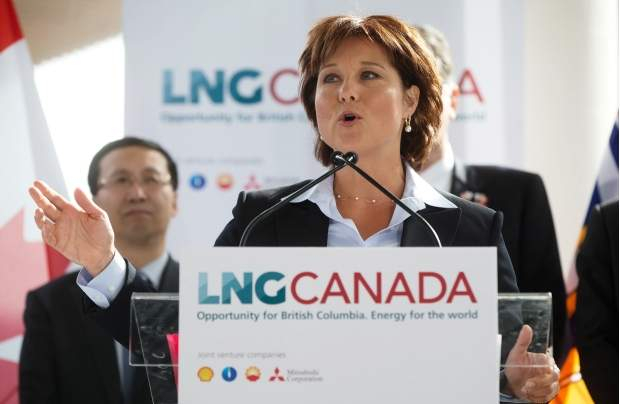
Is British Columbia the corruption capital of Canada? Of Course...


Image result for Is British Columbia the corruption capital of Canada?

Is British Columbia the most corrupt province in the country? If there was any doubt before, I think it’s been safely removed now.
Former RCMP deputy commissioner Peter German’s report into money laundering in the province’s casinos is ground-breaking but also deeply disturbing. It confirms why people are losing faith in the ability of public institutions to safeguard our interests. There has rightly been much talk and focus on the former Liberal government and its failure to address a crime epidemic that many sources warned them about. Less attention has been trained on the police and their ineffectiveness in this sorry drama.
It was evident as far back as 2012 that there were bad things happening inside B.C. casinos, and the River Rock in particular. And in that regard, one passage in Mr. German’s analysis stands out. In it, he’s describing how investigators inside the government’s gaming enforcement branch and officials with the B.C. Lottery Corp., were growing skeptical that efforts to thwart money laundering were actually working.
One agent inside the gaming enforcement branch described in a memo at the time how the River Rock’s VIP room was “full of facilitators,” including inside senior management. What did that mean? It meant they were helping bad guys launder money by knowingly turning a blind eye to their activity. They even stopped reporting suspicious transactions under $50,000.
“In the investigator’s opinion,” Mr. German’s report read, “the matter reached a head in 2012 when the River Rock accepted $100,000 in $20 bills from a patron, who used $3,000 in chips from his pocket to play and then cashed out.” In less time than it takes to run to the store for milk, this guy had cleaned $100,000 in dirty money.
The same guy returned the next day with another $100,000 to launder. And he did. It is now known that no – zero, zilch, nada – transaction was refused by the B.C. Lottery Corp. and its casinos before 2015 despite what was going on. How is that possible?
Many, including myself, have asked: Where was the provincial government? Why wasn’t the solicitor-general at the time, Rich Coleman, all over this? Why wasn’t this issue an urgent priority for the Liberal cabinet of the day? People could see what was going on. These suspicious transactions were being captured on video. And yet, nothing was done.
But at the same time we should ask: Where were the police? People knew years ago that bad guys were showing up at casinos with bags full of illegally obtained money looking to legitimize it. Why weren’t any of these people being arrested and thrown in jail? Instead, this money was allowed to circulate throughout the broader economy and used to begin a horrible escalation in real estate prices and ignite an opioid crisis.
Nice work, police.
The fact that this breakdown by law enforcement, and the RCMP in particular, is underplayed in this report is concerning. And one has to ask the question: did Mr. German let the force off easy because of his association with it?
Let’s be clear: He was the deputy commissioner of the RCMP for western and northern Canada during the period much of this criminal activity was going on. In other words, it happened on his watch. How convenient then this report was to be merely a fact-finding probe and not a fault-finding one. That might have cut a little too close to the bone. It may have implicated people Mr. German knew or even managed at one time. It might have implicated himself.
I would like to know what Mr. German knew personally about what was occurring. I’d like to hear his explanation for the RCMP’s complete abrogation of responsibility in this sorry affair. A community policing office could have protected the public just as well as the RCMP did in this case. And yet all we hear is a lot of rhetoric about internal infighting and turf wars and the general incompetence of government agencies. Well, what about the incompetence of the cops? Everyone’s pointing at the other guy. No one wants to accept responsibility.
Meantime, the corruption that was evident in the casinos was allowed to spread into other sectors of the B.C. economy, having a direct, deleterious impact on the lives of thousands and thousands of innocent people. Unbelievable.
What happened in B.C. is a scandal for the ages and has likely helped make the province the corruption capital of the country. What a well-deserved honour.

Monday, July 2, 2018

Terrifying moment a road collapses in southwest China caught on camera (VIDEO)

Terrifying moment a road collapses in southwest China caught on camera (VIDEO)

Terrifying moment a road collapses in southwest China caught on camera (VIDEO)
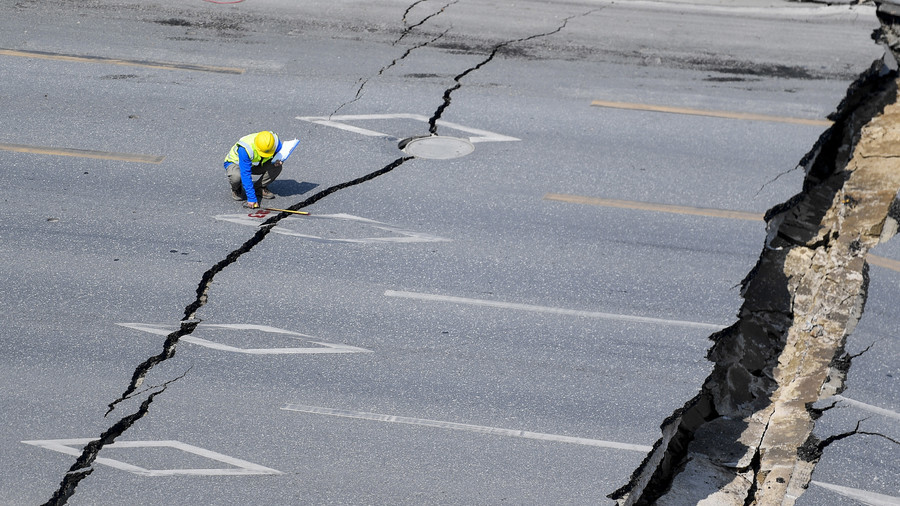
Surveillance video has captured the shocking moment a road collapsed in southwest China, causing its retaining walls to tumble to the ground in dramatic fashion.
The terrifying incident happened in the early hours of Sunday morning in the city of Guang'an in the Sichuan Province.
Footage shows a 50-meter (55-yard) stretch of the road suddenly cave in, followed by the collapse of trees and surrounding debris. In a later clip the wide scale of the destruction can be seen.
The road collapsed near the entrance to the underground parking lot of an apartment complex, the Chengdu Economic Daily reported. Eyewitnesses recalled observing the cracks appearing in the road and the horror of watching them expand as pedestrians approached the section.
Miraculously no casualties have been reported. Residents from more than 50 nearby apartments have been evacuated. Authorities are investigating the cause of the incident. Local media outlets have suggested that heavy rainfall may be a factor in the collapse.

B.C. casinos are ‘laundromats’ for ‘infusion of dirty money,’ report says

B.C. casinos are ‘laundromats’ for ‘infusion of dirty money,’ report says

VANCOUVER—Plastic shopping bags bulging with cash dumped onto casino counters. Hundreds of thousands in $20 bills, bundled by elastic bands. Thirteen minutes spent just counting the money in one security video shown to reporters.
British Columbia’s casinos “unwittingly served as laundromats for the proceeds of organized crime,” representing “a collective system failure” in which the province bears major responsibility, according to a long-awaited report released Wednesday by the Attorney General.
B.C. Attorney General David Eby stands behind Peter German — the former deputy Western RCMP commissioner he commissioned to report on money laundering in Vancouver-area casinos — at the report’s release on Wednesday, June 27, 2018 in Vancouver.
B.C. Attorney General David Eby stands behind Peter German — the former deputy Western RCMP commissioner he commissioned to report on money laundering in Vancouver-area casinos — at the report’s release on Wednesday, June 27, 2018 in Vancouver.  (DAVID P. BALL/STAR VANCOUVER)
The publicly owned BC Lottery Corp.’s anti-money-laundering unit doesn’t even work evenings or weekends, the nine-month investigation found. And the province’s gambling watchdog staff are “frustrated by the lack of tools” to stop laundering.
Eby alleged the previous B.C. Liberal government “turned a blind eye” despite “thousands of suspicious transaction reports” with a total that “well exceeds $100 million” — and that alarms were raised by both casino staff and police as early as 2011.
“The era of inaction and denial is over … It was so strange that it took so long to take action,” B.C. Attorney General David Eby told reporters Wednesday, as casino security footage played behind him. “The only way to combat money laundering is to tackle it full on, to bring the public on in full view.”
Read more:
Eby alleged the province ignored the extent of the problem due to “the mistaken belief that this act is a victimless crime,” he said. “But it is tied to the opioid crisis that has taken thousands of people from their families, and it’s linked to the real-estate market and housing prices that have made life unaffordable for British Columbians.”
Speaking to reporters, author Peter German — former deputy Western RCMP commissioner — said his investigation revealed to him “the modern face of organized crime” and the inability of existing legislation and policies to keep pace.
“It is the underbelly of the violence that we see on our streets and the detritus that permeates society and engages in corruption,” German said. “Most of what (the RCMP) have uncovered has come from drug trafficking.
“The tentacles aren’t just local drug trafficking but potentially international drug trafficking and laundering that money.”
Casinos employ roughly 37,000 staff in B.C., generating “huge revenue” for the province.
German urged B.C. to create a new gambling-funded Crown corporation to crack down on money laundering, as well as an entirely new gambling police force with an intelligence unit and an “emphasis on Lower Mainland casinos.”
Ordered by the province’s crusading Attorney General, David Eby, the 250-page report made 48 key recommendations to address a problem long suspected but until now unsubstantiated.
As early as 2012, German found, the problem was known to employees in the BC Lottery Corp. — which contracts private operators to run its casinos — and the Gaming Policy and Enforcement Branch, which enforces the rules.
Security camera footage from B.C. casinos, showing clients depositing massive bags of $20 bills bundled with elastics. The footage helped spark an investigation into money laundering by the province's Attorney General, released on Wednesday, June 27, 2018.
And two years earlier, German revealed, BCLC was hit with the largest fine ever handed out by the federal fiscal crime agency, the Financial Transactions and Reports Analysis Centre (FinTRAC).
Lawyer and money laundering expert Christine Duhaime called the report a “good step in the right direction” and applauded its recommendation that casinos must report directly to FINTRAC.
“This really is activity that takes place on the casino floor with people the casinos can see,” she said in a phone interview. “They know who they are; they’re clients of theirs.
Attorney General David Eby alleges the previous B.C. Liberal government “turned a blind eye” despite “thousands of suspicious transaction reports” with a total that “well exceeds $100 million.
Attorney General David Eby alleges the previous B.C. Liberal government “turned a blind eye” despite “thousands of suspicious transaction reports” with a total that “well exceeds $100 million.  (FLICKR/ NEWS.GOV.BC.CA)
“So they really are the ones who are best suited to monitor activity to see if it’s suspicious, and do the actual reporting instead of sending it to BCLC head office and letting them make decisions out of context.”
Another of German’s top recommendations is to call for a new independent regulator to enforce anti-money laundering rules — a Crown corporation with its own directors, registrar and in-house legal counsel, funded by gambling profits.
The previous B.C. Liberal government, through its finance minister Mike de Jong, had axed funding to casino crime investigators. German urged that B.C. give its Joint Integrated Gaming Investigation Team “permanent, fenced funding” — presumably “fenced” from future government cuts — within the RCMP’s provincial budget.
And casino staff in “VIP rooms,” he suggested, should not be allowed to handle cash or chips and be given an independent avenue to blow the whistle on “inappropriate conduct” by gamblers.
Eby had warned in an earlier interview that the hotly anticipated report’s findings were “shocking.” And B.C.’s Lower Mainland was so well-known for the practices that Eby learned authorities around the world had begun referring to it as “the Vancouver Model.”
Report author Peter German former deputy suggests that casino staff in VIP rooms should not be allowed to handle cash or chips — and be given an independent avenue to blow the whistle on “inappropriate conduct” by gamblers.
Report author Peter German former deputy suggests that casino staff in VIP rooms should not be allowed to handle cash or chips — and be given an independent avenue to blow the whistle on “inappropriate conduct” by gamblers.  (FLICKR/ NEWS.GOV.BC.CA)
German’s revelations have already led to reforms since he gave Eby a draft in April. Eby said he’d delayed releasing it publicly because it contained allegations against individuals, which required they be given a chance to respond and for law enforcement to weigh in on risks to criminal investigations.
“Naturally with issues of money laundering, the secrecy is what makes it so difficult to track down the actual numbers and the actual scale,” said James Cohen, programs and engagement director of the anti-corruption watchdog Transparency International Canada, in a phone interview. “No doubt it was difficult to assess every aspect of money laundering, but it is important to look at why ‘the Vancouver Model’ was able to proliferate.
“A huge part of it has got to be a lack of oversight, not-good-enough enforcement and Canada’s lax rules and laws around anonymous companies and trusts. The public needs to understand how these complicated tools work.”
Here’s how such tools worked: According to the report, illegal drug trafficking gangs’ cash — from dealing, extortion, fraud and prostitution, almost entirely in $20s — was loaned to “local Chinese nationals” gambling at Vancouver-area casinos.
“The epicentre of the activity was at the River Rock casino in Richmond,” German told reporters, but was by no means alone. Those loans had to repaid through “offshore accounts … used to finance illicit drug and precursor chemical processes, drug importation, distribution and trafficking.”
But German’s work isn’t done. Under Eby’s orders, he is now turning his sights on alleged money laundering in B.C.’s red-hot real-estate sector for a second phase of his investigation and subsequent report.
German concluded by calling for B.C. to research “allegations of organized crime penetration of the real-estate industry,” as well as in horse racing and luxury cars.
But it’s the profit orientation of such crimes, he said, that might be the “Achilles heel” of criminals: “If you go after the money, you could potentially dismantle a criminal organization.”
Cohen said the “report is a very important step” but warned that to “just look at casinos would be to just see the tip of the iceberg.
“To think that money laundering stays in silos would be naive. It crosses geographies. We’ve got to take notice.”

What took them so long: Real estate investigation is next for author of B.C. casino money laundering report

Real estate investigation is next for author of B.C. casino money laundering report

VANCOUVER—While all eyes were on a report about money laundering in casinos released Wednesday, experts are expecting more revelations as investigator Peter German works on a second report, this one focusing on B.C.’s real estate sector.
In his 250-page report, German showed how B.C.’s casinos became havens for laundering hundreds of millions of ill-gotten cash and made a series of recommendations to close the many loopholes in the sector.
Peter German, former deputy commissioner of the RCMP, speaks about his review of anti-money laundering practices in B.C. on Wednesday June 27, 2018. Money-laundering operations through Vancouver-area casinos is tied to the opioid crisis and the real-estate market in British Columbia, Eby said Wednesday.
Peter German, former deputy commissioner of the RCMP, speaks about his review of anti-money laundering practices in B.C. on Wednesday June 27, 2018. Money-laundering operations through Vancouver-area casinos is tied to the opioid crisis and the real-estate market in British Columbia, Eby said Wednesday.  (DARRYL DYCK / THE CANADIAN PRESS)
After releasing a damning report on money laundering in B.C. casinos, investigator Peter German will examine the province’s real estate sector, where ownership of high-end properties is often concealed through trusts and shell companies.
After releasing a damning report on money laundering in B.C. casinos, investigator Peter German will examine the province’s real estate sector, where ownership of high-end properties is often concealed through trusts and shell companies.  (JENNIFER GAUTHIER / FOR STARMETRO)Peter German, former deputy commissioner of the RCMP, speaks about his review of anti-money laundering practices in B.C. on Wednesday June 27, 2018. Money-laundering operations through Vancouver-area casinos is tied to the opioid crisis and the real-estate market in British Columbia, Eby said Wednesday.
Peter German, former deputy commissioner of the RCMP, speaks about his review of anti-money laundering practices in B.C. on Wednesday June 27, 2018. Money-laundering operations through Vancouver-area casinos is tied to the opioid crisis and the real-estate market in British Columbia, Eby said Wednesday.  (DARRYL DYCK / THE CANADIAN PRESS)
After releasing a damning report on money laundering in B.C. casinos, investigator Peter German will examine the province’s real estate sector, where ownership of high-end properties is often concealed through trusts and shell companies.
After releasing a damning report on money laundering in B.C. casinos, investigator Peter German will examine the province’s real estate sector, where ownership of high-end properties is often concealed through trusts and shell companies.  (JENNIFER GAUTHIER / FOR STARMETRO)
German is now moving to examine B.C.’s real estate sector. While his casino report took nine months to complete, the former RCMP deputy commissioner for western and northern Canada expects real estate to be a more challenging investigation. Both reports have been commissioned by the B.C. government.
“Real estate is a really important one … It’s one of the sectors that have been overlooked from the federal oversight perspective, from the provincial oversight perspective,” said Christine Duhaime, a lawyer who specializes in counter-terrorist financing and anti-money laundering law.
Worldwide, luxury property is one of the most common ways money is laundered, said James Cohen, director of programs and engagement at Transparency International Canada. A 2016 Transparency International Canada study found that 45 per cent of the most valuable residential properties in Greater Vancouver are held through corporate structures that hide the owners.
Read more:
“To have as opaque a beneficial ownership system as we do in Canada makes us very attractive for people to store money,” Cohen said, referring to the ability to hold property in corporations, shell companies or trusts and conceal the identity of the owner.
In a press conference on Wednesday, David Eby, B.C.’s attorney general, said that when more scrutiny is placed on one area of money laundering, “it’s like pressing down on a waterbed” with the ripple moving to another area.
Real estate, other types of gambling such as horse racing, and luxury goods such as cars and jewelry are other areas it will now be important to watch closely, added German.
In his report, German described one known link between money laundering, casinos, real estate and the illegal drug trade. The method was named “the Vancouver model” by Australian academic John Langdale. Chinese citizens wanting to relocate some of their illicit wealth from China to Canada, which is difficult because of strict limits set by China, agree to accept cash in Canada from a lender. The person wanting to move money out of China then takes the cash they’ve been loaned to a casino and exchanges it for chips, gambles, then converts the chips into cash again when they leave the casino.
“A complex network of criminal alliances has coalesced with underground banks at its centre,” wrote German. “Money is laundered from Vancouver into and out of China and to other locations, including Mexico and Colombia. Illegal drug networks in North America are supplied by methamphetamines and precursor chemicals from China and cocaine from Latin America. In addition, criminals from China facilitate the flight of capital from China using Canadian casinos, junket operations and investment in real estate.”
Duhaime said luxury goods would likely be a much more minor area than real estate. She warned that German will have a more difficult time finding out what is going on in real estate than he did when investigating casinos, who know their clients well and collect identification information from them.
“He may be able to get some of that information and look up contracts, then he’ll have to talk to realtors, and then he’ll have to identify suspicious transactions,” Duhaime said.
German will then likely encounter property ownership shrouded in secrecy behind trusts or shell companies, Duhaime predicted.
“As soon as he hits that, that’s like a wall. He’s going to have a really difficult time figuring out who’s behind those entities because it’s not obvious who’s behind them or who the beneficiaries are of the trusts.”
B.C.’s finance minister has promised to create a public registry showing who owns real estate in the province, although government will have to consult with stakeholders and introduce legislation before the registry is up and running. There may well be privacy concerns that will need to be worked through, Duhaime said.
“I think what’s important is greater transparency in the area,” Cohen said. “To clean out who’s using it for money laundering, for kleptocracy, for proceeds of criminal actions or terrorist actions as well as tax dodging.”