Ottawa urged to press China for release of Canadian citizenCase of Qian Sun raised at foreign affairs committee hearingJohn McCallum, Canada’s Ambassador to the People’s Republic of China, at a meeting of the House of Commons Standing Committee on Foreign Affairs and International Development in Ottawa on May 2, 2017. (THE CANADIAN PRESS/Sean Kilpatrick)OTTAWA—MPs say the Trudeau government should raise its voice and intervene at high levels about a Canadian arrested in China in order to prevent her from being abused by the Chinese authorities.Conservative foreign affairs critic Peter Kent on May 2 raised the case of Qian Sun, a Falun Gong practitioner seized in Beijing in February who now faces indictment for her faith. Kent was speaking at the parliamentary foreign affairs committee hearing following a speech by new Canadian ambassador to China John McCallum touting more trade with China.Qian Sun.In his remarks, McCallum acknowledged that “the consular side of my job is critical” and noted that Canada and China “disagree on the death penalty, we disagree on some aspects of rule of law, and privately and publicly on how the Chinese government treats human rights advocates.”However, McCallum declined to comment publicly on Sun’s case, and would only say she had access to “regular consular visits” as in all such cases.“That doesn’t always help, for the person in detention, if we broadcast their situation in public, so I think for those cases, almost all the time, it is better to proceed in a low-profile way,” he said.Torture and abuse of prisoners
Kent, however, disagrees and in particular is concerned about this situation involving an adherent of Falun Gong. Also called Falun Dafa, the meditation and spiritual discipline, which emphasizes the principles of truthfulness, compassion, and tolerance, has been the target of a state-sponsored persecution in China since 1999, launched by former Chinese leader Jiang Zemin and reminiscent of the Cultural Revolution.Given the Chinese communist government’s treatment of Falun Gong practitioners, Canada should, in fact, raise its voice before Qian Sun is done harm.“While I understand that in some situations silence may be the right course, I believe that in the case of Falun Gong practitioners, given the Chinese communist government’s treatment of Falun Gong practitioners, that Canada should, in fact, raise its voice before Qian Sun is done harm,” Kent said in an interview with New Tang Dynasty (NTD) Television.“Because we know that in detention in situations like this, the Chinese authorities sometimes resort to torture and to abuse of prisoners,” he added.Kent has reason to be concerned. According to a 2017 Freedom House report, Falun Gong adherents in China have been subjected to arbitrary detention, imprisonment, and torture, and are at a high risk of extrajudicial execution.Freedom House also notes evidence suggesting that the regime has been engaged in the large-scale killing of religious prisoners, particularly Falun Gong practitioners, to provide organs for China’s booming organ transplant industry.Sun, 51, is vice president of Beijing Leadman Biochemistry Co., Ltd., and began practising Falun Gong in 2014, according to Minghui, a website dedicated to reporting on the Falun Gong community worldwide.More than two dozen police broke into Sun’s home and arrested her on Feb. 19, and it took her family several weeks to find out where she was being detained, said the Minghui report.Conservative MP Peter Kent asks a question in the House of Commons on April 11, 2017. (THE CANADIAN PRESS/Adrian Wyld)Canada needs to be ‘far more forceful’
“We think that the Canadian government needs to be far more forceful in representing this Canadian citizen,” Kent said.NDP foreign affairs critic Hélène Laverdière agreed. “It is really important for the Canadian government to be very active on that file,” she told NTD.“International standards of basic human rights include freedom of religion, freedom of expression, and Canada must stand up to defend those principles and those rights,” Laverdière said.“Often they have to work with the host government and put a lot of pressure, sometimes phone calls from high-level people to make sure that you know the fundamental rights of these Canadian people are fully respected.”Committee member Tom Kmiec, the Conservative deputy foreign affairs critic, told NTD he was disappointed the committee got no answer as to the kind of consular assistance being provided to Sun.“When the ambassador is asked a question, they should explain to us what types of consular services they provided to Canadians, whether it is just formal interviews, [whether they were] provided with a lawyer, whether they were able to have someone who is a medical doctor or nurse visit them,” Kmiec said.Raising human rights
McCallum told the committee he had been in China for five weeks and was invited to present his credentials to President Xi Jinping “within 24 hours of arriving in China.”“I conveyed to him a message from our prime minister that can be summarized in three words: more, more, more,” McCallum said. “We want in both directions more trade, more investment, more tourists, more students, more co-operation in every conceivable area.”Asked during the committee hearing if he raised human rights issue when he met with Xi, McCallum said no, because the meeting “was less than five minutes and it was largely scripted.”It is part of Canada’s foreign policy to raise the issue of human rights overseas, especially when it comes to Canadians.Kmiec saw it as a lost opportunity for Sun. The fact that McCallum “wasn’t able to raise the issue of human rights concerns me,” said Kmiec.“It is part of Canada’s foreign policy to raise the issue of human rights overseas, especially when it comes to Canadians,” he said.“That is the number one thing we raise, and I know using an individual’s name with the leader of another country, and raising the issue personally with them, sometimes helps to secure their release or at least a better treatment while they went through their judicial process.”This has been true for other Falun Gong cases, including that of Canadian citizen Kunlun Zhang, a former visiting professor at Montreal’s McGill University, who is believed to be the first Canadian to be arrested in China for practising Falun Gong.Zhang was arrested in China in 2000 and sent to forced labour camp for three years. He might have languished there if his daughter Lingdi Zhang had not broadly publicized his plight starting in November that year.The strong voice from elected officials and steady media coverage helped to grow public outcry over the elder Zhang’s imprisonment, and he was released in January 2001, shortly before then-prime minister Jean Chrétien’s trade mission to China.“Canada should pursue trade talks but we should also have a balanced approach and we should speak openly and publicly and forcefully about the defence of human rights whenever this sort of case occurs,” said Kent.
Thursday, May 4, 2017
Ottawa urged to press China for release of Canadian citizen


Wednesday, May 3, 2017
Is Warren Buffett Scratching His Head Over Berkshire Hathaway's Holding In 'Basket Case' Tesco?
Is Warren Buffett Scratching His Head Over Berkshire Hathaway's Holding In 'Basket Case' Tesco?

With shares in British supermarket giant Tesco hitting an 11-year low last Friday and ending virtually unchanged at 169.10p (c.$2.80) each this Monday, valuing the company at around £13.70 billion (c.$22.6bn), Warren Buffett, CEO and chairman of Berkshire Hathaway BRK.B +% Inc. and pre-eminent world investor, might be mulling the decision to invest in the UK retailer. Yet despite Tesco’s share plunge - down over 53% since 23 October 2013 - Berkshire Hathaway’s fortunes remain undiminished.
Mr Buffett has been open enough to say that he made “a mistake” on Tesco, a group in which Berkshire Hathaway still owns just under a 3% stake worth around £400m (c.$658m). So, since 23 October 2013 the value of that investment has declined by over £400m. For most investors - institutional or otherwise - that kind of loss would be too massive a blow to handle, but not Berkshire Hathaway.
This US holding company and its subsidiaries engage in a diverse range of business activities spanning property and casualty insurance and reinsurance, utilities, energy, freight rail and transportation, finance, manufacturing as well as retail. The common stock of the company is an S&P 500 component and listed on the New York Stock Exchange, with each ‘A’ share having traded at around $208,379 as of 23 October.
That represents an almost 20% increase ($33,799) over the stock’s trading price a year ago. And, even if the stock is down just over $5,000 since their 52-week high achieved on 19 September they are still 31% up from a 52-week low ($163,038) in early May. Therefore the fallout from Tesco, which was the only share to record a loss last year among Berkshire’s top 15 picks, has made no dent in the company.

This is an image of the Tesco store at Kingston Park, Newcastle upon Tyne, England (Photo credit: Wikipedia)
But then that would not be so surprising given that it has over fifty subsidiaries and various equity holdings in an array of US blue-chip companies including American Express AXP -0.60%, Coca-Cola and IBM.
Mr Buffett, dubbed the ‘Sage of Omaha’, held a 3.7% stake in Tesco at the end of 2013 according to Berkshire’s annual report. At the time the holding of 301m shares were worth $1.67bn (c.£1bn). He even became the supermarket group’s third biggest investor after taking an initial stake in 2006 when the chain seemed all-powerful in the UK and was planning what became an ill-fated foray and expansion into the US. Subsequently in January 2012 he increased his stake to over 5% from 3.2% following Tesco issuing its first profits warning in twenty years. Remember Tesco had been a darling of the UK stock market.

Jing Ulrich and Warren Buffett. (Photo credit: Wikipedia)
Fast forward to 2014 and the profits warnings from Tesco came thick and fast, with three issued over a 4-month period. The shares lost 30% in value between 8 August and 3 October, but have fallen by a whopping £13bn since the start of this year. With around 8bn shares in circulation a drop of just 10p (c.16.5 US cents) equates to over £800m being wiped off its market capitalization. So, we are not talking peanuts.
To some though it might appear a tad strange that Berkshire decided to reduce its Tesco holding below the 3% mark only this October. In a notification to the London Stock Exchange dated 16 October, the company revealed that its holding (at 245,298,335 shares prior to the announcement), had fallen below and crossed the 3% threshold in a transaction that had taken place on 13 October.
The Daily Telegraph’s Questor column, for example, reiterated its Sell advice on 21 October on Tesco, which followed the same advice (Sell) made as far back as 2 October 2013 when the shares were trading at 358p each.
Ahead of Tesco’s interim results last week (23 October) the British paper pointed out that the retailer’s shares were “uninvestable” given a number of well-documented issues and problems it faced - including a £250m black hole in its accounts, an on-going investigation by the Financial Conduct Authority, the UK regulator, falling sales and balance sheets woes.
Elsewhere, Terry Smith, the former CEO of inter-dealer broker Tullett Prebon and founder of Fundsmith, which has turned £10,000 into £17,300 in under four years, warned a fair while ago that Tesco exhibited worrying issues in regard to its return on capital.
All these problems were enough for David Herro, a fund manager at Chicago-based Harris Associates, to sell just under 1% of Tesco (worth around £140m at last Friday’s closing price) in the days leading up to the retailer’s interim results statement and liquidate his entire investment in the company. Now an American pension fund has sounded off about legal action against Tesco. But that begs the question as to why it has taken so long for such a move to surface.
In terms of analyst opinions on Tesco, data from Thomson/First Call reveals that just two equity analysts covering the stock rated it as a Buy. Again not surprising. The majority (15) rated it a Hold (up from 13 last month), while five rated it Underperform and none a Sell. One analyst, Rickin Thakrar at Espirito Santo, has even suggested that Tesco could eventually generate “zero profits” in the UK and expressed the view that the risks remain uncertain.
The signs might not look to0 rosy for Tesco at the minute given a 4% loss in sales in the 12 weeks to 17 August 2014 compared to the same period in 2013. It nevertheless still commands just under 30% of the UK supermarket industry - even if sales are falling and discount retailers (Aldi and Lidl) are growing.e
Bottom fishers might consider Tesco an oversold stock, but there are risks. And, predicting just where the bottom is for the stock is tricky. That said, the UK supermarket sector as a whole could witness consolidation. Indeed, in recent weeks there has been market talk that rival grocer Sainsbury’s (shares 40% down since October 2013) and Marks & Spencer could be getting together. However, I doubt for now Mr Buffett is losing too much sleep over Tesco.
Tuesday, May 2, 2017
The Horrors of Communist China
The Horrors of Communist China

By Llewellyn H. Rockwell Jr.
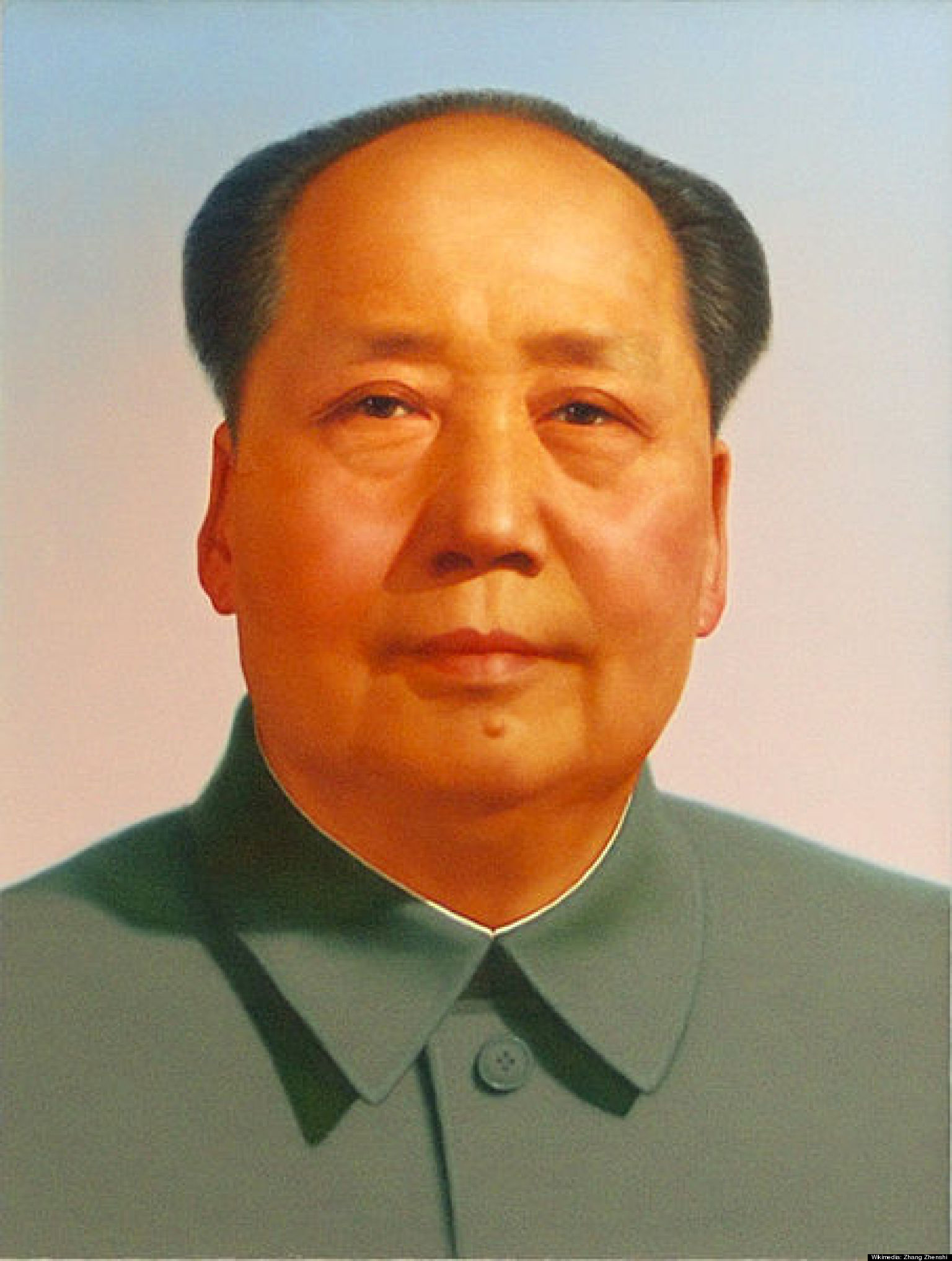
It’s a scandal that few Westerners are even aware, or, if they are aware, they are not conscious, of the bloody reality that prevailed in China between the years 1949 and 1976, the years of communist rule by Mao Zedong.
How many died as a result of persecutions and the policies of Mao? Perhaps you care to guess? Many people over the years have attempted to guess. But they have always underestimated. As more data rolled in during the 1980s and 1990s, and specialists have devoted themselves to investigations and estimates, the figures have become ever more reliable. And yet they remain imprecise. What kind of error term are we talking about? It could be as low as 40 million. It could be as high as 100 million or more. In the Great Leap Forward from 1959 to 1961 alone, figures range between 20 million to 75 million. In the period before, 20 million. In the period after, tens of millions more.
As scholars in the area of mass death point out, most of us can’t imagine 100 dead or 1000. Above that, we are just talking about statistics: they have no conceptual meaning for us, and it becomes a numbers game that distracts us from the horror itself. And there is only so much ghastly information that our brains can absorb, only so much blood we can imagine. And yet there is more to why China’s communist experiment remains a hidden fact: it makes a decisive case against government power, one even more compelling than the cases of Russia or Germany in the 20th century.
The horror was foreshadowed in a bloody civil war following the Second World War. After some nine million people died, the communists emerged victorious in 1949, with Mao as the ruler. The land of Lao-Tzu (rhyme, rhythm, peace), Taoism (compassion, moderation, humility), and Confucianism (piety, social harmony, individual development) was seized by the strangest import to China ever: Marxism from Germany via Russia. It was an ideology that denied all logic, experience, economic law, property rights, and limits on the power of the state on grounds that these notions were merely bourgeois prejudices, and what we needed to transformed society was a cadre with all power to transform all things.
It’s bizarre to think about it, really: posters of Marx and Lenin in China, of all places, and rule by an ideology of robbery, dictatorship, and death that did not come to an end until 1976. So spectacular has the transformation been in the last 25 years that one would hardly know that any of this ever happened, except that the Communist Party is still running the place while having tossed out the communist part.
The experiment began in the most bloody way possible following the second world war, when all Western eyes were focused on matters at home and, to the extent there was any foreign focus, it was on Russia. The “good guys” had won the war in China, or so we were led to believe in times when communism was the fashion.
The communization of China took place in the usual three stages: purge, plan, and scapegoat. First there was the purge to bring about communism. There were guerillas to kill and land to nationalize. The churches had to be destroyed. The counterrevolutionaries had to be put down. The violence began in the country and spread later to the cities. All peasants were first divided into four classes that were considered politically acceptable: poor, semi poor, average, and rich. Everyone else was considered a landowner and targeted for elimination. If no landowners could be found, the “rich” were often included in this group. The demonized class was ferreted out in a country-wide series of “bitterness meetings” in which people turned in their neighbors for owning property and being politically disloyal. Those who were so deemed were immediately executed along with those who sympathized with them.
The rule was that there had to be at least one person killed per village. The numbers killed is estimated to be between one and five million. In addition, another four to six million landowners were slaughtered for the crime of being capital owners. If anyone was suspected of hiding wealth, he or she was tortured with hot irons to confess. The families of the killed were then tortured and the graves of their ancestors looted and pillaged. What happened to the land? It was divided into tiny plots and distributed among the remaining peasants.
Then the campaign moved to the cities. The political motivations here were at the forefront, but there were also behavioral controls. Anyone who was suspected of involvement in prostitution, gambling, tax evasion, lying, fraud, opium dealing, or telling state secrets was executed as a “bandit.” Official estimates put the number of dead at two million with another two million going to prison to die. Resident committees of political loyalists watched every move. A nighttime visit to another person was immediately reported and the parties involved jailed or killed. The cells in the prisons themselves grew ever smaller, with one person living in a space of about 14 inches. Some prisoners were worked to death, and anyone involved in a revolt was herded with collaborators and they were all burned.
There was industry in the cities, but those who owned and managed them were subjected to ever tighter restrictions: forced transparency, constant scrutiny, crippling taxes, and pressure to offer up their businesses for collectivization. There were many suicides among the small- and medium-sized business owners who saw the writing on the wall. Joining the party provided only temporary respite, since 1955 began the campaign against hidden counterrevolutionaries in the party itself. A principle here was that one in ten party members was a secret traitor.
As the rivers of blood rose ever higher, Mao brought about the Hundred Flowers Campaign in two months of 1957, the legacy of which is the phrase we often hear: “Let a hundred flowers bloom.” People were encouraged to speak freely and give their point of view, an opportunity that was very tempting for intellectuals. The liberalization was short lived. In fact, it was a trick. All those who spoke out against what was happening to China were rounded up and imprisoned, perhaps between 400,000 and 700,000 people, including 10 percent of the well-educated classes. Others were branded as right wingers and subjected to interrogation, reeducation, kicked out of their homes, and shunned.
But this was nothing compared with phase two, which was one of history’s great central planning catastrophes. Following collectivization of land, Mao decided to go further to dictate to the peasants what they would grow, how they would grow it, and where they would ship it, or whether they would grow anything at all as versus plunge into industry. This would become the Great Leap Forward that would generate history’s most deadly famine. Peasants were grouped into groups of thousands and forced to share all things. All groups were to be economically self-sufficient. Production goals were raised ever higher.
People were moved by the hundreds of thousands from where production was high to where it was low, as a means of boosting production. They were moved too from agriculture to industry. There was a massive campaign to collect tools and transform them into industrial skill. As a means of showing hope for the future, collectives were encouraged to have huge banquets and eat everything, especially meat. This was a way of showing one’s belief that the next year’s harvest would be even more bountiful.
Mao had this idea that he knew how to grow grain. He proclaimed that “seeds are happiest when growing together” and so seeds were sown at five to ten times their usual density. Plants died, the soil dried out, and the salt rose to the surface. To keep birds from eating grain, sparrows were wiped out, which vastly increased the number of parasites. Erosion and flooding became endemic. Tea plantations were turned to rice fields, on grounds that tea was decadent and capitalistic. Hydraulic equipment built to service the new collective farms didn’t work and lacked any replacement parts. This led Mao to put new emphasis on industry, which was forced to appear in the same areas as agriculture, leading to ever more chaos. Workers were drafted from one sector to another, and mandatory cuts in some sectors was balanced by mandatory high quotas in another.
In 1957, the disaster was everywhere. Workers were growing too weak even to harvest their meager crops, so they died watching the rice rot. Industry churned and churned but produced nothing of any use. The government responded by telling people that fat and proteins were unnecessary. But the famine couldn’t be denied. The black-market price of rice rose 20 to 30 times. Because trade had been forbidden between collectives (self-sufficiency, you know), millions were left to starve. By 1960, the death rate soared from 15 percent to 68 percent, and the birth rate plummeted. Anyone caught hoarding grain was shot. Peasants found with the smallest amount were imprisoned. Fires were banned. Funerals were prohibited as wasteful.
Villagers who tried to flee the countryside to the city were shot at the gates. Deaths from hunger reached 50 percent in some villages. Survivors boiled grass and bark to make soup and wandered the roads looking for food. Sometimes they banded together and raided houses looking for ground maize. Women were unable to conceive because of malnutrition. People in work camps were used for food experiments that led to sickness and death.
How bad did it get? In 1968 an 18-year-old member of the Red Guard, Wei Jingsheng, took refuge with a family in a village of Anhui, and here he lived to write about what he saw:
“We walked along beside the village… Before my eyes, among the weeds, rose up one of the scenes I had been told about, one of the banquets at which the families had swapped children in order to eat them. I could see the worried faces of the families as they chewed the flesh of other people’s children. The children who were chasing butterflies in a nearby field seemed to be the reincarnation of the children devoured by their parents. I felt sorry for the children but not as sorry as I felt for their parents. What had made them swallow that human flesh, amidst the tears and grief of others — flesh that they would never have imagined tasting, even in their worst nightmares?”
The author of this passage was jailed as a traitor but his status protected him from death and he was finally released in 1997.
How many people died in the famine of 1959–61? The low range is 20 million. The high range is 43 million. Finally in 1961, the government gave in and permitted food imports, but it was too little and too late. Some peasants were again allowed to grow crops on their own land. A few private workshops were opened. Some markets were permitted. Finally, the famine began to abate and production grew.
But then the third phase came: scapegoating. What had caused the calamity? The official reason was anything but communism, anything but Mao. And so the politically motivated roundup began again, and here we get the very heart of the Culture Revolution. Thousands of camps and detention centers were opened. People sent there died there. In prison, the slightest excuse was used to dispense with people — all to the good, since the prisoners were a drain on the system, so far as those in charge were concerned. The largest penal system ever built was organized in a military fashion, with some camps holding as many as 50,000 people.
There was some sense in which everyone was in prison. Arrests were sweeping and indiscriminate. Everyone had to carry around a copy of Mao’s Little Red Book. To question the reason for arrest was itself evidence of disloyalty, since the state was infallible. Once arrested, the safest path was instant and frequent confession. Guards were forbidden from using overt violence, so interrogations would go on for hundreds of hours, and often the prisoner would die during this process. Those named in the confession were then hunted down and rounded up. Once you got through this process, you were sent to a labor camp, where you were graded according to how many hours you could work with little food. You were fed no meat nor given any sugar or oil. Labor prisoners were further controlled by the rationing of the little food they had.
The final phase of this incredible litany of criminality lasted from 1966 to 1976, during which the number killed fell dramatically to “only” one to three million. The government, now tired and in the first stages of demoralization, began to lose control, first within the labor camps and then in the countryside. And it was this weakening that led to the final, and in some ways the most vicious, of the communist periods in China’s history.
The first stages of rebellion occurred in the only way permissible: people began to criticize the government for being too soft and too uncommitted to the communist goal. Ironically, this began to appear precisely as moderation became more overt in Russia. Neo-revolutionaries in the Red Guard began to criticize the Chinese communists as “Khrushchev-like reformers.” As one writer put it, the guard “rose up against its own government in order to defend it.”
During this period, the personality cult of Mao reached it height, with the Little Red Book achieving a mythic status. The Red Guards roamed the country in an attempt to purge the Four Old-Fashioned Things: ideas, culture, customs, and habits. The remaining temples were barricaded. Traditional opera was banned, with all costumes and sets in the Beijing Opera burned. Monks were expelled. The calendar was changed. All Christianity was banned. There were to be no pets such as cats and birds. Humiliation was the order of the day.
Thus was the Red Terror: in the capital city, there were 1,700 deaths and 84,000 people were run out. In other cities such as Shanghai, the figures were worse. A massive party purge began, with hundreds of thousands arrested and many murdered. Artists, writers, teachers, scientists, technicians: all were targets. Pogroms were visited on community after community, with Mao approving at every step as a means of eliminating every possible political rival. But underneath, the government was splintering and cracking, even as it became ever more brutal and totalitarian in its outlook.
Finally in 1976, Mao died. Within a few months, his closest advisers were all imprisoned. And the reform began slowly at first and then at breakneck speed. Civil liberties were restored (comparatively) and the rehabilitations began. Torturers were prosecuted. Economic controls were gradually relaxed. The economy, by virtue of human and private economic initiative, was transformed.
Having read the above, you are now in a tiny elite of people who know anything about the greatest death camp in the history of the world that China became between 1949 and 1976, an experiment in total control unlike anything else in history.
Don’t tell me that we’ve learned anything from history. We don’t even know enough about history to learn from it.
This article was originally published at The Mises Institute and is excerpted from The Death Camps of Communist China
Monday, May 1, 2017
An Australian Speaks Out,The Chinese Invasion of Australia--Real Estate
The Chinese Invasion of Australia/Real Estate

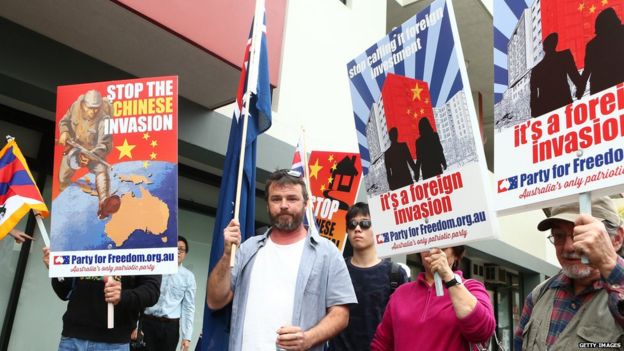


Rather than the Turnbull government determining immigration policy, it is really the UNELECTED Australian real estate agents who determine Australian immigration policy and determine the ethnic mix of Australia which is becoming more Chinese by the minute. This is happening due to the aggressive marketing effort the real estate agents are doing in South East Asia and China. As part of their marketing spin, they offer properties to the infinite supply of Chinese, stating how they will get a better way of life and a visa in Australia. All marketing is done secretly in Mandarin usually by Chinese agents to win the deal. So by default the real estate agents by attracting many Chinese to Australia are determining our new ethnic mix. Go to Boxhill or Chatswood and have a look. The Turnbull government just lets it all happen saying we have a lack of housing supply. Once a Chinese buys a property for at least 1.5 million, they are classed as an investor and can get Visa subclasses 160 or 891 that allows them and their family to live in Australia.
What these visas do, is let the Chinese investor stay in Australia indefinitely, work and study in Australia, enrol in Medicare and then apply for Australian citizenship.


Cheshire Grin Realtors


Manufacturing companies got wrecked by cyber-spies last year, Verizon report says
Manufacturing companies got wrecked by cyber-spies last year, Verizon report says
APR 27, 2017 | CYBERSCOOP

Cyber-spies backed by nation-states were behind a majority of data breaches experienced by manufacturing companies in 2016, according to Verizon’s newly published 2017 Data Breach Investigations Report.
Verizon identified 620 data breach incidents in the manufacturing sector last year — of which 94 percent could be defined as “espionage” driven and attributable to “state-affiliated” actors.
Roughly 91 percent of material stolen in these breaches had been categorized as “secret,” relating to proprietary information owned solely by the victim.
Cybersecurity experts say hackers largely target the manufacturing industry in order to steal trade secrets, business plans and valuable intellectual property. Verizon defines cyber-espionage as incidents that include “unauthorized network or system access linked to state-affiliated actors and/or exhibiting the motive of espionage.”
“When you make stuff, there is always someone else who wants to make it better, or at least cheaper. A great way to make something cheaper is to let someone else pay for all of the R&D and then simply steal their intellectual property. With that in mind, it will probably be of no surprise that Cyber-Espionage is by far the most predominant pattern associated with breaches in Manufacturing,” the Verizon report reads.

Prototypical of a government-backed hacking operation, most data breaches in the sector, according to Verizon, are highly targeted and narrowly focused on certain content that is stored by specific companies — rather than opportunistic, these breaches are well-planned and usually indicative of a longer term intelligence gathering effort.
Following years of damaging, cyber-enabled economic espionage, former U.S. President Barack Obama met with Chinese President Xi Jinping in late 2015 to discuss and agree to a diplomatic treaty. Since that agreement, cybersecurity firms that track Chinese hackers noticed a sizable increase in economic espionage coming from Beijing.
“Until recently, the bulk of Chinese cyber-espionage was attributed for the purpose of stealing information for their own corporations, notably manufacturing. In a global economy, goods can be produced anywhere and if you can steal the R&D behind those goods, an unethical company will always be able to undercut and win on price,” said John Bambenek, threat research manager at Fidelis Cybersecurity. Use cheaper components.“Further complicating the matter is that while manufacturing is increasingly high-tech, they often don’t have high security.”
Verizon found that most computer intrusions in the manufacturing industry begin with a well-crafted spear-phishing email, containing a malicious link or attachment, that is sent to a company employee. In such cases, malware is installed in the form of a backdoor or C2 after a booby-trapped attachment is opened, giving the attacker remote access to an internal computer.
Social engineering and malware-based cyberattacks combined for a whopping 73 percent of all data breaches in the manufacturing sector last year. Spies are known to favor email phishing techniques and using malware to compromise victims.

In a broader context, Verizon claims that cyber-espionage groups were responsible for 289 confirmed data disclosures in 2016 alone across all sectors. Similar to past years, the unique state-affiliated, threat actor group accounted for a majority of the known breaches experienced by organizations in the government and manufacturing sectors.
“Unlike organized criminal groups, who are typically after directly monetizable data, state-affiliated actors are playing the long game and are more selective of their targets,” the report notes.
Capable, government-backed digital espionage groups are sometimes referred to as Advanced Persistent Threats, or APTs, by the cybersecurity research community — a reference that ties back to the ability of these attackers to gain and maintain access to a target network.
Some of the most high-profile cybersecurity storylines of 2016 involved APT groups attacking political organizations, including a breach at the Democratic National Committee eventually attributed to APT-28, a Russia-linked espionage group.
Power Corporation & How [Jesuit] China Fits In
Power Corporation controls our boy Trudeau, the same way they did with his Dad.
Subscribe to:
Posts (Atom)