Wednesday, May 30, 2018

Xi Jinping Calls for China’s Tech Self-Reliance Amid ZTE Troubles

Xi Jinping Calls for China’s Tech Self-Reliance Amid ZTE Troubles

 Epoch Times
May 29, 2018

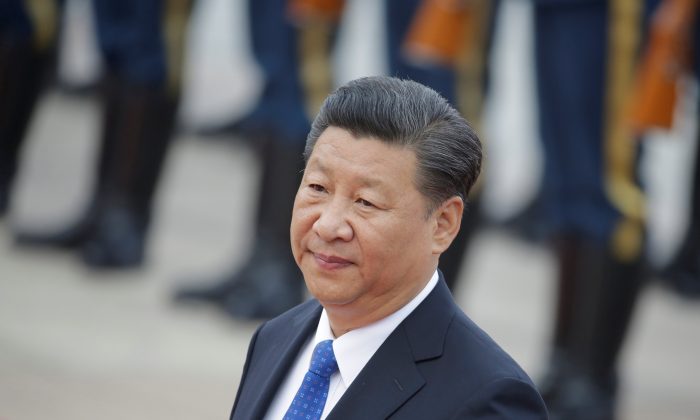
Amid an escalating crisis within Chinese telecom firm ZTE, Chinese leader Xi Jinping spoke at a conference for Chinese state scientists and engineers about the country’s need to become technologically self-reliant.
“Only when we have fully grasped key technologies, can we fundamentally protect the country’s economic and national security,” Xi said on May 28, according to a transcript published by state-run media Xinhua.
Operations have screeched to a halt at China’s second largest telecoms company, after the United States imposed a ban that prohibited U.S. companies from selling tech parts or software to ZTE. The penalty was issued in April after ZTE was found to have defied terms of an agreement it signed in 2017 for violating U.S. sanctions against Iran and North Korea.
ZTE relies heavily on U.S.-imported chips and optical modules for manufacturing its smartphones. A 2016 report released by a Chinese regime-affiliated think tank found that the firm purchased 53 percent of its chips from American firms, worth $3.1 billion. It predicted that any U.S. sanctions would have a detrimental effect on ZTE and the Chinese tech industry in general.
The recent ZTE ban has only highlighted the innovation gap China still faces as it struggles to produce the chips critical to manufacturing practically all electronic devices. In fact, semiconductors make up one of China’s largest import categories by value.
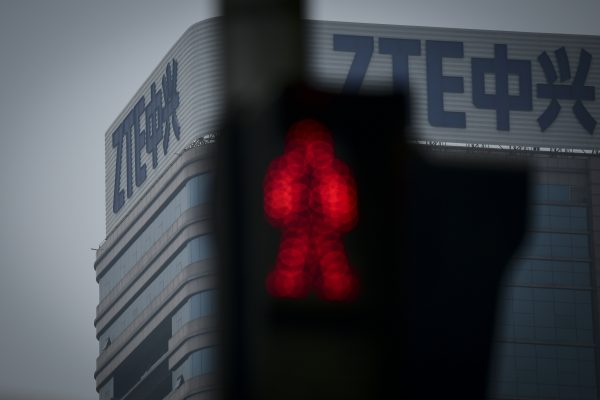
The ZTE logo is seen on a building in Beijing on May 14, 2018. (Wang Zhao/AFP/Getty Images)
Xi’s recent speech demonstrates how politically important—and urgent—the Chinese regime views tech innovation, as ZTE has become ensnared in broader trade negotiations between China and the United States. U.S. President Donald Trump’s administration is currently negotiating a way for ZTE to continue running its business in exchange for China eliminating tariffs on U.S. agricultural goods or agreeing to buy more U.S. imports, sources have told Reuters.
The Chinese regime had earlier outlined in its economic plan, Made in China 2025, how it seeks to attain self-sufficiency, and then eventually dominate global supply chains, in 10 major tech sectors.
Xi repeated those ambitions at the conference. “Self-reliance and innovation are inevitable on our path to becoming the world’s science and tech leader.”
The United States’ punitive tariffs on Chinese tech products, announced in March, had targeted Made in China 2025 as evidence of the Chinese regime’s strategic scheme to acquire and steal intellectual property for its national interests.
ZTE fit into that mold. Taiwan tech publication IP Observer found thatbetween 2009 and June 2017, ZTE was the defendant in more than 140 patent lawsuits in the United States. Around the world, it faces over 240 lawsuits, including in China, Germany, Holland, France, Canada, Australia, and India.
Back in October 2017, the U.S. Commerce Department published its investigation of ZTE, detailing how it engaged in shady practices in its dealings with Iran, such as labeling transactions with Iran as Qatar instead; offering monetary awards to staff to complete projects with Iran; and finding third parties to act as middlemen for shipping goods there.
Tech website Techcrunch also found that ZTE refused to pay royalties for using other companies’ intellectual property.

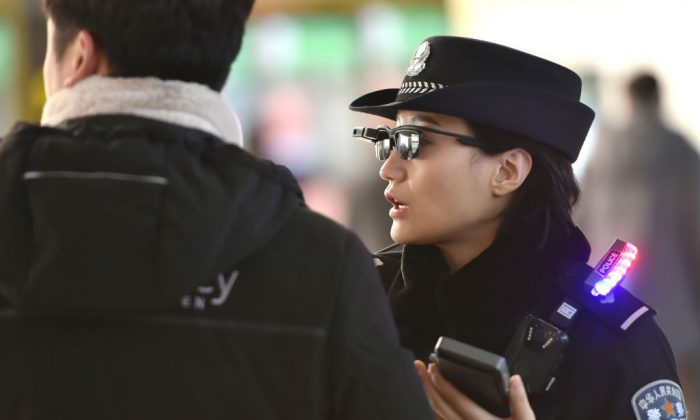
Millions of Chinese Cannot Travel by Air or Train Under China’s Social Credit System

Millions of Chinese Cannot Travel by Air or Train Under China’s Social Credit System

Epoch Times
May 21, 2018 

China’s push to implement a nationwide social credit system by 2020 is on full throttle as millions have been prohibited to fly or ride on high-speed trains, according to the latest statistics by the Chinese regime.
As of the end of April, about 10 million Chinese who have defaulted on their debts have been banned from flying 11.11 million times and denied access to high-speed trains 4.25 million times, reported the Chinese regime’s mouthpiece People’s Daily on May 16, citing data from China’s National Development and Reform Commission (NDRC), a planning agency under the State Council.
The travel ban was part of the social credit system, because, according to People’s Daily, it would “reward citizens with a good credit record and punish repetitive violators.”
China first announced plans for a social credit system in 2014—where every Chinese citizen will be rated according to his online, social, financial, and legal behavior. Misdeeds, such as using fake IDs at train stations and airports, refusal to sign up for required social insurance, and failing to pay fines for illegal actions in stocks or futures trading, could result in a travel ban on using trains for 180 days and flying for a year, reported NDRC in March. The penalty went into full effect in May.
Frank Xie Tian, a business professor at the University of South Carolina–Aiken, explained that while the credit scoring system in the United States is about “ensuring the effective operation of the economy and financial system in society,” China’ social credit system is completely different.
China’s system is about ruling over people and a form of oppression, Tian said in an interview with The Epoch Times.
While the Chinese regime says its system is about “purifying” society and rewarding people who are trustworthy, it could, in fact, be used to target andsilence dissidents and other groups in China.
“For example, I know people who have become petitioners seeking redress for their grievances. They were included into a list of people with bad credit,” said Qin Weiping, an economic scholar and former reporter in China, in an interview with Radio Free Asia (RFA).
Petitioning originated from ancient China, when ordinary citizens would travel to the capital and plead with imperial court officials as a last resort to seek justice. The practice still exists in modern-day China.
Today’s petitioners, however, face the risk of harassment and being thrown into black jails—extralegal facilities designed to hold and intimidate petitioners into giving up their petitions—by Chinese Communist authorities.
Qin added that dissidents in China could also be included into the list of people with low credit ratings, given the Chinese regime’s history of using surveillance and other advanced technology to monitor and suppress dissidents.
Mr. Bao, a petitioner from northern China’s Hubei Province, recalled his experience with the travel ban in an interview with New York-based broadcaster NTD.
“Two days ago, I went to Wuhan [the capital of Hubei] and I tried to buy a train ticket. I got a call immediately, telling me I couldn’t board,” said Bao. “This system is about controlling people, where people become so transparent that they don’t have any privacy.”
Li Shanjian, a U.S.-based independent political commentator, warned of the dangers of the social credit system.
“With the Chinese regime, there is no check on the system,” Li told The Epoch Times.

Huge Sinkhole Swallows Cars on Chinese Building Site

Huge Sinkhole Swallows Cars on Chinese Building Site

By Reuters
May 23, 2018

A sinkhole at a construction site swallowed three vehicles in Hangzhou, east China.
The incident happened at 4:10 a.m. on May 19. There were no reports of casualties.
Work on upgrading the drainage pipes had been taking place on the site.
Heavy rainfall occurred just before the road collapsed.

Chinese Doctor Becomes Mentally Unstable After Police Interrogation for 12 Hours

Chinese Doctor Becomes Mentally Unstable After Police Interrogation for 12 Hours

Doctor exposed harmful side effects of Chinese medicinal liquor and was already detained for months
Epoch Times
May 21, 2018 

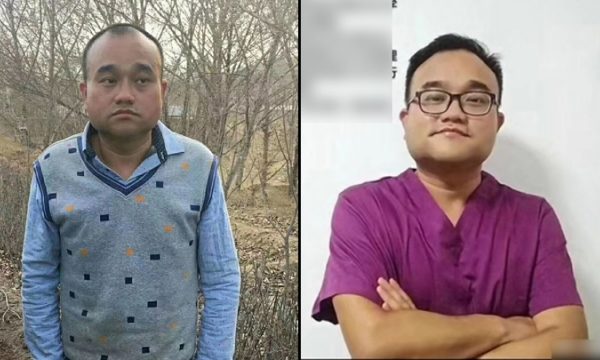
When a Chinese doctor posted an online article warning people against the side effects of a brand of Chinese medicinal liquor, police were instructed to arrest him. News recently emerged that the doctor has become mentally unstable after being detained by authorities in Inner Mongolia for three months.
Tan Qindong, 39, a doctor from Guangzhou City, Guangdong Province, posted an article on Dec. 19, 2017, explaining that “Hongmao Medicinal Liquor”—which is advertised as a cure-all tonic—has an adverse effect on the elderly, who could experience side effects such as changes in heart muscles, vascular aging, and atherosclerosis. He called it “poison” and warned against elderly people taking it.
Tan graduated from Central South University in Changsha City, Hunan Province in 2010, with a master’s degree in anesthesiology. He has a doctor’s qualification certificate and a clinical certificate. He was an anesthesiologist at the Third Affiliated Hospital of Southern Medical University in Guangzhou, and started a pharmaceutical technology company in 2015, according to a report by NTD, The Epoch Times’ sister media.
Hongmao Medicinal Liquor is produced by Inner Mongolia Hongmao Co., located in Hongmao Town, Inner Mongolia in northern China.
Police in Inner Mongolia charged Tan with “damaging the reputation of a commodity,” and arrested him. He was detained at a facility in Inner Mongolia for three months, and released on April 17 to await his court trial.
Less than a month after Tan returned to his hometown, on May 11, he was summoned by Inner Mongolia police. They arrived at his home and interrogated him for 12 hours. He became mentally unstable upon returning home, according to a May 14 online post by his wife, Liu Xuan, on Sina Weibo, the Chinese equivalent of Twitter.
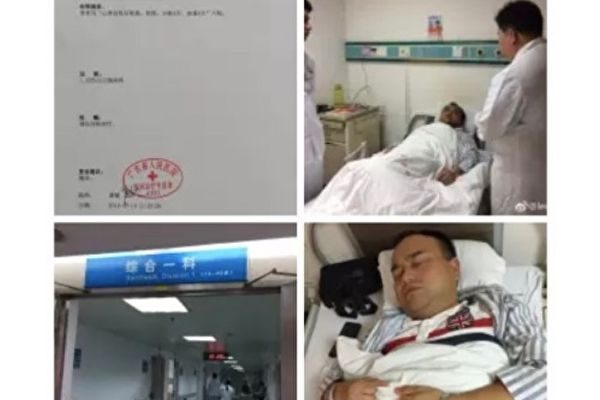
Doctor Tan is diagnosed with post-traumatic stress disorder (PTSD) and hospitalized in the mental health unit of Guangdong Provincial People’s Hospital. (Screenshot from the Weibo of Tan’s wife Liu Xuan)
His wife wrote that beginning at midnight after Tan returned from speaking with Inner Mongolia police, Tan locked himself in his room and was emotionally out of control. He started to cry, talk to himself, slap his own face, and bang his head against the wall. His family sent him to the hospital. He was diagnosed with post-traumatic stress disorder (PTSD) and hospitalized in the mental health unit of Guangdong Provincial People’s Hospital. Liu’s post was soon deleted by internet censors.
Observers suspect that Tan may have been tortured while under police custody.
Mr. Zhao, a rights activist from Liaoning Province, told NTD, The Epoch Times’ sister media, in an interview on May 17 that he heard from many people who indeed have experienced side effects after drinking the Hongmao medicinal liquor.
“The Chinese police have too much power. They can arrest people unscrupulously. They can arrest people at will under any name of crimes,” Zhao said. “People in China really live in extreme fear. Now, we can’t say anything. Whoever tells the truth will be arrested.”
Mr. Zhang, a rights activist from Jiangxi Province, told NTD that he believes the Hongmao company pressured the local police to arrest and detain the doctor. “Simply put, Hongmao has a lot of money and is a big taxpayer in the local area [of Inner Mongolia],” he said. “Clearly, they used their power to trample on the law.”
Senior media commentator, Shi Feike, posted an online article on May 15, noting the lack of rule of law in Tan’s case. He was detained without bail; criminal proceedings have turned into a form of punishment and social control.

Leaked Document Reveals Informant Culture on China’s Campuses

Leaked Document Reveals Informant Culture on China’s Campuses

By Annie Wu, Epoch Times
May 22, 2018 

A leaked document circulating on the Chinese internet recently demonstrates how the Chinese Communist Party stifles dissent in academia and encourages Chinese citizens to inform on each other.
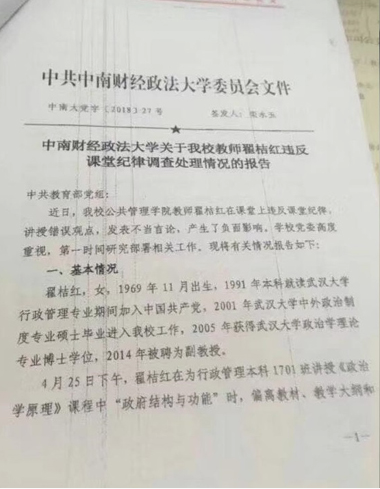
The document, a letter addressed from the Party organization of the Zhongnan University of Economics and Law located in Wuhan City, Hubei Province, to China’s Ministry of Education, described an incident involving a faculty member.
According to the document, Di Jiehong, an associate professor who teaches public management at Zhongnan University, gave a lecture on April 25, whereby she expressed criticism toward China’s constitution, state-owned firms, and the National People’s Congress, China’s faux legislature that rubber-stamp-approves the Party leadership’s decisions. She also spoke about other countries’ political systems.
Di “violated classroom discipline, lectured about wrong views, expressed inappropriate opinions, and created a wrong influence,” the document stated.
It further explained that a student had questioned Di’s points, which led observers to suspect a student in the class had informed on Di.
The university’s Party  “investigation team” and “discipline commission” recommended that Di receive a demerit, be stripped of her Party membership, be transferred to another workplace, and have her teaching qualifications revoked, the document said. The decision was already approved by the school’s Party committee, and was in the midst of formal procedures to enact penalties against her.
Party organizations are set up in the workplace to ensure staff and workplace decisions toe the Party line, and it is these entities that Di had offended against.

The leaked document from Zhongnan University explaining professor Di’s transgressions. (Screenshot via RFA.org)

Di began working at the university in 2001 and became an associate professor in 2014, according to public records.
The hard-lined approach to stamping out criticism of the Communist Party was reminiscent of an internal Party order to university administrators and professors, known as the “7 Don’t Speaks,” that circulated in May 2013, whereby instructors were prohibited from discussing specific topics in class, including civil rights, freedom of the press, and civil society.
Another directive, from the Ministry of Education in October 2014, included a list of prohibitions for institutions of higher education—among them, “having words or actions that go against the Party’s path, direction, and policies.”
Speaking to Radio Free Asia (RFA), former professor at Guizhou Minzu University, Cao Zhenhua, explained that schools typically set up “informants” among students and faculty, in order to report on any activities or opinions that are critical of the Party or otherwise deemed inappropriate.
“Each class has one or two students who report on the teachers’ lessons, and report back to security agents,” Cao said.

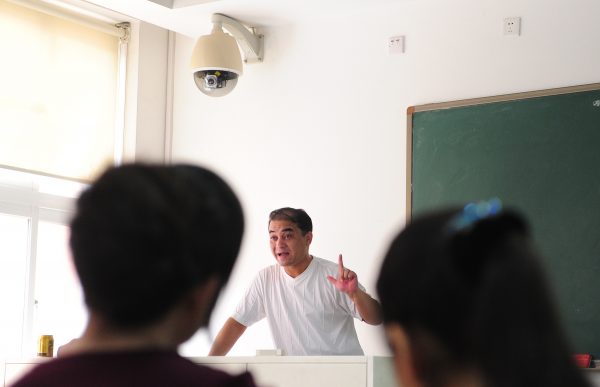
A security surveillance camera mounted above the teacher’s podium as university professor Ilham Tohti lectures in a classroom in Beijing, China on June 12, 2010. (Frederic J. Brown/AFP/Getty Images)

Furthermore, instructors are expected to instill and teach Communist ideology to students, and avoid any topics that conflict with it. To increase monitoring of college instructors, “many university classrooms have cameras installed,” Cao told RFA.
Tan Song, a Chinese professor, spoke about the culture of informing on teachers that is all too common in universities. “[Some students’] brains are filled with red sentiment. Once they hear words from a teacher that is different from what they were taught, they will instinctively go to report on them.”

Tuesday, May 29, 2018

White House to Impose Tariffs on $50 Billion of Chinese Goods

White House to Impose Tariffs on $50 Billion of Chinese Goods

May 29, 2018 
The United States will levy a 25 percent tariff on $50 billion of goods imported from China, the White House announced on Tuesday, May 29.
The tariff will apply to products “containing industrially significant technology.” The Trump administration has collected feedback from consumers on potential items and the final list will be announced by June 15. 
“From now on, we expect trading relationships to be fair and to be reciprocal,” President Donald Trump said in a statement.
Trump has long said that China has taken advantage of the United States with unfair trade practices, including industrial subsidies and prohibitive trade barriers. The communist regime has also engaged in rampant intellectual property theft. Trump is using trade negotiations to recoup the losses.
The announcement comes as a surprise since Treasury Secretary Steven Mnuchin said earlier this month that the imposition of tariffs would be suspended as American negotiators continued trade talks with their Chinese counterparts.
The White House initially proposed $150 billion in tariffs. The reduction to $50 billion is a sign of Trump’s standard approach to negotiations: ask for way more than you can get and settle for a better deal than most would deem possible.
The United States Trade Representative will also continue a dispute settlement with the World Trade Organization (WTO) against China. The dispute was initiated in March over Beijing’s “discriminatory technology licensing requirements,” the White House said.
The Trump administration has already won a WTO trade dispute with China in February. As a result, China terminated “unfair antidumping and countervailing duties” on poultry exports, according to the White House.
The United States is also preparing to implement investment restrictions and export controls meant to restrict access of Chinese people and companies to American technology. The list of restrictions will be announced by June 30, the White House said.
Last week Trump said he had reached a deal to let Chinese telecommunications firm ZTE stay in business. Trump has said that ZTE is part of the larger trade talks.
The United States imposed crippling sanctions on ZTE due to national security concerns. The impact of the sanctions prompted a personal plea from Chinese Premier Xi Jinping for Trump to step in.

Hackers threaten to reveal personal data of 90,000 Canadians caught in bank hack

Hackers threaten to reveal personal data of 90,000 Canadians caught in bank hack

BMO and Simplii say thieves stole information, demanded $1M ransom for safe return


Hackers have threatened to release personal information for nearly 100,000 customers of two Canadian banks unless the lenders pay a $1-million ransom for its safe return.
On Monday, Bank of Montreal and online bank Simplii Financial — owned by CIBC — revealed that they learned over the weekend that the identifying personal information of a combined 90,000 different account holders at the two banks was stolen.
The thieves said they accessed information such as names, account numbers, passwords, security questions and answers, and even social insurance numbers and account balances, by exploiting weaknesses in the two banks' security systems.
"We warned BMO and Simplii that we would share their customers informations if they don't cooperate," a Russian-based email purportedly from the thieves said Monday evening.

How they did it

The email also provided a brief explanation of how they say they hacked the accounts. The hackers claim they were able to gain partial access to accounts by using a common mathematical algorithm designed to quickly validate relatively short numeric sequences such as credit card numbers and social insurance numbers.
The hackers say they used the algorithm to get account numbers, which allowed them to pose as authentic account holders who had simply forgotten their password. They say that was apparently enough to allow them to reset the backup security questions and answers, giving them access to the account.
"They were giving too much permission to half-authenticated account which enabled us to grab all these information," the email said, adding that the bank "was not checking if a password was valid until the security question were input correctly."


CBC News
Bank hack: What’s at risk


00:00 01:26
Why financial breaches are so worrying. 1:26
The email demanded a ransom of $1 million in a cryptocurrency known as Ripple be paid for the return of the data by yesterday at midnight, otherwise the information would be released.
"These ... profile will be leaked on fraud forum and fraud community as well as the 90,000 left if we don't get the payment before May 28 2018 11:59PM," the email said.
That deadline has now passed.
CBC News reached out to both banks for confirmation as to whether any ransom had been paid. 
"Our practice is not to make payments to fraudsters," Bank of Montreal said. "We are focused on protecting and helping our customers."
For Simplii's part, the bank said "we are continuing to work with cybersecurity experts, law enforcement and others to protect our Simplii clients' data and interests."
To back up the veracity of their claims, the thieves shared identifying information about two Canadians — each a customer of each respective bank.

Image result for Hackers claim to have stolen the personal banking information of 90,000 customers at two major Canadian banks. (Mark J. Terrill/Associated Press)


'Very distressed'
CBC News contacted those two individuals, and both confirmed the veracity of the information the thieves sent out.
"I'm very distressed," one victim told CBC News when told their information had been stolen. "How could this happen? I barely slept last night, I'm so worried."
Another Simplii customer — who was not named in the hackers' email claiming responsibility — says he was told by the bank on Monday evening that he, too, is a victim of the hack.
"It's concerning," Mike McCarthy of Edmonton said. "I'm not sure in this day and age what I can do to get control of that data again."
"Some of those things you can't change about yourself so I'm sure it's going to exist out there for as long as someone wants to look for it."
McCarthy says he's heartened by the bank's response, offering free credit monitoring and some other services. But he still worries about what he calls "glaring gaps" in the banking system. 
"Who knows? Maybe I go back to showing up at the teller," he said. "I don't want to, but who knows what might happen next?"​