Monday, April 10, 2023

Canadian Politicians Sign Letter to CCP Official Pledging to Promote Beijing’s Image in Fighting COVID-19: Report
 

Canadian Politicians Sign Letter to CCP Official Pledging to Promote Beijing’s Image in Fighting COVID-19: Report


April 9, 2023
0:006:49

Senator Victor Oh and former Ontario cabinet minister Michael Chan were signatories among those who signed a 2020 letter from an Ontario-based Chinese-Canadian business association to a Chinese Communist Party (CCP) official saying the association has been promoting China’s image in fighting COVID-19 and pledges continuing support of the “great motherland.”

Oh signed as the association’s honorary president as well as a Canadian senator and “chair” of the Canada-China Legislative Association (CACN). Oh’s biography on the Senate of Canada website indicates he is the “Vice-Chair” of CACN, though his name currently is not on the members page of the association.

Chan, for his part, signed as CACN’s honorary president as well as a former minister of international trade of Ontario and an honorary citizen of Jiangsu Province.

The correspondence was in response to a letter issued by the CCP official to Jiang Rui, president of Richmond Hill-based Jiangsu Commerce Council of Canada (JCCC), as reported in April 2020 by the Chinese-language media ccmedia.news, and first reported in English by the Found in Translation newsletter on Substack. The ccmedia.news website includes copies of the two letters.

The March 27, 2020, letter by the CCP official, Lou Qinjian, former secretary of the Jiangsu provincial committee, bears the letterhead of the Jiangsu Provincial Committee of the CCP. It is addressed directly to Jiang as well as all overseas Chinese from Jiangsu in Canada. It is co-signed by another CCP official, Wu Zhenglong, then-governor of Jiangsu. Jiangsu is a province on China’s east coast, north of Shanghai.

Neither Oh nor Chan responded to requests for comment from The Epoch Times.

‘Telling China’s Story Well’

In what Jiang described as a “letter from home,” CCP official Lou’s letter expressed care and concern toward the overseas Chinese in Canada amid the COVID-19 pandemic and said they will “resolutely implement [Chinese] President Xi Jinping’s instructions and requirements, and make the utmost effort to provide help and support for the health and safety of all overseas compatriots.”

Meanwhile, the letter also urged the JCCC to take advantage of its connections as a Chinese diaspora association to promote to Canadians a positive image of Beijing’s pandemic response.

“[We] hope that you will make use of overseas Chinese as a bridge to convey confidence, actively tell well the story of the fight against the pandemic at home [in China], promote the image of the motherland as a responsible major country, and demonstrate the good citizenship of overseas Jiangsu people,” the letter said.

“Telling China’s story well” is a phrase introduced by Chinese leader Xi in 2013, encapsulating his approach of messaging on the world stage to promote the image of the communist regime.

Response Letter

The ccmedia.news article included images of the three pages of Jiang’s response letter, dated April 10, 2020, addressed only to Lou and bearing Jiang’s signature on the second page and the signatures of Oh, Chan, and over a dozen other senior JCCC members on the third page.

In the response letter, Jiang expressed gratitude for the “special letter from home,” saying that following that lead, other Jiangsu government departments have also reached out to show their care and concern, including the Jiangsu Provincial United Front Work Department (UFWD). The UFWD functions as the CCP’s “primary foreign interference tool” working to co-opt international politicians and facilitate espionage, among other activities that endanger national security, says a 2020 report by Public Safety Canada citing research by think tanks.
Epoch Times Photo
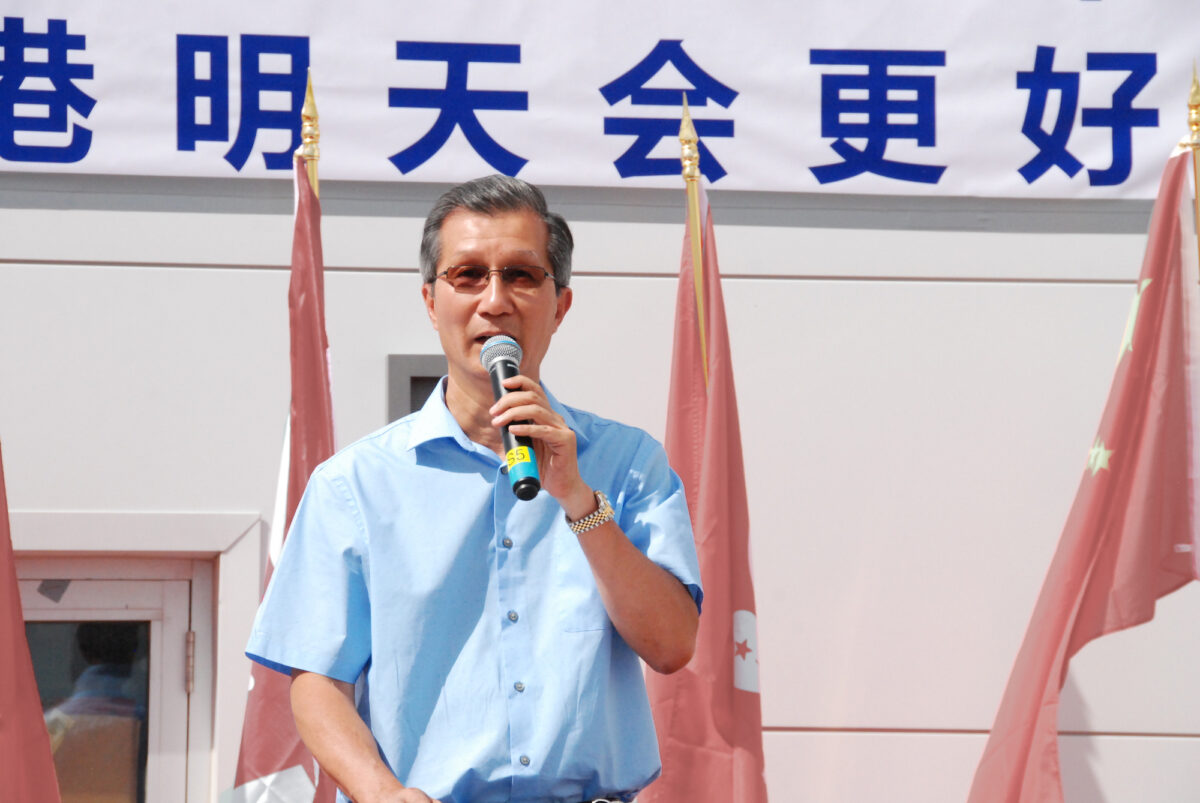
Former Ontario cabinet minister Michael Chan speaks at a rally held to condemn protests in Hong Kong, in Markham, Ont., on Aug. 11, 2019.

Jiang also said his group has been committed to the cause of promoting China’s image in Canada since early in the pandemic.

“Since the early days of China’s fight against the pandemic, we’ve made use of the special resources and channels of many JCCC members to tell the story of China’s fight against the pandemic to the Canadian government and people,” Jiang wrote.

“Through extensive and in-depth publicity, China’s demeanour [image] as a responsible, courageous, competent, and cooperative great power … is receiving more and more understanding, support, and appreciation from the Canadian government, people, and overseas Chinese!”

The ccmedia.news article included photos of Oh and Chan signing the letter.

Oh, a Conservative senator representing Ontario, was appointed to the Senate in 2013.

Chan, who was a cabinet member in the previous Liberal government in Ontario, is now deputy mayor of Markham, Ont., a city that is part of the Greater Toronto Area. At the time of the signing of the letter, he was not a public office holder.

The Ontario provincial government was reportedly warned by CSIS in 2010 about its fear that Chan was under the influence of China, according to the Globe and Mail. Chan has said he is taking legal action against the Globe for its reporting.

As reported previously by The Epoch Times, Chan has spoken against anti-Beijing protests in Hong Kong, and supported the regime’s national security law for the region. Canada and other democratic countries have condemned the new law as suppressing freedoms.

Affiliation

The JCCC, established in 2002, says its goal is to promote trade and business collaboration between Ontario and Jiangsu. It has over 1,000 members, including elites in the business, government, and academic communities, according to its website.

Jiang Rui, who began serving as JCCC president in 2018, has also held positions in organizations associated with the CCP, according to reports in local Jiangsu media and state media in China.

Apart from being JCCC president, Jiang is also an overseas representative of the provincial-level Chinese People’s Political Consultative Conference, a political advisory body in the People’s Republic of China, and also a key body of the CCP’s UFWD, according to ourjiangsu.com, a Chinese website directly owned by the Jiangsu provincial branch of the UFWD.

The Epoch Times reached out to Jiang for comment via the JCCC but didn’t hear back.

According to a January 2021 JCCC report, Jiang was also elected vice-president of the Jiangsu branch of the China Council for the Promotion of Peaceful National Reunification (CCPPNR), a China-based organization directly supervised by officials in the Politburo, the CCP’s highest decision-making body.

The report included photos taken at a conference on the establishment of the Jiangsu CCPPNR, held on Jan. 9, 2020, in Nanjing City, Jiangsu Province. A number of senior CCP officials, including the vice governor of the province, members of the Jiangsu Provincial Committee of the CCP, and the head of the UFWD, attended the conference, according to an article posted on the Jiangsu provincial government website.

The CCPPNR has branches in many countries, including two in Canada and at least 20 in the United States. In October 2020, the U.S. State Department designated a CCPPNR branch, the Washington, D.C.-based National Association for China’s Peaceful Unification, as a foreign mission of the Chinese regime, describing it as a front organization of the UFWD.

Sunday, April 9, 2023

‘Wonderful to welcome you’: Asylum-seekers from Chinese church arrive in Dallas-Fort Worth

‘Wonderful to welcome you’: Asylum-seekers from

Chinese church arrive in Dallas-Fort Worth


 Apr 7, 2023

About 63 members of the Shenzhen Holy Reformed Church plan to resettle in Tyler, according to two Texas aid organizations

A group of asylum-seekers from an overseas Chinese Christian church, including dozens of children, arrived at DFW International Airport on Friday night with plans to resettle in Tyler, according to two Texas aid organizations.

At Terminal E, about three dozen Texas church members greeted the Chinese group. They carried red, white and blue pinwheels and flags, as well as signs that read “Welcome Christians” and “Welcome Friends” and “Jesus Christ is risen indeed.” A few carried signs with Chinese lettering.

“Welcome to Texas,” they shouted as the Chinese families filed into a conference room. Children carrying pink, purple and green balloons looked sleepy but smiled at the strangers. The group will spend the night in a Dallas hotel before leaving for Tyler in the morning.

A group of asylum-seekers from an overseas Chinese Christian church, including dozens of children, are welcomed after arriving in the U.S. at DFW International Airport on Friday, April 7, 2023. They plan to resettle in Tyler, according to two Texas aid organizations.

About 63 members of the Shenzhen Holy Reformed Church, who were detained in Thailand last week for visa violations, have been seeking to live outside of China for the past three years.

At the airport, Julie Hu of the Wichita Falls Bible Reform Church and an immigrant from China, chatted in Mandarin with the newcomers. “The church of Jesus Christ always wins,” she said.

The children broke into a religious song in Mandarin about joy. A State Department official traveled with part of the group and addressed them with simple, powerful words. “It is wonderful to welcome you,” said Rashad Hussain, U.S. ambassador at large with the Office of International Religious Freedom.

Deana Brown, the director of Freedom Seekers International in Tyler, confirmed Friday that she was accompanying the group as the church members moved through immigration procedures at an unspecified location. Because of security issues, she said she could not provide more details.

Launched in 2007, the nonprofit seeks to “rescue ‘last resort’ and the most severely persecuted Christians in hostile and restrictive countries. Through methods of resettlement, we save their voices, allowing the Gospel to continue through their lives,” according to the group’s website.

The State Department said Friday in a statement: “Due to privacy and security considerations, we do not have anything to share.”

Religious freedom

ChinaAid, a faith-based nonprofit in Midland, has also assisted the congregants and praised the effort to bring the group to the U.S.

“We’re so excited for them to be in the U.S. to practice their religious freedom, to practice what they believe peacefully,” said Jonathan Dingler, the communications director for ChinaAid. “And we know that these Christians are going to fit into our society … They’re excited to do ministry here in America and excited to contribute to our culture and society as a whole.”


Dingler said there are three babies in the group, as well as a pregnant woman.

Human rights advocates say the Shenzhen church is one of the first known to flee China as a large group.

The church, founded in 2012, is considered illegal by Chinese officials, The Wall Street Journal reported. Its members say they have faced government harassment. In late 2019 and early 2020, many church members left China, relocating to the South Korean island of Jeju.

Dingler said he was part of a group that helped the church members leave South Korea and enter Thailand last year.

In late March, Thai authorities arrested the church members — 28 adults and 35 children — for visa overstays in a coastal Thai city, according to Human Rights Watch, a nongovernmental organization. They could not get their visas renewed because Thailand’s immigration regulations require Chinese nationals to report to the Chinese Embassy first, the group said.

Tyler resident Roger Conaway (left) embraces an asylum-seeker from an overseas Chinese Christian church, including dozens of children, as his wife Phyllis Conaway (right) speaks with those who arrived in the U.S. Friday with plans to pass through Dallas-Fort Worth via DFW International Airport on Friday, April 7, 2023. They plan to resettle in Tyler, according to two Texas aid organizations.

Last week, Human Rights Watch issued a statement urging that the 63 church members not be deported from Thailand back to China. They would face persecution, torture and other serious harm, the advocacy group said.

“In China under President Xi Jinping, leaders and members of ‘house churches’ that refuse to join official churches increasingly face harassment, arbitrary arrests and imprisonment,” said Elaine Pearson, Asia director at Human Rights Watch, in the statement.

Dingler of ChinaAid agreed: Had they been returned to China, they would have faced “certain retaliation, abuse and prison time.” He added that Rep. Nathaniel Moran, an East Texas Republican, and Rep. Nancy Pelosi, a California Democrat, and other members of Congress worked with State Department officials to negotiate the release of the church members.

High win rates

It is unclear whether the group entered the U.S. with humanitarian parole or if they have attorneys to assist with asylum requests. But one thing is clear: Chinese have very high win rates in federal immigration courts.


The success rate “is just tremendous,” said Austin Kocher, a research assistant professor at Transactional Records Access Clearinghouse, a Syracuse University nonprofit. “We just don’t see anything else like it in the data.”

For this fiscal year, Chinese asylum-seekers were denied only 16% of the time, compared to an overall rate of 50%, Kocher said. The U.S. government looks favorably on those fleeing Communist countries, he said.

Over a 23-year period for completed cases, Chinese asylum-seekers won their cases nearly 70% of the time. During that same period, asylum-seekers from any country won about 41% of the time.

Members of the Shenzhen Holy Reformed Church, also known as the Mayflower Church, leave from the Nongprue police station on their way to Pattaya Provincial Court in Pattaya, Thailand, Friday, March 31, 2023. More than 60 members of a Chinese Christian church have been detained in Thailand, supporters said Friday, raising fears they may be returned to their home country, where they face possible persecution. 


Howard Levitt: On the China file, Johnston fails the test of Caesar's wife — and he must know it


Howard Levitt: On the China file, Johnston fails the test of Caesar's wife — and he must know it


An executive would never be permitted to be in such a position


Potential leaders of influential B.C. groups undergo Chinese ‘political review,’ recording reveals


China’s consulate in Vancouver conducts political screening on the potential leadership at influential community organizations that promote candidates for Canadian political office, according to a recording obtained by The Globe and Mail of remarks by a former executive of one of those groups.

Based in Richmond, B.C., the Canadian Community Service Association, or CCSA, regularly attracts Canadian political leaders and Chinese diplomats to its events, calling itself “the Chinese community’s spiritual home,” and a hub for trade and cultural exchange between the two countries.

The Canadian Alliance of Chinese Associations (CACA), meanwhile, is made up of 130 groups, and similarly dedicates itself to “encouraging mutual communications and interactions.”

Neither organization discloses formal ties with the Chinese government. The CCSA describes itself as a non-government organization that is apolitical.

But there are requirements for the associations’ leadership, and the Chinese consulate plays a role, according to comments made by Wang Yan in a recorded conversation in 2020. Ms. Wang previously served as the CCSA’s executive president, but resigned several years ago. She had been asked to consider a leadership role in CACA, she said in the recording.

“If you want to be the chairperson, you must not be a person with a Red Notice, or a supporter of Falun Gong, or Taiwan and Hong Kong independence,” she said. People who match that description “can never sit in the chairperson’s chair,” she said.

And, she said in the recording of a conversation that was made in 2020, “if we want to reach the chairman level, we must go through a political review.”

“We have to provide things to the Chinese consulate – everything must go through this political review process,” said Ms. Wang, who resigned from the CCSA several years ago.

A Red Notice is an Interpol tool that functions somewhat like an international arrest warrant, and has been frequently deployed by the Chinese government to seek the extradition of people it considers fugitives.

Beijing considers calls for independence in Hong Kong and Taiwan – the latter a self-ruling democracy – to be threats to its sovereignty.

The Globe is not identifying the person who made the recording, who risks professional retribution for its disclosure.

Canadian cities are home to hundreds of Chinese societies, some organized by place of origin in China, others for humanitarian and other goals. The Globe has no evidence of direct links between Chinese diplomats and that broader array of associations.

The Globe played back Ms. Wang’s recorded comments to her. In response, she said she does not now understand the process for selecting leadership.

Before coming to Canada, Ms. Wang worked in shipping and real estate development in China, she said on the recording. She also spent time with the Central Commission for Discipline Inspection, the feared internal graft-busting arm of the Chinese Communist Party, she said.

In the interview, she said she is now working in the diamond business in Canada and has no interest in politics.

But both Chinese associations have openly advocated for individual candidates.

In 2018, the CCSA formed “election assistance teams” to support Peter Liu for Richmond city council and Jason Zhen Ning Li for the city’s school board; the association published on its website an image of a ballot with both men’s names circled. A document on the CCSA website lists 20 election team captains.


Neither candidate won, but Mr. Liu was among the candidates also recommended by the Canada Wenzhou Friendship Society, which was briefly investigated by police after offering a $20 transportation subsidy to those who voted. The RCMP later said it had found no evidence of criminal wrongdoing.

The CACA, meanwhile, says part of its primary mission is to organize and mobilize the participation of ethnically Chinese people in politics.

In the 2017 provincial election, the association’s chairman met with several Chinese candidates and promised to “mobilize volunteers and other organizations … to actively help solve some real difficulties.”

The association has supported Richmond Liberal candidate Steven Kou, Vancouver city council candidate Steven Low and Karen Wang. Ms. Wang was a Burnaby Liberal candidate who pulled out of a 2019 by-election after a message on WeChat in which she called herself “the only Chinese candidate in the riding,” while describing opponent and NDP Leader Jagmeet Singh as being “of Indian descent.”

The Chinese embassy did not respond to questions. Neither did the two associations.

Any Chinese political screening of CCSA leadership amounts to “a direct relationship” between the association and China, said Margaret McCuaig-Johnston, a senior fellow with the Graduate School of Public and International Affairs at the University of Ottawa.


“I would see it as a direct impact on our democracy by the Chinese government,” she said.

Formed in 2002, the CCSA said at a 20th anniversary celebration last year that its membership now exceeds 30,000 people, with 260 corporate members.

It organizes Lunar New Year galas, a cultural-heritage festival and a water-splashing festival. Its events are often attended by local politicians and Chinese diplomats – including former consul-general Tong Xiaoling, who was described in a 2022 Canadian intelligence document as seeking to mobilize voters in favour of a specific candidate in last year’s Vancouver mayoral election. That candidate was not named.

Among those who attended the 20th anniversary event were George Chow, a former Vancouver city councillor who is now a provincial MLA, and Han Dong, the Toronto-area MP who left the Liberal caucus in late March pledging to fight allegations about the contents of his February, 2021 conversation with Han Tao, China’s consul general in Toronto.

There can be practical reasons for groups to maintain close relationships with Chinese diplomats, especially among people who may need to arrange travel visas, seek business opportunities or gain access to certain conferences, noted Jia Wang, interim director of the China Institute at the University of Alberta.

Organizations whose members tend to be more recent immigrants, or from mainland China, “tend to have more of an alignment with the perspectives of the Chinese authorities – and some of it is also genuine,” she said. “They just may see things differently.”

Still, political screening for leaders suggests the Chinese consulate is acting like a board of directors for certain groups, said Cheuk Kwan, co-chair of the Toronto Association for Democracy in China.

“This is direct evidence of China’s interference,” he said.

It raises particular questions for Canadian politicians who attend events hosted by those organizations, said Kenny Chiu, a former Conservative MP who believes he was targeted by a Chinese interference campaign in the past election.

“Elected officials must realize who these people are,” he said.