Saturday, April 8, 2023

Plead not guilty: Gong Xiaohua paid a lot of money to hire a lawyer to deny all the allegations

Justin Trudeau poses at an event with donor and convicted money-launderer Edward Xia Hua Gong (龚晓华) - the man who paid $63 million in the largest settlement ever made under the New Zealand Criminal Proceeds Act.


Plead not guilty: Gong Xiaohua paid a lot of money to hire a lawyer to deny all the allegations


Gong Xiaohua was arrested on December 28, 2017 after being accused of fraud by the Ontario Securities Regulatory Commission and related charges, and was released on bail on the morning of the 29th. The next court appearance time is January 31, 2018. According to the Globe and Mail, Gong Xiaohua has hired two well-known lawyers in Toronto to defend him. These two lawyers are good at handling criminal cases and commercial fraud cases. The lawyer said that the Ontario Securities Regulatory Commission judged and brought charges based on the information provided by the Chinese government, which was influenced by the Chinese government. So far, Gong Xiaohua has not been questioned by the Securities Regulatory Commission. Therefore, they will all deny the relevant allegations made by the Ontario Securities Regulatory Commission and the Mounted Police, and plead not guilty to the death.
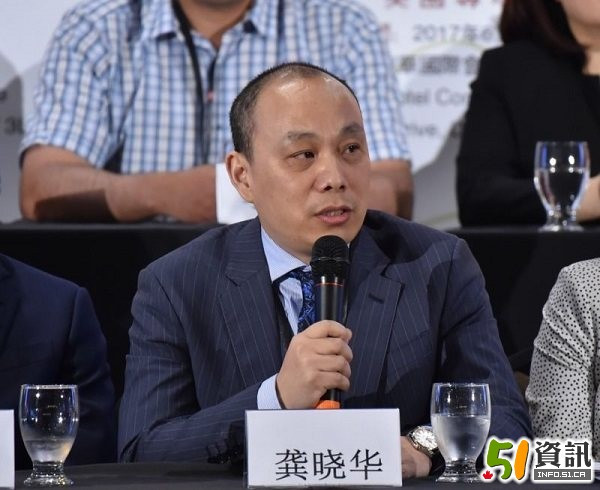
According to reports, the Ontario Securities Regulatory Commission charged Gong Xiaohua on December 21, 2017 with fraud, possession of property obtained by crime, money laundering of proceeds of crime and forgery of documents.

The allegations implicate companies including O24 Pharma PLC, run by Gong Xiaohua, and Canadian National TV Inc., which are accused of defrauding Chinese nationals of hundreds of millions of dollars in sales and At the same time, he planned securities sales in the Greater Toronto Area. In the end, most of the funds obtained from the scam were transferred to Gong Xiaohua's personal bank account in Canada. Relevant personnel said that if the above charges are convicted, Gong Xiaohua may be sentenced to a maximum of 14 years in prison.
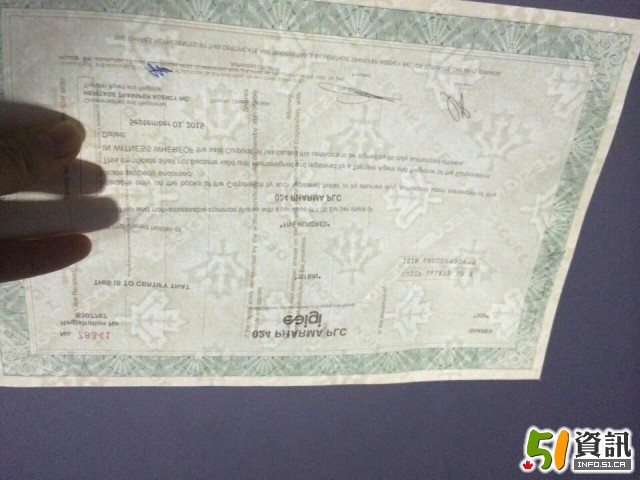
O24 anti-counterfeit stocks issued by "A Peng"

The editors of 51.com found that the website of the Canadian National Television Station could no longer be opened, but the website of the Million Manor Manor, which was introduced by "A Peng" "Chairman of the Canadian Edward Group Corporation Gong Xiaohua's Family History", was still open. According to the article, Gong Xiaohua, the chairman of the Canadian Edward Group Corporation, is a native of Nanjing, China. He immigrated to Canada in 2002 to start a business, and began to buy a small pharmaceutical factory. He happened to encounter SARS in the world in 2003. The company developed a SARS vaccine. With the first pot of gold, the company bought the British O24 pharmaceutical company with this pot of gold, and began to reorganize its funds. In 2013, the company spent 60 million US dollars to buy out the Canadian National Chinese Television, and issued 200 million additional shares, of which 100 million shares were given to the TV station, which sold out in just three and a half months, and the other 100 million shares were sold in the Chinese market. Due to everyone's ignorance and disbelief, the Chinese market sold for more than a year. The company sells in the form of global network shareholding, that is, spend 5,000 yuan to buy the company's pharmaceutical products and give a single 500 shares of stock as a gift.

The article predicts that according to the analysis of old shareholders who have followed the company for a year, the stock price of the first branch will be three orders worth 1 million yuan, that is to say, the return on investment of 15,000 yuan can reach 1 million yuan. The second media stock is listed on NASDAQ in the United States. It is expected that the stock price will be traded more than three times higher than the first one, that is, more than 3 million yuan. If you miss the opportunity, you will regret it for several lifetimes. I hope the lucky ones will take good care of it.
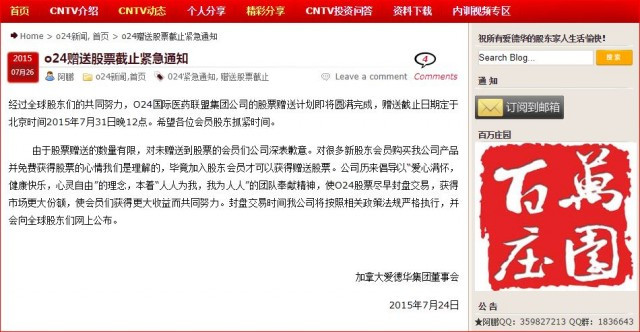
A Peng introduced another article in "Million Manor" " If you don't believe in O24 , then what else can you believe in?" He said that if you don't believe in the O24 project, then I advise you that all Internet investment projects in the future You don't want to participate.

The introduction of all aspects of O24 is so comprehensive, specific and detailed. Gong Xiaohua is such a well-known figure, the World Economic and Trade Personality Award; the winner of the Fifth Canadian Chinese Entrepreneur Award; the Vice Premier of the State Council Wang Yang invited to visit Europe to participate in the World Economic and Trade Forum; The president of China Construction Bank signed a number of strategic agreements; Canadian Prime Minister Harper met and talked in person; Queen Elizabeth II awarded him the Honorary Diamond Jubilee Medal in recognition of his outstanding contributions; Featured on the cover of "China Foreign Trade" magazine; member of the Chinese Direct Selling Legislative Committee; served as the director of Canadian Chinese TV Station, and held two large-scale overseas Spring Festival Gala programs in 2014 and 2015; on May 16th, he spent a lot of money to create a queen of Asian Chinese music that has dominated the Asian Chinese music scene for decades Superstar Na Ying's concert in Toronto has attracted much attention and so on.
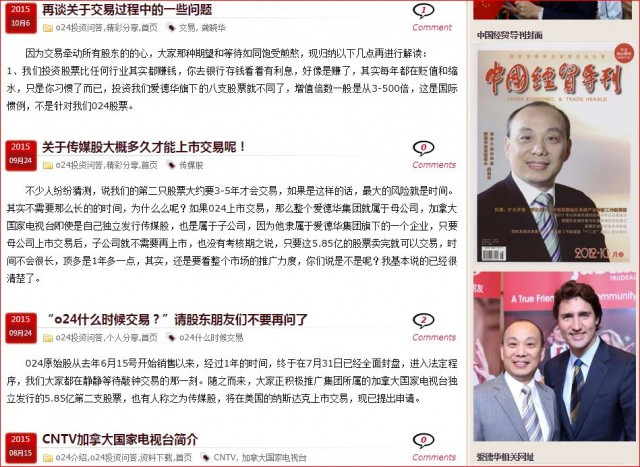
If you don't believe in counting so many honors and achievements, then I really don't know what else you will believe in? After investigations and inspections, the delay in making a move is incomprehensible. Don't always try to seize the last chance to make a move, asking this and that all day long, how many orders are left? What is the number now? By then it will be too late and there is no chance for you. When you understand everything clearly, the day lily is cold, and the market has already opened for trading. Do you think the wealth will still belong to you? At that time, everyone is counting the money in great surprise, and you can only hold the quilt and shed tears in pain, silently in deep regret.

A Peng also reposted "The Shareholder's Real Experience in Canada", introducing a shareholder's feelings in Canada. The article said that my wife was very happy to hear that I was going to Toronto, Canada, because she bought O24 stock behind my back, and Edward Company is in Toronto. She asked me to check it out for her. I really want to see where our family's money has gone. With this mission, I have to go to the company to see.
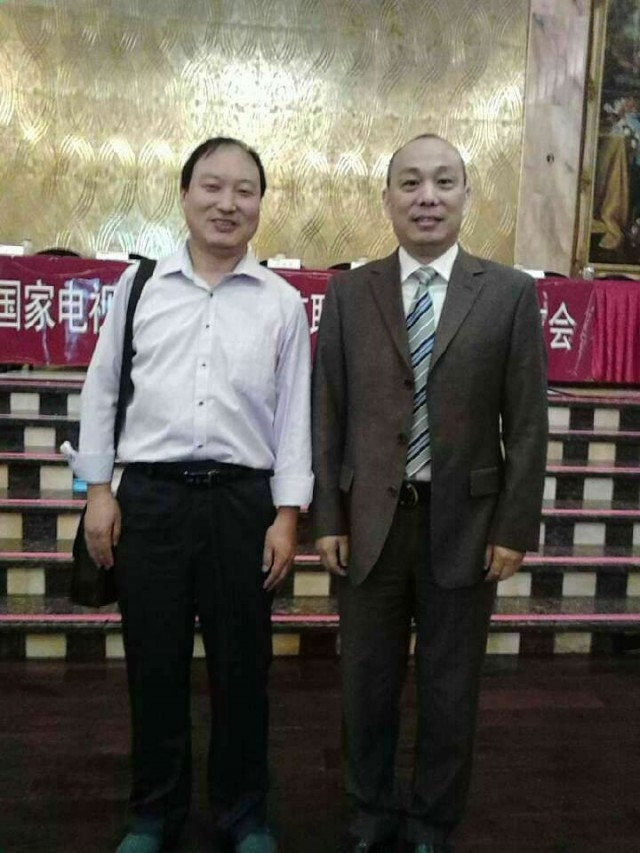
Chinese stockholders took a group photo with Gong Xiaohua

To be honest, before I came here, I thought I had encountered some kind of liar again, but when I saw it with my own eyes, I thought I was still a character, but standing in front of others now pales in comparison. They are all Chinese, why is there such a big difference? The biggest influence the chairman gave me is "free and easy"! Facing such a large group company, which is also a medical alliance, a real estate company, an energy company, a mining industry, an art academy, a TV station, etc., it is amazing that he can behave so freely!

I suddenly remembered my stock, and I asked him to see if it was real, and he said it was real. It seems that the boss is real, the company is real, and the stock is real.

According to the website introduction, the deadline for the stock gift of O24 International Pharmaceutical Alliance Group Company is set at 12:00 pm on July 31, 2015, Beijing time. After that, investors will wait for the stock to go public, but as of today, investors are still waiting quietly.

.............................. This is one of the dudes seen at Justin Trudeau's dumpling-rolling party/Liberal fundraiser at the Vancouver home of Pan Miaofei: "Chinese-Canadian businessman Xiao Hua Gong cuts record-breaking $70m deal with NZ police over frozen assets".

Gong, far left
SO WHAT WAS DISCUSSED at this 2016 fundraiser?? Why, host Pan asked Trudeau to make it easier for Chinese developers to buy land in Canada. He also told Trudeau rich immigrant investors from China should be treated better

A wealthy Vancouver businessman used a cash-for-access fundraiser at his home to lobby Prime Minister Justin Trudeau directly to allow Chinese investment in seniors' care, relax immigration restrictions on financiers and make it easier for foreign real estate developers to plow money into Canada.

The Nov. 7 fundraiser hosted by Miaofei Pan, where talk of investment by Chinese companies in seniors' care took place, came as the Trudeau government is reviewing a bid by China's Anbang Insurance Group to buy one of B.C.'s biggest retirement-home chains.

Anbang is a massive Chinese insurance firm with a murky ownership structure that is seeking a majority stake in Vancouver-based Retirement Concepts, believed to be worth more than $1-billion. It would give the company, which has been on a global buying spree, a significant role in the delivery of taxpayer-funded health care in British Columbia.

Globe editorial: Justin Trudeau didn't invent cash-for-access, but he can end it

Related: Influential Chinese-Canadians paying to attend private fundraisers with Trudeau

Related: Trudeau defends fundraiser as effort to attract Chinese investment

The Liberal Party has repeatedly told The Globe and Mail "individuals wishing to discuss government business at party events are immediately redirected to instead make an appointment with the appropriate office."

Mr. Pan told The Globe in an interview that Mr. Trudeau was "approachable and friendly" when he raised the issues, including Chinese companies' keen interest to invest in Canadian health care for seniors.

At the $1,500 fundraiser, more than 80 guests dined and had their photographs taken with Mr. Trudeau. The event is one of several Liberal Party fundraising events aimed at wealthy Chinese-Canadians. Attendance figures suggest the party collects $50,000 to $120,000 per event.

"First of all, we said that in Canada, the government investment for elderly care is not enough," Mr. Pan said. "We need to receive the investments from Chinese entrepreneurs to provide for the elderly. The Prime Minister was very happy when he heard that."

Mr. Pan did not mention a specific deal or company, but his entreaties came as Ottawa is reviewing Anbang's bid to make precisely the kind of investment he said he discussed with the Prime Minister.

Retirement Concepts owns and operates about 24 retirement communities, mostly in B.C., except for several properties in Calgary and Montreal. It owns unused or partly developed land that would allow major expansions of facilities.

The company is an important part of B.C.'s health-care delivery system. Retirement Concepts is the highest-billing provider of assisted living and residential care services in the province. The B.C. government paid the company $86.5-million in the 2015-16 fiscal year, more than any other of the 130 similar providers.

An investigation by The New York Times earlier this year revealed that 92 per cent of Anbang is currently held by firms either fully or partly owned by relatives of Anbang's chairman, Wu Xiaohui or his wife, Zhuo Ran, the granddaughter of former Chinese leader Deng Xiaoping, or Chen Xiaolu, the son of a famous People's Liberation Army leader.

New Democratic Party MP Nathan Cullen said it was completely inappropriate for Mr. Trudeau to discuss the kind of investment issues that Mr. Pan said he raised with him at the Liberal Party fundraiser. Mr. Trudeau's Open and Accountable Government rules state that "there should be no preferential access to government, or appearance of preferential access" in exchange for political donations.

"That's a prime minister selling himself out very cheap," Mr. Cullen said. "It is directly against the explicit orders that the Prime Minister himself wrote. It is selling off access to the Prime Minister of Canada to Chinese investors."

In a meeting with the Toronto Star's editorial board on Friday, Mr. Trudeau argued that critics of the Liberal Party's special-access fundraisers are jaded and off base.

"The fact is $1,500 a year is … you have to be pretty cynical to imagine that a government could be bought off for that amount of money," Mr. Trudeau said. He told The Star he will look at Ontario Liberal government reforms that forbid the premier, cabinet ministers and MPPs from attending fundraising events.

Mr. Pan said he also urged the Prime Minister to make it easier for Chinese real estate developers to buy land in Canada. He mentioned Sunshine 100 China Holdings Ltd. and Evergrande Group, major property developers in China.

"They both have the willingness to invest here," Mr. Pan said. "Some of their deputies have immigrated to Canada. But for a long time, they have not found good projects to invest in. I was thinking [Canada needs policies] that can attract investments and help expand investments."

Over a banquet of fish cakes and Wenzhou soup, Mr. Pan said, he also complained to Mr. Trudeau about how Ottawa treats immigrant investors from China.

"I told the Prime Minister that these people are not thieves, neither are they lawbreakers. If they cannot stay long enough [to meet the requirements], then just don't give them a Canada permanent-resident card," he said. "But don't treat them as bad guys and expel them. I think it's not very proper to do so."

Canadian rules regarding permanent residency impose restrictions on arrivals from countries such as China. To retain permanent-resident status, a person must have been physically present in Canada for two of the previous five years. Those who fail this test can lose their permanent residency.

"Once they start to spend time in Canada … it's easier to enforce the obligation to file a Canadian income-tax return," immigration lawyer Richard Kurland said. "But if it's less days in Canada, it's more difficult for [the] CRA to enforce its residency provision."

The problem for wealthy permanent residents is that Canadian tax returns require them to declare their global income and global property holdings and be taxed on them in Canada. Reducing the time required for permanent residents to be in Canada would reduce the likelihood of that happening.

In response to a Globe story on Friday about the Nov. 7 fundraiser, Conservative House Leader Candice Bergen told the House of Commons that Mr. Pan's "stunning admissions" make it abundantly clear government business is being discussed at Liberal cash-for-access events.

"These insiders paid $1,500 each to tell the Prime Minister precisely what it was that they needed to make more money, and you know, the Prime Minister listened to their wish list," Ms. Bergen said. "It seems the Prime Minister is being bought."

Liberal MP Kevin Lamoureux, the Government House Leader's parliamentary secretary, read from a statement saying Canada has "the strictest rules around fundraising on any level and the government respects those rules."

Since The Globe first reported on the cash-for-access events on Oct. 19, Mr. Trudeau has avoided referring to his own rules, but said the party is following election financing rules. A year ago, Mr. Trudeau said an "obligation to act is not fully discharged by simply acting within the law.... 'I was just following the rules,' isn't good enough."

Exclusive: Venue for a controversial

 2016 Trudeau fundraiser has become a

 crime scene in 2019

The $7.7 million Shaughnessy mansion that hosted Justin Trudeau for a private Liberal Party fundraiser in 2016 is now the subject of a Vancouver Police Department investigation, theBreaker.news has learned.

Vancouver Fire and Rescue Services referred theBreaker.news to VPD Sgt. Aaron Roed, who said the major crimes section is now involved. An early morning fire on Sept. 21 destroyed a garage detached from the house on Churchill Street near 47th Avenue.
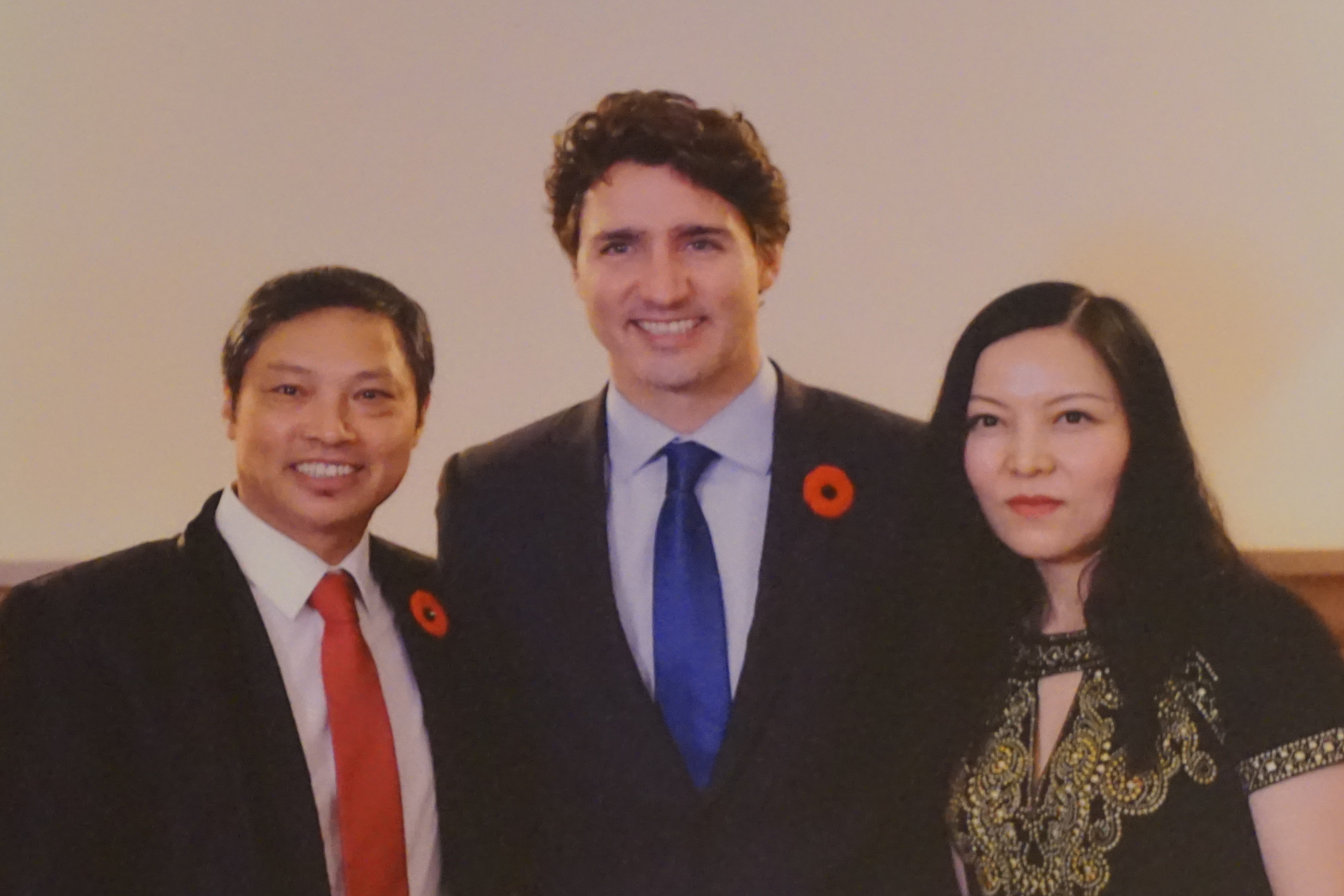
PRIME MINISTER JUSTIN TRUDEAU VISITED WITH MIAOFEI PAN (LEFT) AND WEN HUAN YANG IN NOVEMBER 2016


Owner Miaofei Pan showed a reporter surveillance footage of the fire. He also pointed to broken windows on the front of the house that he said were caused by gun shots more than an hour after the police left the fire scene. The fire, he said, cut the camera feed from the front of the house.

“We want to go back to China just for safety, but the children are studying and living here, so we have no choice, we have to accompany the children,” Pan said through a translator.

By coincidence, no cars were parked in the detached garage that night.

It was the second fire to tear through a Pan-owned property in less than two years. In October 2017, the 1911-built heritage mansion Pan owns with wife Wen Huan Yang at 3737 Angus in Shaughnessy suffered a devastating fire that was later ruled arson. Nobody has been charged.

Pan said that, before the Angus fire, he had planned to repair and renovate the heritage mansion, also known as Rounsefell House, after a tenant caused extensive water damage. He wanted to move his family from the Churchill house to Angus, because his daughters were complaining they needed more space.

“We already made the repair plan, we signed a contract with developers and construction companies. All documents have been done to repair the water damage,” he said.

MIAOFEI PAN OUTSIDE THE FIRE-DESTROYED GARAGE 

City hall filed a B.C. Supreme Court petition against Pan, alleging he did not follow an order after the fire to maintain the Angus mansion so as to prevent further weather damage and decay. The September 2018 response from Pan said the house could not be repaired because of hazards presented by the chimneys and hazardous materials inside the house. The structure is so fragile that WorkSafeBC issued a temporary stop work order that has since been lifted.

No court date has been set for the dispute with city hall. Pan has another court matter on the horizon, as he is appealing the late 2018 award of only $1 after a judge ruled he had been defamed by journalist Bing Chen Gao. In the verdict, the B.C. Supreme Court judge criticized Pan for being an uncooperative witness.

Pan is a past chair of the Beijing-aligned Canadian Alliance of Chinese Associations and was a donor to the Canada Wenzhou Friendship Society’s clubhouse near Aberdeen Centre in Richmond. Pan hails from the Zhejiang province coastal city Wenzhou, where he was in the real estate development business. The Richmond-based society gained attention during the 2018 civic elections for endorsing a slate of candidates in Richmond, Burnaby and Vancouver and offering a $20 transportation subsidy via WeChat. Richmond RCMP did not recommend vote buying charges.

Pan said the 2016 Liberal event attended by 80 people at his house was organized by the party, which had been trying to recruit his son to be a member. He said nobody made donations on-site, on the night of the event. The Liberal Party, he said, returned his $1,500 donation and paid for tea and cookies.

Pan said he was familiar with Raymond Chan, the former Richmond MP who became a party fundraiser in the Chinese community and is in one of the photographs, but said it was a woman from the Liberal Party office that called to ask if Pan’s house could be used as a venue. Pan said he was in China at the time, so he flew back to host the event. Police did come to the house for a security sweep before the event and that he spoke briefly with Trudeau, but the conversation was “very limited” due to the language barrier.

MIAOFEI PAN SAID SOMEONE SHOT A WINDOW AT HIS HOUSE MULTIPLE TIMES, HOURS AFTER A FIRE DESTROYED A DETACHED GARAGE 

According to The Tyee, Pan decided to hold the Nov. 7, 2016 fundraiser at his house after Trudeau invited him to a dinner in September of that year with China’s visiting Premier Li Keqiang. That was denied by the Liberal Party. In a Dec. 2, 2016, Globe and Mail story, Pan was quoted as saying he asked Trudeau to make it easier for rich investors from China to invest and stay in Canada.

Trudeau was in Vancouver for an earlier announcement of funding to help Department of Fisheries and Oceans deal with more South Coast oil tanker traffic.

The fundraiser was not advertised and Canadian media only found out from Wenzhou government and media websites. The ripple effects were felt across Canada.

By April of 2017, the Liberal Party buckled to pressure and announced reforms, including proactive disclosure of fundraising events and attendee lists. Elections Canada later began an online registry of major fundraising events involving party leaders and cabinet ministers. In B.C., it helped hasten campaign finance reforms after the 2017 provincial election. The Green-supported NDP government eventually adopted caps on donations and banned corporate and union financing of provincial and municipal elections.

Pan said he met Trudeau again in Ottawa and jokingly told him that he would invite him to the other mansion, after it is repaired.

Pan said he believes Trudeau will win re-election on Oct. 21, but not with as many votes as in 2015. He considers Trudeau a “good guy and with enough capability to be a prime minister in Canada. Of course [Stephen] Harper was also a good guy as well.”

Elections Canada shows donations by Pan of $1,478.96 and $1,420 to the Liberal Party on Nov. 24, 2016 and $1,100 to the Abbotsford Conservative Association in September 2011. He also gave $1,000 and $1,450 to MP Jenny Kwan’s Vancouver East NDP association in 2016 and 2018.

His wife, Wen, donated $1,478.96 and $1,420 on the same November day in 2016 to the Liberals. Last December, she gave $1,550 to the Don Valley North Federal Liberal Association in Ontario. Han Dong is running instead of Geng Tan, the first Mainland China-born Member of Parliament when he was elected in 2015.

Friday, April 7, 2023

The man who made friends with Mao

The man who made friends with Mao

The first American to join the Chinese Communist party in the 1940s tells about his extraordinary life 

Jonathan Margolis 


JANUARY 11 2013


From the Marxes to the Milibands, it’s a well-trodden path. Few have taken this tradition quite as far, however, as Sidney Rittenberg, scion of a prominent Jewish family in Charleston, South Carolina. It was in the 1930s that Rittenberg rejected a career as a lawyer and became a trade union and civil rights activist. He then went a little further. He became a communist, learnt Chinese, went to China, joined Mao Zedong’s guerrillas fighting Chiang Kai-shek’s nationalists, emerged after the communist victory as a senior party member close to Mao, ran Radio Peking, translated Mao’s thoughts into English, became a leading rabble rouser in the Cultural Revolution – and, by the by, was imprisoned for 16 years in solitary confinement, accused of being a US spy. Then he came back to the US and made a fortune advising American companies on how to get into China. I first heard of this historical revolutionary figure in China, where he is known as Li Dunbai (it sounds a little like Rittenberg to Chinese ears). To this day, he is taught about in schools as a righteous American who helped build Chinese communism. Now 91, Rittenberg is not only alive, but living in Arizona – quite unusual for one honoured by Mao as an international communist fighter – and still running his company and teaching at a university. He is also on Facebook. The answer to an interview request came in five minutes. From his iPad. “You’re welcome,” he said. For a veteran Chinese communist revolutionary, Rittenberg’s impish sense of humour comes as a surprise. Could I bring him anything from Britain? “I have always yearned for one of those old Scottish castles,” Rittenberg replied. “It could be disassembled, modular style, brought here and reassembled. I would, of course, require a tartan to match it.” Even without the castle, Rittenberg greets me warmly on the doorstep. He looks, perhaps, 70. He was starved in Chinese jails, but never physically tortured – just mentally. Yulin Wang Rittenberg, his wife of 60 years, had it even tougher after the Cultural Revolution went bad on the couple in the late 1960s. She spent three years in a back-breaking labour camp – after being brutally beaten and made to sit in the doorway of the women’s restroom with a placard round her neck saying, “This is the unrepentant wife of a dog of an Imperialist spy.” “Yulin, it’s the British invasion!” Rittenberg says. “Remember we watched The Iron Lady? So you know what to expect.” Rittenberg has a pronounced southern accent; when he says “China” the “i” is as long and drawn out as if we were shooting the breeze on a porch back in the Deep South. He also has a warm, hospitable manner. Yet in photos from his China years – especially the one of him haranguing a crowd of adoring Red Guards in the Cultural Revolution – he looks terrifying. Lest one forget, this was one of the most vicious events in human history, a million Nazi Kristallnachts in an explosion of insanity several years long. And Sid, as people call him now, was one of its key figures – until he made the crucial error of upsetting Mme Mao, aka, Jiang Qing, the revolution’s psychopathic main leader. Then he became one of the victims. … Before we even sit down for the first of several interviews, there is the question of how to raise the trickier areas of Sid’s life. There is his complicity, albeit very indirect, in the death of perhaps 70 million people in the Cultural Revolution and the Great Famine that preceded it. I also have to slip in the name “Lord Haw-Haw”; Sid broadcast – anonymously, in English – on national propaganda station Radio Peking from time to time. Heaven knows what that accent must have sounded like to those in the west he had left behind. Sinister, you would think. Mao Zedong signs Rittenberg’s copy of the 'Little Red Book', Beijing, 1967 © Sidney Rittenberg The clearer the incongruities and paradoxes of Sidney Rittenberg’s life become, the greater the problem of describing him in anything less than a weighty book. A 2001 autobiography published in the US makes a good start, but still leaves you wanting more. A new documentary on Rittenberg, The Revolutionary, currently doing the festival and art cinema rounds, makes compelling viewing, but is only 90 minutes long. Rittenberg studied philosophy but dropped out of college aged 19 and applied to join the US Army the day after Pearl Harbor. More talented as a linguist than an infantryman, he was sent to China in 1945 as a GI interpreter. Honourably discharged after the war’s end, he stayed on and trekked 45 days on foot to Mao’s guerrilla camp at Yan’an where he became an active participant in the revolution. He was also an intimate of the leaders, spending days with Mao discussing the US, with which Mao was obsessed. But Rittenberg also spent six years in jail, from 1949 to 1955 – the first in total darkness and sensory deprivation – after Stalin wrote to Mao to warn him that his American Jew was a US spy. Eventually he was cleared and rose to be a leading party propagandist, PR man, top-level translator and liaison with foreign journalists and dignitaries, a kind of media-friendly revolutionary without portfolio. He lived in luxury and was better paid than Mao. Some might call Rittenberg a party hack. He was so keen on the Cultural Revolution that when he found he was exempt, as a foreigner, from the excoriating criticism sessions that drove many to madness or suicide, he launched a criticism campaign against himself, an apparently unique example, even in the cauldron of the time, of what might be called sado-narcissism. But it helped him become, at 45, leader of a Red Guard franchise: “The Rebel Regiment to Defend Mao Zedong Thought at the Broadcast Administration”. He was an icon across China – a jealous Jiang Qing, before she jailed him for a 10-year stretch, did say to him acidly, “You’re a little old to be a Red Guard, aren’t you?” Released when she herself was jailed following Mao’s death, Rittenberg returned to the US aged 60 and was surprisingly well received by the Carter administration – fostering a feeling in intelligence circles that he had been a CIA spy all along. He started teaching evening classes, Yulin ran cookery courses, and they founded Rittenberg Associates, which has helped businesses from Colgate-Palmolive to Warner Music to Intel, Microsoft and PwC find their way in China. So, how much of the communist is left in Sidney Rittenberg? “Nothing,” he says firmly. “I was drawn to the communist movement through the study of philosophy. And given the suffering around us in the south, it was the right response. But I was in total delusion as to what was really happening in China. After I got out of prison the second time and saw the basic tenets of Marxism-Leninism were wrong, I felt a free man. Today, my politics are … well, I think one day there will be a better system. We have to wait for capitalism to be properly cooked. We need an abundance of the basic means of living and better understanding. The point is how to make the capitalist system work.” Rittenberg addresses Red Guards during China’s Cultural Revolution, late 1960s Rittenberg has a tendency to correct perceptions of communist China, which can give the impression that there is still revolutionary fire in his belly, but it is more likely that he just knows more about his subject than anyone else. He defends Mao when he feels he was misunderstood. Mao is often accused of boasting that he “buried alive more intellectuals than the Emperor Qin Shihuangdi”, who was notorious for interring scholars alive. “He did say we buried more,” Rittenberg explains, “but he didn’t mean physically.” A feeling that Rittenberg must, surely, have been a deep-cover CIA agent still surfaces occasionally in the US. “There were actually no western agents in China in my time,” he says. “But former intelligence people are convinced to this day that I was an agent under deep cover. I get asked quite probing questions even today by retired CIA people. When I deny it, they say, ‘Wow, you’re good.’ I always considered myself a representative of the genuine American people, in the tradition of revolutionaries like Tom Paine. That’s why I always dressed as an American. I wanted to be an American friend of China, not Chinese.” So do Americans regard him as a traitor? His face takes on a bleak, haunted look, but it seems they don’t. When he turned up at the US Embassy in Beijing in 1980 saying he’d lost his American passport on the road to Yan’an in 1947 and wanted to go home, they swiftly got him a new one and welcomed him and the couple’s four children to the States. “If they think I’m a traitor, they don’t say it within my hearing. I belong to a very conservative country club here and have a seat at the top table.” Rittenberg’s prolonged, brutal treatment in China drove him close to mental collapse; did this maybe put him off both Chinese culture and the politics, just a bit? His answer has more than a little PR spin about it, a faint, albeit amiable, shadow of the skilled propagandist he was. “A revolution can’t be as civilised as inviting guests to dinner. And it wasn’t. But I don’t think the cruelty was specifically Chinese. I grew up in the south and saw police brutality in Birmingham and elsewhere. It was worse, because this was racist sadism. I think what Chinese people did had to do with growing up under the strong tradition of feudalism. I think of it like the splitting of the atom. The stronger the bonds are at the beginning, the more energy is released. But it’s important for the whole human race to know how people behave when no holds are barred, when anything is allowed and sanctioned.” When he was imprisoned, he says, he didn’t hate his false accusers. “It was like you have a sweetheart whom you’re devoted to, and you’ve been together a long time, and all of a sudden she appears with a lawyer and accuses you of rape. How can you think that of me? How could this happen?” He used prison, he says, to become an even more devoted revolutionary, reading the whole of Das Kapital in Chinese, and becoming an ever more fervent devotee of the thoughts of Mao. “They did say once, ‘If you’re a real revolutionary, you should be able to stand this test.’ And that was all I needed.” He was even offered the chance to be sent back to the US, but – without knowing that back home the McCarthy committee would have eaten him alive – decided to stay and study like a demon. He became a Mao monk. “When I was going mad, I had nightmares of Mao trying to cut me up, but consciously I was just getting into ever deeper study of his writings and deciding he was a genius.” … So how does the man on the gated estate in Arizona, who once played gin rummy with Mao and introduced him to the dictator’s much-loved Laurel and Hardy, assess Mao today? “I think China has to face the fact that Mao was a monster, one of the worst people in human history. He was a genius, but his genius got completely out of control, so he was a great historic leader, and a great historic criminal. He gave himself the right to conduct social experiments that involved upturning the lives of hundreds of millions of people, when he didn’t know what the outcome might be. And that created famines in which tens of millions died, and a revolution in which nobody knows how many died.” Mao, Rittenberg believes, began to feel guilt for his more catastrophic actions. “In 1967, I saw him sitting on the Tiananmen gate tower with a look of complete anguish on his face. I think he was upset that things weren’t going right.” But at a personal level, he says, “although he said nice things about me, I didn’t feel any warmth. He liked to meet for a lively, democratic discussion on why his policies were correct. If you disagreed, you were a counter-revolutionary. He was an enlightened, ingenious strategist, but the narrow peasant envy and prejudice were obviously there all the time.” Rittenberg with his wife Yulin Wang Rittenberg at their home in Arizona © Jonathan Margolis Rittenberg’s own part in China’s history means that he carries regrets with him into old age. “I took part in victimising innocent, good people. It was institutionalised bullying and scapegoating, and I couldn’t see it because everything about the regime was good for me and I felt I was part of a movement for human progress, freedom and happiness. I wasn’t feeling what happened to other people. It’s a kind of corruption, exactly the kind of corruption that ruins the whole thing. “I should have taken the side of the people fighting for the right to speak and have different opinions. I should have quit. Instead I continued to let these things be done in my name. I couldn’t get down off that high horse. There was too much glory and glamour. I believed I was part of history. I couldn’t let it go. That’s what you get with ideology and power. You learn to harden your heart in the name of the wonderful new world you’re building. Once you do that, you do all kinds of things. I did.” And then there’s today’s China. Does Rittenberg’s old revolutionary self despise the country’s consumerism and even the small, green shoots of a less restricted society? Or does his new, capitalist self admire it? Rittenberg has publicly, if gently, opposed the regime’s stance on Tibet, on Taiwan and the Falun Gong. “Look, the regime has lifted more people out of poverty than has ever been done before. They’ve solved food, shelter and clothing. The percentage of people living below that line is below that in America. The real challenge is adjusting to the new society in political and social terms, and I think they’re doing that. They’re not suppressing local protests. They still won’t allow dissident intellectuals to become a focal point for other intellectuals. But the reason for that is not the leaders but the police, who are like police everywhere.” Sidney Rittenberg leaves one with the impression of the world’s most dedicated and tenacious dilettante. Even after 35 years in China, nearly half of them in solitary confinement, he still makes it sound like a spectacular teenage rebellion. And he makes no attempt to deny his roots. He’s remarkably Jewish in many ways. He points out with pride that most of the western leftists who fetched up in Beijing to help the communists were also Jewish intellectuals, many from Britain. I leave him with a classic Jewish joke. It’s one about a nice Jewish American boy who goes to India and becomes a guru. After many years, his mother treks to his ashram. She is allowed to see him, but permitted to speak only six words. “Fine,” she says, then turns to the guru. “Sheldon,” she scolds, “enough is enough. Come home.” As we reach the punchline, I begin to worry that Rittenberg is so angry, he has had a heart attack. There is a wheezing sound, but it becomes clear that he is just laughing so hard, he can’t catch his breath. And slapping his knees. And shouting out, “Sheldon, enough is enough! That’s me! That’s me!”

Han Dong takes Global News to court over 'unverified' claims

Han Dong takes Global News to court over 'unverified' claims

The Han Dong saga continues after the disgruntled MP threatened legal action against Global News and its parent company after it was found the Toronto MP spoke to a Chinese diplomat about delaying the release of two Canadians.

Han Dong takes Global News to court over 'unverified' claims
Facebook/ Han Dong

"Yes, I am taking legal action against Global News and Corus Entertainment," Dong said in a statement on Monday. "I have retained a lawyer to begin legal action to its fullest extent."

The statement follows a Global News report last week citing national security sources that Dong privately advised a senior Chinese diplomat not to free Michael Kovrig and Michael Spavor in February 2021. 

Both sources said Dong suggested to Han Tao, China's consul general in Toronto, that releasing the two Michaels would benefit the Conservatives in the polls.

Despite China accusing the two Canadian citizens of espionage then, their jailing was widely considered retribution for Canada's detention of Meng Wanzhou, the Huawei executive facing extradition to the U.S.


Global News also alleged that Dong had asked Beijing for progress in the Kovrig and Spavor cases to help the ruling Liberal Party amid public pushback then.

Dong resigned from the Liberal caucus to sit as an Independent MP and contest the allegations against him after the scathing report became public on March 22.

Global News previously named Dong a "witting affiliate in China's election interference networks" on February 24. They said CSIS surveilled Dong as early as June 2019, months before his election to Parliament, and named him in an intelligence memo distributed to the Prime Minister's Office (PMO).

Intelligence services urged the PMO to rescind Dong's nomination over alleged foreign interference, which he vehemently denies. 

"I strongly reject the insinuations in media reporting that I have played a role in offshore interference in these processes and will defend myself vigorously against such inaccurate and irresponsible claims that come from an unverified and anonymous source," wrote Dong in a previous statement.

There was "no indication of any irregularities or compliance issues regarding my candidacy or election," he claimed.

The Canadian Press has yet to independently verify the allegations against Dong.

Global News Editor-in-Chief Sonia Verma defended the outlet's reporting on Monday, stating: "Global News is governed by a rigorous set of journalistic principles and practices, and we are very mindful of the public interest and legal responsibility of this important accountability reporting."

Dong did not immediately respond to questions about his lawyer's identity or whether he had filed a statement of claim in court to formally launch legal proceedings.

On Monday, Dong pushed back against allegations of having worked with Beijing by relating his father's experience under the Chinese Communist regime, including being sent to a "re-education camp" in 1970.

"The trauma left on my father is one of the compelling reasons why, as co-chair of the Canada-China Legislative Association and a member of Parliament, I took every available opportunity to advocate on behalf of Michael Kovrig and Michael Spavor and to call for their immediate release," he said.

"It is inconceivable that I would ever suggest a falsely accused individual should spend an extra minute in jail."

Dong supported a public inquiry into foreign interference in Canada and would willingly meet with former governor general David Johnston, Trudeau's friend, who Prime Minister Justin Trudeau tapped as a special rapporteur to investigate such allegations.

"I can look at myself in the mirror and know, with full certainty, that I have the truth on my side," he said. "My anonymous false accusers and their enablers cannot say the same."

Before running for an elected office, the Independent MP served as marketing director of the Canada-Shanghai Business Association and a longtime Liberal aide at the Ontario legislature. He was also a Toronto assembly member before winning a contested federal nomination in Don Valley North in 2019.


China Crisis: Protesters descend on the Toronto constituency office of Liberal MP Han Dong. Their message: this puppet of Communist China must go!

As for Trudeau’s response? Oh, he’s going to get to the bottom of things – no, not the Chinese interference. Rather, he wants to find out who the CSIS whistleblower is.

According to recent CSIS leaks to journalists, Don Valley North Liberal MP Han Dong is one of 11 beneficiaries of Chinese interference in the last two federal elections.

Indeed, according to a whistleblower with the Canadian Security Intelligence Service, the communist Mandarins in Beijing actually used operatives and loyalists to bus in seniors to vote for him. And just to make sure their weren’t any communication issues, Dong's name was written on their arms with a magic marker!

The CSIS whistleblower also told media outlets that foreign students were threatened with having their visas revoked if they did not turn up to support Dong.

In fact, the CSIS insider says the spy agency warned senior Liberals to terminate Dong's candidacy, but Justin Trudeau intervened to save him. Why? Well, let’s not forget Justin’s infamous quote back in 2013 in which he inexplicably professed admiration for China’s dictatorship. Amazing.

And Dong has proven to be a good little puppet for his Beijing puppet-masters. For example, he conveniently skipped out at the last minute on two Liberal-sponsored votes to condemn the Uyghur genocide at the hands of China. Disgraceful.

As for the 2021 election campaign, it would appear China was successful in their goals. The regime wanted Dong and certain other Liberals re-elected; they also wanted the Trudeau Liberals to maintain its minority government; and according to ex-Conservative leader Erin O’Toole, Chinese interference prevented nine Conservative MPs from being re-elected (naturally, these Conservatives had less than favourable views regarding China.)

As for Trudeau’s response? Oh, he’s going to get to the bottom of things – no, not the Chinese interference. Rather, he wants to find out who the CSIS whistleblower is. Talk about shooting the messenger as opposed to dealing with the message!

And get this: should a concerned Canadian have the audacity to criticize Dong for allegedly being a Beijing puppet, well, according to Trudeau, this is racist behaviour! Here’s what Trudeau said last week: “One of the things we’ve seen, unfortunately, over the past years is a rise in anti-Asian racism linked to the pandemic and concerns being raised or arisen around people’s loyalties.”

Talk about chutzpah! Allegations of racism being tossed about from someone who can’t remember how many times in his life he’s donned blackface...

Rebel News decided to pay a house call to Mr. Dong. Shockers! Neither Dong nor any of his staff members were at the constituency office that day.

But to ensure our message was delivered, we sent out our jumbotron-equipped truck into Dong’s riding, requesting that this MP must step down.