Tuesday, March 13, 2018

U.S. Considers Broad Curbs on Chinese Imports, Takeovers

U.S. Considers Broad Curbs

 on Chinese Imports, Takeovers


  • USTR investigating China’s intellectual-property practices
  • Gary Cohn to resign as top Trump economic adviser amid tariffs

The Trump administration is considering clamping down on Chinese investments in the U.S. and imposing tariffs on a broad range of its imports to punish Beijing for its alleged theft of intellectual property, according to people familiar with the matter.
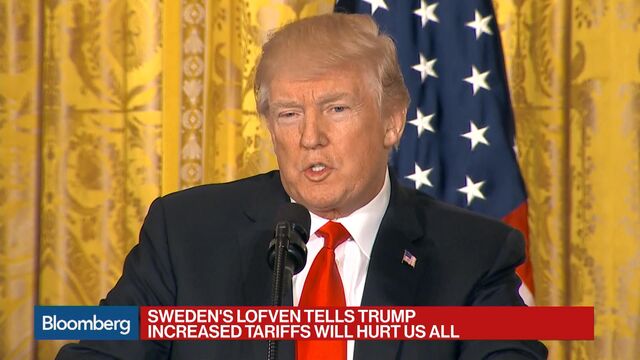
Image result for U.S. Considers Broad Curbs on Chinese Imports, Takeovers
An announcement following an investigation by the U.S. Trade Representative’s office into China’s IP practices is expected in the coming weeks, potentially handing President Donald Trump further cause to impose trade restrictions. His announcement last week of tariffs on steel and aluminum imports has already ratcheted up global trade tensions -- and led to the resignation Tuesday of his chief economic adviser Gary Cohn, who opposes such measures.
“The U.S. is acting swiftly on intellectual property theft. We cannot allow this to happen as it has for many years!” Trump said in a Twitter post on Wednesday. In an earlier tweet, he said China has been asked to develop a plan to reduce their “massive trade deficit with the United States.”
“Our relationship with China has been a very good one, and we look forward to seeing what ideas they come back with,” the president stated. “We must act soon!”

Stocks fell, and Treasuries rose on Wednesday on concern trade disruptions will hurt the global economy. Trump tweeted he’ll be making a decision on a replacement soon and that there are “many people wanting the job.”
Adding to the administration’s angst about trade fairness, the U.S. trade deficit widened more than forecast in January to a post-recession high. The gap increased 5 percent to $56.6 billion, the biggest since October 2008, from a revised $53.9 billion in the prior month, Commerce Department data showed Wednesday.
The president is now fighting trade offensives on multiple fronts, from targeting strategic rival China to angering allies like Canada and the European Union with threats to erect fresh barriers. While his counterparts have threatened retaliation, concrete action that would herald the start of an all-out trade war has yet to come.
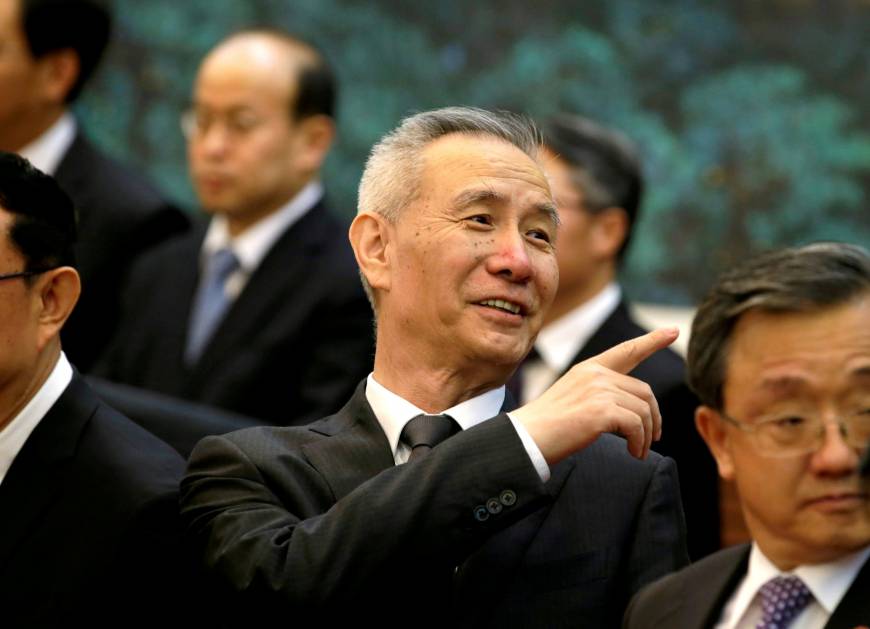
Image result for U.S. Considers Broad Curbs on Chinese Imports Liu He, President Xi Jinping’s top economic adviser

Liu He, President Xi Jinping’s top economic adviser who met with Cohn in Washington last week, told delegates at the National People’s Congress in Beijing that both sides had expressed a desire to avoid a trade war, according to the Beijing Youth Daily. Chinese officials -- who have been studying curbs on U.S. products such as soybeans according to past reports -- were otherwise largely quiet on the tariff question Wednesday.
Under the most severe scenario being weighed, the U.S. could impose tariffs on a wide range of Chinese imports, from shoes and clothing to consumer electronics, according to two people familiar with the matter who spoke on condition of anonymity because the discussions aren’t public.
The Trump administration could combine the tariffs with restrictions on Chinese investments in the U.S., which are reviewed for national-security risks by Treasury’s Committee on Foreign Investment in the U.S., the people said. The new measures being considered by the administration could go beyond even domestic security considerations.
With the probe into China, known as a Section 301 action, U.S. officials are also considering a more targeted approach that would seek to rein in Chinese investments, the people said. The administration is looking at ways to enforce reciprocity with China on foreign investment, meaning the U.S. would only allow takeovers in sectors that U.S. companies can access in China, according to the people.
Image result for Treasury Secretary Steven Mnuchin
Treasury Secretary Steven Mnuchin has urged closer vetting of foreign takeovers, and Republican lawmakers are pushing legislation aimed at curbing China’s influence.U.S. officials are still examining various options, and USTR could decide to do nothing, the people said, adding that an announcement is expected next month. A White House spokesperson declined to comment on an ongoing process, adding that no final decisions have been made. China’s Ministry of Commerce didn’t respond to a fax seeking comment on the 301 investigation.
Mnuchin, speaking before a congressional panel on Tuesday, said the administration’s objective is to achieve a “fair and balanced” trading relationship with China. America’s trade gap in goods with the Asian nation surged 8 percent last year to a record $375 billion.
Mnuchin said the U.S. isn’t trying to provoke a trade war with the steel and aluminum tariffs, an action that he backed. “The good news” is that Chinese President Xi and Trump have a “very good relationship and communicate regularly,” said Mnuchin.


Mnuchin Says 'We're Not Looking to Get Into Trade Wars'
"We’re not looking to get into trade wars," Treasury Secretary Steven Mnuchin says.
Source: Bloomberg

Wide-ranging tariffs on goods made in China may provoke a backlash from U.S. retailers such as Walmart Inc. and Target Corp. The retail industry successfully pushed back last year against a proposal by Republican leaders in Congress to apply a border tax on imports.
USTR has argued that Beijing uses a range of practices to force companies to transfer IP, and Chinese entities engage in widespread theft of U.S. trade secrets, as it seeks to become a leader in advanced manufacturing and artificial intelligence. U.S. businesses in China have long complained about being forced to hand over technology as the price of gaining access.
U.S. companies have been urging the Trump administration to negotiate with Beijing before imposing any penalties, according to industry lobbyists. Vice Foreign Minister Zhang Yesui said this week that China will host talks on trade issues with U.S. officials.
Last year, an independent commission on U.S. intellectual property estimated that the annual cost to the economy in counterfeit goods, pirated software, and theft of trade secrets from all sources exceeds $225 billion and could be as high as $600 billion.

Tuesday, March 6, 2018

China's Tiangong-1 space station will crash to Earth within weeks

China's Tiangong-1 space station will crash to Earth within weeks

Experts say it is impossible to plot where module will re-enter the atmosphere, but the chance is higher in parts of Europe, US, Australia and New Zealand
An image of the Tiangong-1 space station which is expected to come crashing to earth within weeks
 The Tiangong-1 space station, which is expected to come crashing to earth within weeks. Photograph: -
China’s first space station is expected to come crashing down to Earth within weeks, but scientists have not been able to predict where the 8.5-tonne module will hit.
The US-funded Aerospace Corporation estimates Tiangong-1 will re-enter the atmosphere during the first week of April, give or take a week. The European Space Agency says the module will come down between 24 March and 19 April.
In 2016 China admitted it had lost control of Tiangong-1 and would be unable to perform a controlled re-entry.
The statement from Aerospace said there was “a chance that a small amount of debris” from the module will survive re-entry and hit the Earth.
“If this should happen, any surviving debris would fall within a region that is a few hundred kilometres in size,” said Aerospace, a research organisation that advises government and private enterprise on space flight.
Aerospace warned that the space station might be carrying a highly toxic and corrosive fuel called hydrazine on board.
The report includes a map showing the module is expected to re-enter somewhere between 43° north and 43° south latitudes. The chances of re-entry are slightly higher in northern China, the Middle East, central Italy, northern Spain and the northern states of the US, New Zealand, Tasmania, parts of South America and southern Africa.
However, Aerospace insisted the chance of debris hitting anyone living in these nations was tiny. “When considering the worst-case location … the probability that a specific person (ie, you) will be struck by Tiangong-1 debris is about one million times smaller than the odds of winning the Powerball jackpot.
“In the history of spaceflight no known person has ever been harmed by reentering space debris. Only one person has ever been recorded as being hit by a piece of space debris and, fortunately, she was not injured.”
Jonathan McDowell, an astrophysicist from Harvard University and space industry enthusiast, also sounded a note of caution. He said fragments from a similar-sized rocket re-entered the atmosphere and landed in Peru in January. “Every couple of years something like this happens, but Tiangong-1 is big and dense so we need to keep an eye on it,” he told the Guardian.
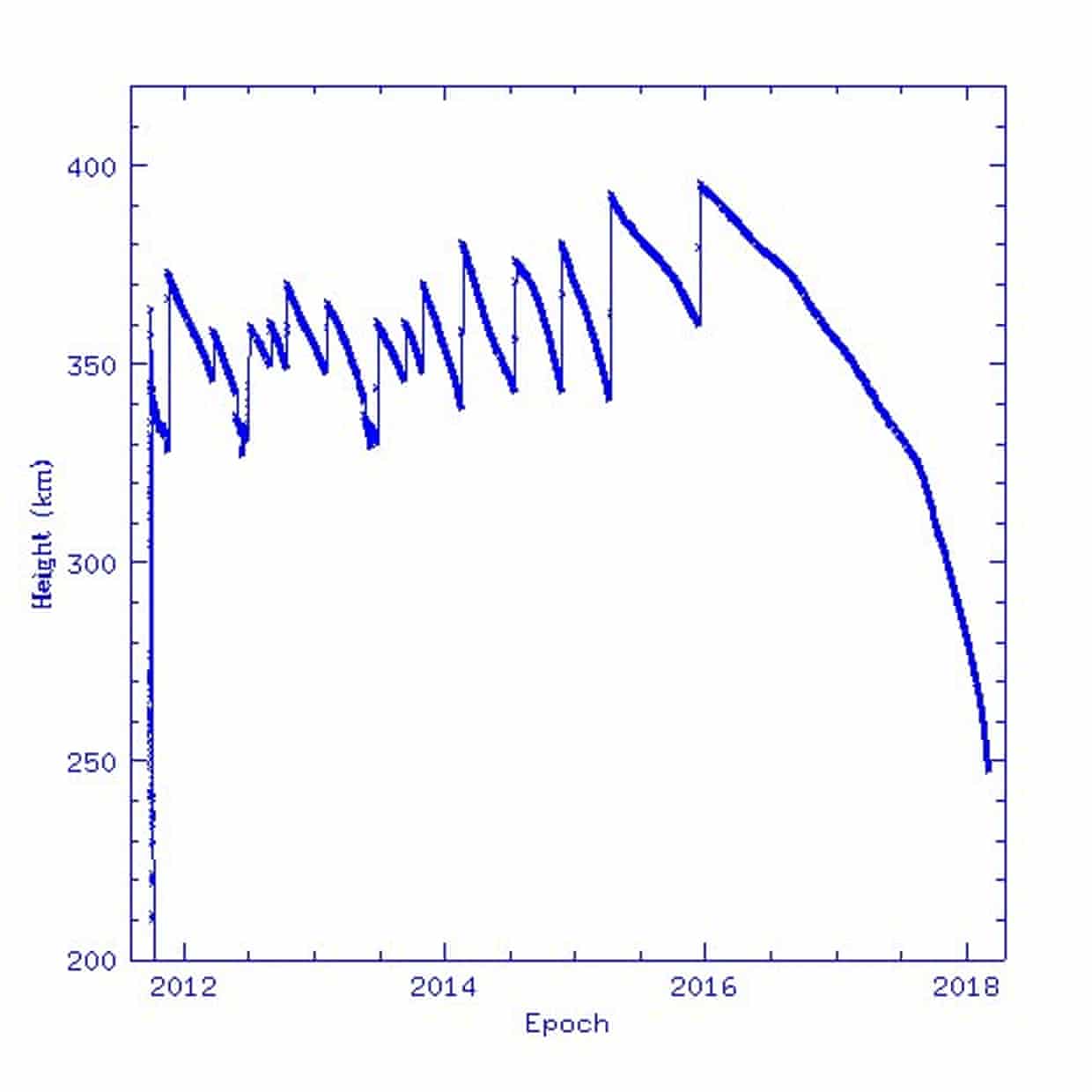
A chart showing the descent of the Tiangong-1
 A chart showing the descent of the Tiangong-1 Photograph: Jonathan McDowell
McDowell said Tiangong-1’s descent had been speeding up in recent months and it was now falling by about 6km a week, compared with 1.5km in October. It was difficult to predict when the module might land because its speed was affected by the constantly changing “weather” in space, he said.
“It is only in the final week or so that we are going to be able to start speaking about it with more confidence,” he said.
“I would guess that a few pieces will survive re-entry. But we will only know where they are going to land after after the fact.”
The Tiangong-1 or Heavenly Palace lab was launched in 2011 and described as a “potent political symbol” of China – part of a scientific push to become a space superpower.
It was used for both manned and unmanned missions and visited by China’s first female astronaut, Liu Yang, in 2012.
In 1991 the Soviet Union’s 20-tonne Salyut 7 space station crashed to Earth while still docked to another 20-tonne spacecraft called Cosmos 1686. They broke up over Argentina, scattering debris over the town of Capitán Bermúdez.
Nasa’s 77-tonne Skylab space station came hurtling to Earth in an almost completely uncontrolled descent in 1979, with some large pieces landing outside Perth in Western Australia.

Friday, March 2, 2018

FATAL DELUSIONS OF WESTERN MAN

FATAL DELUSIONS OF WESTERN MAN

Pat Buchanan: Leaders have adopted policies 'rooted in hopes unjustified by reality


Image result for FATAL DELUSIONS OF WESTERN MAN Pat Buchanan: Leaders have adopted policies 'rooted in hopes unjustified by reality

“We got China wrong. Now what?” ran the headline over the column in the Washington Post.
“Remember how American engagement with China was going to make that Communist backwater more like the democratic, capitalist West?” asked Charles Lane in his opening of U.S. markets would cause the People’s Republic to coexist benignly with its neighbours and the West.
We deluded ourselves. It did not happen.
Xi Jinping just changed China’s constitution to allow him to be dictator for life. He continues to thieve intellectual property from U.S. companies and to occupy and fortify islets in the South China Sea, which Beijing now claims as entirely its own.
Meanwhile, China sustains North Korea as Chinese warplanes and warships circumnavigate Taiwan threatening its independence.
Who is responsible for this epochal blunder?
The elites of both parties. Bush Republicans from the 1990s granted China most-favored-nation status and threw open America’s market.
Result: China has run up $4 trillion in trade surpluses with the United States. Her $375 billion trade surplus with us in 2017 far exceeded the entire Chinese defense budget.
We fed the tiger, and created a monster.
Why? What is in the mind of Western man that our leaders continue to adopt policies rooted in hopes unjustified by reality?
Recall. Stalin was a murderous tyrant unrivaled in history whose victims in 1939 were 1,000 times those of Adolf Hitler, with whom he eagerly partnered in return for the freedom to rape the Baltic States and bite off half of Poland.
When Hitler turned on Stalin, the Bolshevik butcher rushed to the West for aid. Churchill and FDR hailed him in encomiums that would have made Pericles blush. At Yalta, Churchill rose to toast the butcher:
“I walk through this world with greater courage and hope when I find myself in a relation of friendship and intimacy with this great man, whose fame has gone out not only over all Russia, but the world. … We regard Marshal Stalin’s life as most precious to the hopes and hearts of all of us.”
Returning home, Churchill assured a skeptical Parliament, “I know of no Government which stands to its obligations, even in its own despite, more solidly than the Russian Soviet Government.”
George W. Bush, with the U.S. establishment united behind him, invaded Iraq with the goal of creating a Vermont in the Middle East that would be a beacon of democracy to the Arab and Islamic world.
Ex-director of the NSA Gen. William Odom correctly called the U.S. invasion the greatest strategic blunder in American history. But Bush, unchastened, went on to preach a crusade for democracy with the goal of “ending tyranny in our world.”
What is the root of these astounding beliefs – that Stalin would be a partner for peace, that if we built up Mao’s China she would become benign and benevolent, that we could reshape Islamic nations into replicas of Western democracies, that we could eradicate tyranny?
Today, we are replicating these historic follies.
After our victory in the Cold War, we not only plunged into the Middle East to remake it in our image, we issued war guarantees to every ex-member state of the Warsaw Pact and threatened Russia with war if she ever intervened again in the Baltic Republics.
No Cold War president would have dreamed of issuing such an in-your-face challenge to a great nuclear power like Russia.
If Putin’s Russia does not become the pacifist nation it has never been, these guarantees will one day be called. And America will either back down – or face a nuclear confrontation.
Why would we risk something like this?
Consider this crazed ideology of free-trade globalism with its roots in the scribblings of 19th-century idiot savants, not one of whom ever built a great nation.
Adhering religiously to free-trade dogma, we have run up $12 trillion in trade deficits since Bush I. Our cities have been gutted by the loss of plants and factories. Workers’ wages have stagnated. The economic independence Hamilton sought and Republican presidents from Lincoln to McKinley achieved is history.
But the greatest risk we are taking, based on utopianism, is the annual importation of well over a million legal and illegal immigrants, many from the failed states of the Third World, in the belief we can create a united, peaceful and harmonious land of 400 million, composed of every race, religion, ethnicity, tribe, creed, culture and language on earth.
Where is the historic evidence for the success of this experiment, the failure of which could mean the end of America as one nation and one people?

Thursday, March 1, 2018

Kicking the elderly in China is accepted as normal behaviour, how cowardly

Listen how the public laughs while this continues ...it appears amusing to them.
Again  beating the elderly is commonplace and the public standing around as if entertained.


Shocking video shows man kicking librarian at Richmond community meeting

Shocking video shows man kicking librarian at Richmond community meeting


The Richmond RCMP are investigating an attack on a city librarian that was caught on camera Wednesday night. Video uploaded to YouTube shows a man kicking a woman at an information session about temporary, modular housing and then running away.

A man kicked a librarian at the Richmond Public Library’s Brighouse branch as a community meeting on a planned modular housing project for the city was being held there on Wednesday.
In a video that was uploaded to YouTube, a man could be seen kicking a woman hard enough that she hit the ground.
The man then fled the scene on foot.
Three people in the video attended to the woman and helped her back to her feet.
Richmond RCMP Cpl. Dennis Hwang said police became aware of an incident that happened at the library at around 5:30 p.m. on Wednesday night.
An artist’s rendering of a proposed modular supportive housing project at 7300 Elmbridge Way in Richmond.

An artist’s rendering of a proposed modular supportive housing project at 7300 Elmbridge Way in Richmond.
City of Richmond
The suspect, who is “currently outstanding,” was described as an Asian male in his early to mid-thirties, who was clean shaven and wearing a black puffy three-quarters length winter jacket, dark pants, dark Converse-style sneakers, wearing glasses and possibly carrying a blue backpack.
The victim sustained minor injuries but overall she’s expected to make a full recovery, Hwang added.
Anyone who knows the suspect’s identity has been asked to contact the RCMP.
WATCH: Uncertainty surrounds Richmond homeless shelter
Richmond Mayor Malcolm Brodie called the incident “reprehensible,” though he said it’s not clear whether the man’s actions were related to the housing project.
“Just what this young man’s relation to this consultation is, I guess we’ll find out in due course, but we don’t know that right now,” he said.
People had met at the branch to talk about a three-story modular housing buildingthat’s being planned for a site at 7300 Elmbridge Way.

In a news release issued as part of its “Rapid Response to Homelessness” program, the City of Richmond said, “Homelessness is increasing in Richmond and a quick response is needed to ensure that people are not living outside.”
The project would be located on city-owned land. It would have 40 studio units that would remain in place for up to five years.
“These studios would house people experiencing homelessness in Richmond, while providing the services they need to get back on their feet,” the release said.
The project, if realized, would be built in partnership with BC Housing.
Anyone with feedback on modular housing in Richmond can submit it to the city until March 4.

Chinese Fly-in workers to be paid 3/4 of NZ wage

Chinese Fly-in workers to be paid 3/4 of NZ wage

FEBRUARY 28, 2018


Image result for Chinese Fly-in workers in New Zealand
A Chinese development company planning to fly in 200 overseas tradies for an Auckland hotel build are prepared to pay only three-quarters of the normal hourly rate - with further deductions to workers' pay for travel and accommodation.
The news is the latest development in the Fu Wah Auckland Park Hyatt Hotel build, which hit headlines earlier this month after the company said it needed 198 temporary workers from China to complete the fit-out stages of the project by deadline.
Fu Wah, which formally submitted its application to Immigration New Zealand two weeks ago, pointed to the labour shortage in local trades as justification.
At the time, fears regarding equitable pay and working conditions for the overseas workers - an ongoing, and cross-sector problem associated with imported labour in New Zealand - were raised.
Since then, Fu Wah has communicated with the Council of Trade Unions, and a meeting has taken place between the company’s lawyer, former  Alliance MP Matt Robson, and E TÅ« -  the union which represents between 1200 and 1500 construction workers. As part of the application process, Immigration New Zealand consults with the CTU, Worksafe and the Labour Inspectorate.
In the meeting between E-TÅ« and Robson last week, Fu Wah laid out a proposed hourly pay rate of $25 for workers. Deductions for the workers’ travel and accommodation arrangements would also come out of their wage, said Joe Gallagher, the national industry coordinator who attended the meeting on behalf of E-TÅ«.
“Depending on what the role is, the average pay for someone like a tiler or a commercial painter [for the fit-out stages of a job] would be about $32 per hour - and you’d charge more if you were a qualified builder. It could be up to $55 depending on what you were doing.
“This is really where the rubber hits the road with migration, with firms saying they cant find local workers, yet aren’t paying anywhere near the going rate."
- CTU national secretary Sam Huggard
“Those guys with the top-line finishing skills, which I assume you’d want in a luxury hotel build like this, would be pricier.”
The “$25 rate”, and the outlined plan to deduct for travel and accommodation is a “huge red flag”, Gallagher said.
“In recent years, there hasn’t been the openness to engage with us around these types of things,” he said in reference to projects involving large numbers of overseas workers.
“We thought … it was good that Fu Wah’s lawyer wanted to meet, but by the end of the meeting, when we saw the proposed contract with that rate, it was clear there wasn’t going to be a positive outcome - particularly because he [Robson] didn’t appear to have any room to negotiate on it.”
And while New Zealand’s lack of skilled trades workers was a significant problem for the wider economy, the current situation with Fu Wah needed to be put in perspective.
“We’re in a crisis where we’ve got to build 100,000 homes in 10 years, and we haven’t got enough people, so you’re going to have to blend that with bringing some people in from overseas - but we should be maintaining some proper standards around that,” Gallagher said.
“When you bring people in on temporary work permits, they’re much more open to exploitation because they want to make some money and they tend to come from low-wage economies. If there aren’t proper standards in place, managing pay and living conditions, then the quality of the work suffers - which we’ve seen before.”
Gallagher pointed to compliance problems with numerous development sites in Auckland that epitomised issues around regulation of overseas developers and workers - including a site where raw sewage was being discharged into a stream. Building compliance problems have also emerged out of the Christchurch rebuild, which has relied heavily on overseas workers. Currently, the rail and maritime transport union is also embroiled in a legal challenge with KiwiRail over its use of Chinese workers to repair asbestos-ridden locomotives in 2015. While the case is based on a potential breach of the collective contract, the union has also claimed the overseas workers were paid below minimum rate and forced to live in substandard conditions while in the country.
Both Gallagher and Sam Huggard, the CTU national secretary, said the proposed contract from Fu Wah was “unacceptable”.
“This is really where the rubber hits the road with migration, with firms saying they cant find local workers, yet aren’t paying anywhere near the going rate," Huggard said. 
"Fu Wah’s application shouldn’t be supported if they are sticking to a $25 rate with deductions for travel and housing tacked on."
Robson, who acknowledged last week’s meeting when contacted by Newsroom, would not confirm or deny whether an hourly rate was discussed.
“I’m not at liberty to say exactly what figures [were] or weren’t done, but there have been negotiations with the union,” he said.
“Fu Wah and the people that they are employing, and everyone they’re working with [are] setting various conditions, but I’m not at liberty to say what the negotiations they’ve had or what they haven’t had.