- 13 May 2020
Keeping an eye on Communist, Totalitarian China, and its influence both globally, and we as Canadians. I have come to the opinion that we are rarely privy to truth regarding the real goal, the agenda of China, it's ambitions for Canada [including special focus on the UK, US & Australia]. No more can we trust the legacy media as there appears to be increasing censorship applied to the topic of communist China. I ask why. Here is what I find.
Thursday, July 30, 2020
Terry Glavin: Who do Chinese diplomats think they are, threatening Canadians this way?
Consul general's remarks in Vancouver just the latest in a series of menacing statements from Chinese envoys in recent weeks
Author of the article:
Terry GlavinPublishing date:
Jul 29, 2020 • 
Here we go again. Another emissary from the People’s Republic of China warning Canadians yet again to mind their manners. More sinister propaganda in aid of whitewashing Beijing’s massive police-state crackdown in Hong Kong as a perfectly normal, unremarkable and necessary exercise in law enforcement. More thinly-veiled threats.
This time around it’s Tong Xiaoling, China’s consul general in Vancouver. In a Monday interview with the self-described “Voice of Vancouver’s Chinese Community,” AM 1320, Tong singled out what she called “an extremely small group of people” in Metro Vancouver’s ethnic Chinese community who are “deliberately smearing and attacking Hong Kong’s national security law” and “collaborating with anti-Chinese powers in attempts to cause trouble overseas, to even create bases in foreign countries to stand against China and disrupt Hong Kong.”
The alleged activities Tong described are specifically outlawed in the sweeping national security law that Beijing has imposed on Hong Kong in Xi Jinping’s efforts to crush the nominally autonomous city-state’s vigorous pro-democracy movement. The new law applies not just to Hong Kong residents but to anyone, of any nationality or citizenship, anywhere in the world.
The new law applies not just to Hong Kong residents but to anyone anywhere in the world
Unilaterally imposed on Hong Kong’s legislative council effective July 1, in direct contravention of the Sino-British treaty that allowed for Britain’s handover of Hong Kong to Beijing in 1997, the statute purports to outlaw secession, subversion, terrorism and collusion with foreign or external forces. Offences under the law are punishable by life imprisonment.
The law’s overseas critics are sowing division in overseas Chinese communities and “trying to destroy the Canada-China relationship,” Tong said. Tong then issued specific instructions to Metro Vancouver’s half-million-strong Chinese diaspora: “Understand what is right, and don’t be misled by a minority group who are anti-China and engaged in disruptive activities. Do not participate in their destructive actions, so we can better protect China-Canada relations … those in the Chinese community, those who want to create divisions or a climate of terror, who are plotting schemes, their plans are doomed to fail.”
Cherie Wong of the pro-democracy Alliance-Canada Hong Kong organization calls Tong’s remarks an explicit threat to the safety of Chinese-Canadians. It’s the kind of threat that Chinese officials are increasingly communicating through Chinese-language media in Canada, and through the various front groups Beijing operates in various Chinese-Canadian communities under the direction of Beijing’s United Front Work Department.

The Chinese Communist Party is aiming to “unify all ethnic Chinese groups under the Chinese regime,” Wong says, and to “mute criticism of its heavy-handed response in Hong Kong, and concentration camps in East Turkestan (also known as Xinjiang).”
Blustering along the lines of Tong’s claims that Canadians are “interfering in Chinese affairs” is not a recent phenomenon. As far back as 1990, Vancouver’s Chinese consul general An Wenbin warned the University of British Columbia that the erection of the now-famous “Goddess of Democracy” statue on campus, to commemorate the victims of the 1989 Tiananmen massacre in Beijing, was “an attempt to interfere into China’s internal affairs” that would “surely harm in concrete terms the existing relations between UBC and China.”
But Beijing’s power and influence in Canada, aided by compliant corporate and political figures, has grown dramatically over the past 30 years. So has the Chinese Communist Party’s penchant for brutal repression at home and swaggering belligerence abroad. Tong’s threats are just the latest in a series of menacing statements from Chinese diplomats in recent weeks. Earlier this month, Chinese ambassador Cong Peiwu accused Canada of interfering in Chinese affairs for merely cancelling an extradition agreement with Hong Kong and barring sales of Canadian equipment to the hated Hong Kong Police Force. Canada would be made to “bear the consequences” of its decision, Cong said. “I’d like to suggest you just wait and see.”
Canada would be made to 'bear the consequences' of its decision, Cong said
Ottawa continues to avoid putting up any effective resistance, however, even while Beijing continues to imprison Michael Kovrig and Michael Spavor in retaliation for Canada merely acting on a U.S. Justice Department request to extradite Meng Wanzhou, Huawei Technologies’ chief financial officer. Meng is facing several counts of bank fraud and conspiracy in New York, related to alleged evasions of sanctions on Iran.
Meng’s detention set off a barrage of Chinese retaliatory measures, and Meng bides her time in one of her mansions in Vancouver’s posh Shaughnessy district while her lawyers fight the U.S. extradition request. In its latest effort to spring Meng, Huawei has recently hired five separate law firms to apply pressure on HSBC Bank, according to reports in the South China Morning Post this week. China’s state propaganda has lately accused HSBC of colluding with the Federal Bureau of Investigations to “frame” Meng. HSBC has responded by backing Beijing’s national security law in Hong Kong, in the hope of getting the Chinese Communist Party’s boot off the bank’s neck.
With Chinese corporate and diplomatic officials continuing to throw their weight around in Canada, threatening expatriate Hong Kongers and Uyghur human rights activists, the National Security and Intelligence Committee of Parliamentarians calls Canada an “attractive and permissive target” for Chinese interference. “The government must do better,” NSICOP stated in its annual report, released in March. “The threat is real, if often hidden … If it is not addressed in a comprehensive, whole-of-government approach, foreign interference will slowly erode the foundations of our fundamental institutions, including our system of democracy itself.”
The threat is real, if often hidden
NATIONAL SECURITY AND INTELLIGENCE COMMITTEE OF PARLIAMENTARIANS' ANNUAL REPORT
But Ottawa is not addressing the threat by any approach. The Trudeau government has broken with Canada’s Five Eyes intelligence-sharing partners — the U.S., the United Kingdom, Australia and New Zealand — by refusing to bar Huawei from Canada’s fifth-generation (5G) internet connectivity architecture. And Ottawa has failed to establish a central law-enforcement office to address a campaign of harassment and intimidation, meticulously documented by Amnesty International and a coalition of diaspora groups, that Beijing’s agents in Canada are mounting against expatriate Hongkongers and Uyghur human rights activists here.
Last December, Justin Trudeau’s minority government was outvoted in its attempt to prevent the establishment of a special Parliamentary committee to review the shambolic Canada-China relationship. While the committee trundled along through the early spring, pro-democracy Hongkongers and Uyghurs expressed shock in May when New Democrats and Greens voted with the Liberals against a Conservative motion to reconvene the Canada-China committee to address the Hong Kong crisis. But last week, that vote was overturned. The committee is up and running again this week.
It would serve Parliament well, and do some service to the cause of “the foundations of our fundamental institutions, including our system of democracy itself,” as NSICOP put it, if the Canada-China committee summoned the Vancouver consul general Tong Xiaoling, and Ambassador Cong Peiwu, so that they might explain who the hell they think they are, threatening Canadians in these ways.
Terry Glavin is an author and a journalist.
Wednesday, July 29, 2020
All charges dropped against Red Bull heir in Ferrari crash that killed cop
July 24, 2020
View photos
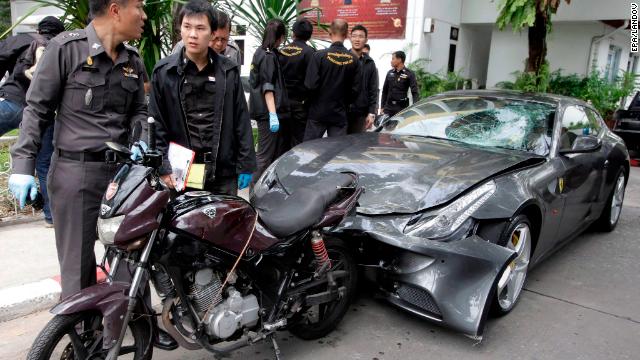
Vorayuth "Boss" Yoovidhya was driving his Ferrari up to 110 mph before striking and dragging a motorcycle police officer in 2012. (AP)


BANGKOK, Thailand — Prosecutors in Thailand have dropped all charges against a Thai heir to the Red Bull energy drink fortune who was accused of killing a Bangkok police officer in a 2012 car crash, officials said Friday.
Police Lt. Col. Thanawuth Sanguansuk confirmed that all charges against Vorayuth Yoovidhya have been dropped. The statute of limitations had run out for several, but the charge of causing death by reckless driving would not have expired for 15 years after the date of the crash.
The case attracted widespread attention because of perceptions that it showed the rich and well-connected have impunity in Thailand’s judicial system, which in recent years has also been criticized for alleged political bias, as have other state institutions.
Thanawuth said prosecutors who handled the case informed police last month of their decision to withdraw the last remaining charge.
“Yes, they had informed us of their opinion to drop all charges. They are citing the fact the family members (of the police officer) have been compensated” by Vorayuth's family, Thanawuth said.
Vorayuth’s family owns about half of the Red Bull empire, which was co-founded by his grandfather. Forbes magazine’s list of the richest families in Thailand places them second, with an estimated wealth of $20.2 billion.
Vorayuth, better known by his nickname “Boss,” was wanted in connection with the Sept. 3, 2012, accident that occurred when he was allegedly roaring down one of Bangkok's main streets at speeds of up to 177 kilometers (110 miles) per hour when his Ferrari struck and killed motorcycle policeman Sgt. Maj. Wichean Klunprasert.
Wichean and his mangled motorcycle were dragged by the Ferrari for several dozen yards before his body fell to the road. Police followed a trail of brake fluid to the Yoovidhya family’s nearby property. The car, which they found there, had a shattered windshield and its bumper was dangling. At first, a chauffeur was blamed for the accident, but Vorayuth later admitted to being the driver. He turned himself in and was released on the equivalent of about $16,000 bail the same day.
View photos
His lawyers managed to repeatedly put off any court appearances until April 2017, when a warrant was issued for his arrest a few days after he had left the country. His Thai passports were later revoked.
Despite the legal threats hanging over him, Vorayuth managed after the accident to lead a busy globetrotting life, flying in private Red Bull jets to attend Formula One races, go snowboarding in Japan and cruising in Venice, among other activities. His continuing jet-set lifestyle provoked widespread public anger when it was revealed by an Associated Press investigation.
Porn-anant Klunprasert, brother of the dead police officer, said in a phone call with The Associated Press that he signed a contract with the Yoovidhya family in 2012 in which the officer's survivors agreed not to file criminal and civil charges over the death in exchange for 3 million baht ($94,400) in compensation.
However, he expressed dismay over the decision of prosecutors to drop charges.
“Many of my friends called to tell me that the state prosecutors have dropped the case,” he said. "It hurts me a lot. It shows no justice for the poor. Thailand has a very wide gap between the rich and the poor in every aspect, and this case is a clear example.”
At a news conference Friday, police spokesman Col. Krissana Pattanacharoen declared that the dropping of charges was done according to standard procedure and did not involve favoritism or double standards.
He said police had made known to the prosecutors the evidence they had collected and the results of their investigation, and the prosecutors made the decision to drop the charge, which police agreed with.
Krissana said Thai and Interpol arrest warrants were being canceled and news of the decision was already conveyed to the Yoovidhya family.
Sira Jenjaka, a lawmaker from the ruling Palang Pracharath party who heads the House of Representatives' Committee on Legal Affairs, Justice, and Human Rights, told reporters that representatives of the police and prosecutor's office will be summoned to explain the decision to drop charges.
Wuhan'Virus: China’s new army of tough-talking diplomats
By James LandaleDiplomatic correspondent
Image copyrightAFP
Once upon a time Chinese statecraft was discreet and enigmatic.
Henry Kissinger, the former US secretary of state, wrote in his seminal study Diplomacy that "Beijing's diplomacy was so subtle and indirect that it largely went over our heads in Washington".
Governments in the West employed sinologists to interpret the opaque signals emanating from China's politburo.
Under its former leader, Deng Xiaoping, the country's declared strategy was to "hide its ability and bide its time". Well, not any more.
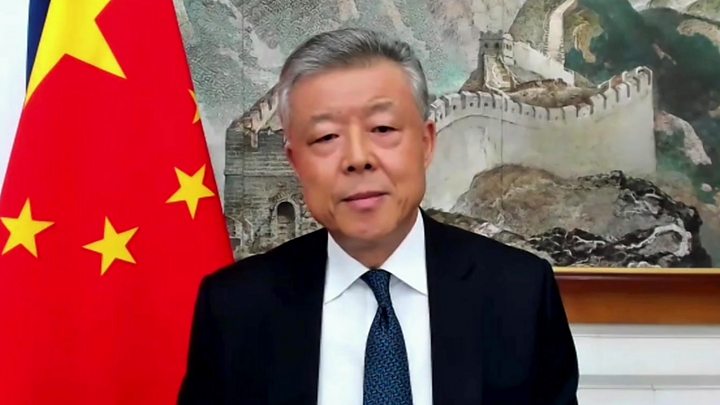
China has dispatched an increasingly vocal cadre of diplomats out into the world of social media to take on all comers with, at times, an eye-blinking frankness. Their aim is to defend China's handling of the coronavirus pandemic and challenge those who question Beijing's version of events.
Image copyrightGETTY IMAGES
So they launch salvos of persistent tweets and posts from their embassies around the world. And they hold little back, deploying sarcasm and aggression in equal measure.
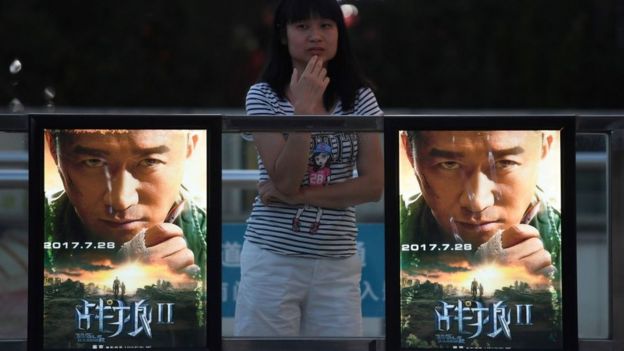
Such is the novelty of their techniques that they have been dubbed "wolf warrior" diplomats after the eponymous action films.
Wolf Warrior and Wolf Warrior 2 are hugely popular movies in which elite Chinese special forces take on American-led mercenaries and other ne'er-do-wells. They are violent and extremely nationalistic in tone.
One critic dubbed them "Rambo with Chinese characteristics". A promotional poster showed a picture of the central character raising his middle finger with the slogan: "Anyone who offends China, no matter how remote, must be exterminated."
Image copyrightGETTY IMAGES
In a recent editorial, the Chinese Communist Party newspaper, Global Times, declared the people were "no longer satisfied with a flaccid diplomatic tone" and said the West feels challenged by China's new "Wolf Warrior" diplomacy.
A new kind of language
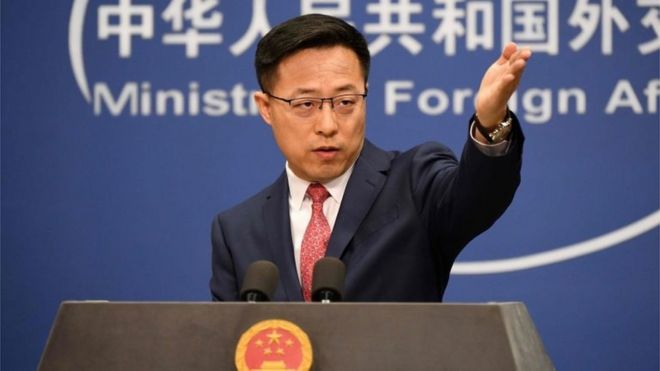
Perhaps the quintessential "wolf warrior" is Lijian Zhao, China's young foreign affairs spokesman. He is the official who made the unsubstantiated suggestion that the United States might have brought coronavirus to Wuhan.
He has more than 600,000 followers on Twitter and he exploits that audience almost by the hour, relentlessly tweeting, retweeting and liking anything that promotes and defends China.

This is of course what diplomats anywhere in the world must do: it is their job to promote their country's national interest. But few diplomats use language that is, well, so undiplomatic.
Take the Chinese embassy in India which described calls for China to pay compensation for spreading the virus as "ridiculous and eyeball-catching nonsense".
China's ambassador in the Netherlands accused President Donald Trump of being "full of racism".
In response to Mr Trump's much mocked speculation about the best ways of tackling the virus, the chief spokesman for the Chinese Communist Party in Beijing tweeted: "Mr President is right. Some people do need to be injected with #disinfectant, or at least gargle with it. That way they won't spread the virus, lies and hatred when talking."
In London, China's "wolf warrior" is Ma Hui, number 3 at the embassy. His Twitter username includes the words "warhors" and he is as prolific as he is robust.
He tweeted: "Some US leaders have stooped so low to lie, misinform, blame, stigmatise. That is very despicable, but we should not lower our standard, race to the bottom. They don't care a lot about morality, integrity but we do. We can also fight back [against] their stupidity."

Now much of this may look like the familiar knockabout you get on social media. But for China, it is a huge departure. Research by the German Marshall Fund think-tank suggests there has been a 300% increase in official Chinese state Twitter accounts over the last year, with a fourfold increase in posts.
Kristine Berzina, a senior fellow at the GMF, said: "This is very unusual from what we have come to expect from China.
"In the past, China's public face has been to show a positive image of the country. There has been an encouragement of friendship. Cute panda videos would be much more common than harsh take-downs of various government policies. So this is a really big departure."
Image copyrightAFP
And it is clearly a policy choice by China's authorities. They could have chosen to focus their information campaign entirely on what has been dubbed their "mask diplomacy", namely the donation and sale of protective medical kit around the world.
This promoted China's soft power as other countries struggled to cope. But such goodwill as was generated by this "health silk road" appears to have been dissipated by the aggression of the "wolf warriors".
Angry ambassadors
China's ambassador in Australia, Cheng Jingye, has been engaged in a furious row with his hosts. When the government backed an independent international investigation into the origins of the virus, Mr Cheng hinted China might boycott Australian goods.
"Maybe also the ordinary people will say, 'Why should we drink Australian wine or eat Australian beef?'" he told the Australian Financial Review.

Ministers accused him of threatening "economic coercion". Officials at the Department for Foreign Affairs and Trade called the ambassador to ask him to explain himself. He responded by publishing an account of the conversation on the embassy website, in which he urged Australia to stop playing "political games".
China this week imposed import bans on some Australian beef processors and threatened tariffs on Australian barley.
In Paris, China's ambassador Lu Shaye was summoned by the foreign ministry to explain comments on his embassy website suggesting that France had abandoned its elderly to die of Covid-19 in care homes.
The pushback against Chinese diplomats has perhaps been strongest in Africa where a number of ambassadors - from Nigeria, Kenya, Uganda, Ghana and the African Union - were summoned by their hosts in recent weeks to explain racist and discriminatory treatment of Africans in China.
The Speaker of Nigeria's House of Representatives, Femi Gbajabiamila, published footage of him remonstrating with China's ambassador.

In an article for Foreign Affairs magazine, Kevin Rudd, the former Australian prime minister, argues that China is paying a price for its new strategy: "Whatever China's new generation of 'wolf-warrior' diplomats may report back to Beijing, the reality is that China's standing has taken a huge hit (the irony is that these wolf-warriors are adding to this damage, not ameliorating it).
"Anti-Chinese reaction over the spread of the virus, often racially charged, has been seen in countries as disparate as India, Indonesia, and Iran. Chinese soft power runs the risk of being shredded."
The risk is that China's diplomatic assertiveness may harden attitudes further in the West, with countries becoming more distrustful and less willing to engage with Beijing.
In the United States, China has already become an issue in the presidential election, with both candidates competing to be tougher than the other. In the UK, Conservative MPs are organising to impose greater scrutiny on Chinese policy.
The question is whether these diplomatic tensions will deepen into a more serious confrontation between China and the West. This matters not just because of the general risks of escalation but also because there is much on which the world needs to co-operate.
Image copyrightREUTERS
In the short term, the research, testing, development and distribution of a Covid-19 vaccine will require international co-operation including China. In the longer term, most analysts expect some kind of global collective action to repair the world economy. But the chances of that are looking slim.
Bonnie Glaser, director of the China Power Project at the Centre for Strategic and International Studies in Washington, said: "If the US and China did not set aside their differences in order to work together to fight a global pandemic, it is hard to believe they are going to find a way to work together to bolster their economies."
Some strategists argue that while the West will have to increase its strategic independence from China after the pandemic, it will also have to find a new framework for co-operation.
China's "wolf warrior" diplomacy may not be making that any easier.
Subscribe to:
Posts (Atom)