Keeping an eye on Communist, Totalitarian China, and its influence both globally, and we as Canadians. I have come to the opinion that we are rarely privy to truth regarding the real goal, the agenda of China, it's ambitions for Canada [including special focus on the UK, US & Australia]. No more can we trust the legacy media as there appears to be increasing censorship applied to the topic of communist China. I ask why. Here is what I find.
The Uighur People [currently being killed are claimed to be terrorists by Beijing] are an ancient people dating back further than the much self-heralded Chinese civilization so genetic research has proven. All this jingoism, fanaticism [Fenqing...look it up! Its promoted by the state towards the youth], propaganda and downright chest beating must come to a screaming halt. The ruling Han are embarrassed to have to admit they have been telling lies for decades that they are the oldest living civilization on the planet when the Uighur's are. Now it doesn't take a rocket scientist to work out that this group should get any limelight, so why not paint them as terrorists. Terrorism is a catch all for undesirables against the state these days. How convenient to be seen as cleaning ones house as it were, eliminating undesirables and thus putting a stop to any controversy against the Totalitarian Fascist State that Red China [The PRC] is. The world will see how righteous they can be taking these steps. All this is, is smoke and mirrors much like the false flag operations of the CIA in fact taken from the same hymn book. Like I have said so many times "All Roads Lead To Rome". The Vatican, The Jesuits fomenting hatred, wars and unrest as they have done for centuries. This is nothing short of Democide or Ethnic Cleansing a heinous practice found in totalitarian/racist societies, AKA Bolshevist Russia for example, or recently, Mao's China. Conan
* Ethnic cleansing is the attempt to create ethnically homogeneous geographic areas through the deportation or forcible displacement of persons belonging to particular ethnic groups. Ethnic cleansing sometimes involves the removal of all physical vestiges of the targeted group through the destruction of monuments, cemeteries, and houses of worship.
Ethnic Cleansing is happening in Tibet and East Turkestan (Xinjiang). Ever since Chinese Communists occupied Xinjiang, they have been encouraging more and more number of Han Chinese to migrate to Xinjing. Aside from perpetrating flagrant violations of human rights, the Chinese have also instituted a systematic and discriminatory program to change the demographics in Xinjiang Uyghur Autonomous Region (XUAR). Since the 1950’s the central authorities have worked to change the ethnic mix of the region. According to Paul George, who wrote a commentary on the situation for the Canadian Security Intelligence Service (CSIS), China’s one-child, family planning policy does not apply to any ethnic Han couple relocating to East Turkistan. Not surprisingly, such incentives have altered the demographic mix significantly. The population estimates for the territory range from 17 million to 40 million. And according to 1997 figures cited by Amnesty International, the ethnic composition is now 47 percent Uighur, 42 percent Han, 7 percent Kazak and the rest made up of other minorities. The Uighurs made up 80 percent of the territory prior to Mao’s policy of ethnic dilution. In fact, the U.S. State Department in its 1998 China human rights report, states that according to some estimates, the migration of ethnic Han in "recent decades has caused the Han-Uyghur ratio in the capital of Urumqi to shift from 20 to 80, to 80 to 20…"
The Han have also gained control over the economic and political landscape. This was achieved by banning the Uighur language and extending preferential treatment in employment, education, health care and other services to the growing Han community. Those locals without any facility for the Chinese language are totally out of the loop.
Because of the centrality of Islam in the Uighur culture, the government has also focused on removing any symbols of Islam. Islamic schools and Mosques which were only opened during the administration of Deng Xiao Ping took, are once again seriously restricted. Religious activity has been curtailed and only material approved by the State is allowed to be published and distributed.
This program of systematic ethnic cleansing that was first started in Xinjiang was also extended to Tibet. So Uyghurs and Tibetans both face the prospect of becoming minorities in their own lands.
The Mummies of Xinjiang
The Tarim mummies are a series of mummies discovered in the Tarim Basin in present-day Xinjiang, China, which date from 1800 B.C. to 200 A.D. Some of the mummies are frequently associated with the presence of the Indo-European Tocharian languages in the Tarim Basin although the evidence is not totally conclusive.
The Archeological record
At the beginning of the 20th century European explorers such as Sven Hedin, Albert von Le Coq and Sir Aurel Stein all recounted their discoveries of desiccated bodies in their search for antiquities in Central Asia. Since then, many other mummies have been found and analysed, most of them now displayed in the museums of Xinjiang. Most of these mummies were found on the eastern (around the area of Lopnur, Subeshi near Turpan, Kroran, Kumul) and southern (Khotan, Niya, Qiemo) edge of the Tarim Basin.
The earliest Tarim mummies, found at Qäwrighul and dated to 1800 B.C, are of a Caucasoid physical type whose closest affiliation is to the Bronze Age populations of southern Siberia, Kazakhstan, Central Asia, and the Lower Volga. The cemetery at Yanbulaq contained 29 mummies which date from 1100–500 B.C, of which 21 are Mongoloid — the earliest Mongoloid mummies found in the Tarim Basin — and 8 of which are of the same Caucasoid physical type found at Qäwrighul.
Notable mummies are the tall, red-haired "Chärchän man" or the "Ur-David" (1000 B.C.); his son, a small 1-year-old baby with blond hair protruding from under a red and blue felt cap, and blue stones in place of the eyes; the "Hami Mummy" (c. 1400–800 B.C.), a "red-headed beauty" found in Qizilchoqa; and the "Witches of Subeshi" (4th or 3rd century B.C.), who wore two foot long black felt conical hats with a flat brim. Also found at Subeshi was a man with traces of a surgical operation on his neck; the incision is sewn up with sutures made of horsehair.
The Loulan Beauty
A 2008 study by Jilin University showed that the Yuansha population has relatively close relationships with the modern populations of South Central Asia and Indus Valley, as well as with the ancient population of Chawuhu. In 2007 the Chinese government allowed a National Geographic Society team headed by Spencer Wells to examine the mummies' DNA. Wells was able to extract undegraded DNA from the internal tissues. The scientists extracted enough material to suggest the Tarim Basin was continually inhabited from 2000 BCE to 300 BCE and preliminary results indicate the people, rather than having a single origin, originated from Europe, Mesopotamia, Indus Valley and other regions yet to be determined.[citation needed] In years 2009-2015, the remains of in total 92 individuals found at the Xiaohe Tomb complex were analyzed for Y-DNA and mtDNA markers. Genetic analyses of the mummies showed that the Xiaohe people were an admixture from populations originating from both the West and the East. The maternal lineages of the Xiaohe people originated from both East Asia and West Eurasia, whereas the paternal lineages all originated from West Eurasia. Mitochondrial DNA analysis showed that maternal lineages carried by the people at Xiaohe included mtDNA haplogroups H, K, U5, U7, U2e, T and R*, which are now most common in West Eurasia. Also found were haplogroups common in modern populations from East Asia: B5, D and G2a. Haplogroups now common in Central Asian or Siberian populations included: C4 and C5. Haplogroups later regarded as typically South Asian includedM5 and M*. The paternal lines of male remains surveyed nearly all – 11 out of 12, or around 92% – belonged to Y-DNA haplogroup R1a1, which are now most common in West Eurasia; the other belonged to the exceptionally rare paragroup K* (M9). The geographic location of this admixing is unknown, although south Siberia is likely. According to a comment posted on 18 July 2014 by one of study co-authors - prof. Hui Zhou - Xiaohe R1a1 lineages does not belong to R-Z93 branch and the study supports the "steppe hypothesis". It has been asserted that the textiles found with the mummies are of an early European textile type based on close similarities to fragmentary textiles found in salt mines in Austria, dating from the second millennium BCE. Anthropologist Irene Good, a specialist in early Eurasian textiles, noted the woven diagonal twill pattern indicated the use of a rather sophisticated loom and said that the textile is "the easternmost known example of this kind of weaving technique." Mair claims that "the earliest mummies in the Tarim Basin were exclusively Caucasoid, or Europoid" with east Asian migrants arriving in the eastern portions of the Tarim Basin around 3,000 years ago while the Uyghur peoples arrived around the year 842. In trying to trace the origins of these populations, Victor Mair's team suggested that they may have arrived in the region by way of the Pamir Mountains about 5,000 years ago. Mair has claimed that: The new finds are also forcing a reexamination of old Chinese books that describe historical or legendary figures of great height, with deep-set blue or green eyes, long noses, full beards, and red or blond hair. Scholars have traditionally scoffed at these accounts, but it now seems that they may be accurate. Chinese historian Ji Xianlin says China "supported and admired" research by foreign experts into the mummies. "However, within China a small group of ethnic separatists have taken advantage of this opportunity to stir up trouble and are acting like buffoons. Some of them have even styled themselves the descendants of these ancient 'white people' with the aim of dividing the motherland. But these perverse acts will not succeed". Barber addresses these claims by noting that "[The Loulan Beauty] is scarcely closer to 'Turkic' in her anthropological type than she is to Han Chinese. The body and facial forms associated with Turks and Mongols began to appear in the Tarim cemeteries only in the first millennium BCE, fifteen hundred years after this woman lived. Due to the "fear of fuelling separatist currents", the Xinjiang museum, regardless of dating, displays all their mummies, both Tarim and Han, together.
Tarim mummies
Many of the mummies have been found in very good condition, owing to the dryness of the desert and the desiccation it produced in the corpses. The mummies share many typical Caucasoid body features (elongated bodies, angular faces, recessed eyes), and many of them have their hair physically intact, ranging in color from blond to red to deep brown, and generally long, curly and braided. It is not known whether their hair has been bleached by internment in salt. Their costumes, and especially textiles, may indicate a common origin with Indo-European neolithic clothing techniques or a common low-level textile technology. Chärchän man wore a red twill tunic and tartan leggings.
Genetic links
DNA sequence data shows that the mummies had a Haplogroup R1a (Y-DNA) characteristic of western Eurasia in the area of East-Central Europe, Central Asia and Indus Valley.
A team of Chinese and American researchers working in Sweden tested DNA from 52 separate mummies, including the mummy denoted "Beauty of Loulan." By genetically mapping the mummies' origins, the researchers confirmed the theory that these mummies were of West Eurasian descent. Victor Mair, a University of Pennsylvania professor and project leader for the team that did the genetic mapping, commented that these studies were: extremely important because they link up eastern and western Eurasia (NOT Europe) at a formative stage of civilization (Bronze Age and early Iron Age) in a much closer way than has ever been done before. An earlier study by Jilin University had found an mtDNA haplotype characteristic of Western Eurasian populations with Europoid genes.
Note; still at this late date, we have White scientists trying to find a way to suggest that these people CAME from Europe, as opposed to their kind GOING to Europe. They have been unsuccessful in this, because it didn't happen, and the evidence that it DIDN'T happen is overwhelming! But since when has the truth ever stopped the White man from telling a good lie.
Mair states that "the earliest mummies in the Tarim Basin were exclusively Caucasoid, with east Asian (Chinese) migrants arriving in the eastern portions of the Tarim Basin around 3,000 years ago, while the Uyghur peoples arrived around the year 842. In trying to trace the origins of these populations, Victor Mair's team suggested that they may have arrived in the region by way of the Pamir Mountains about 5,000 years ago. This evidence remains controversial. It refutes the contemporary nationalist claims of the present-day Uyghur peoples who claim that they are the indigenous people of Xinjiang, rather than the Han Chinese. In comparing the DNA of the mummies to that of modern day Uyghur peoples, Mair's team found some genetic similarities with the mummies, but "no direct links". It should be noted that the Chinese are in a bind politically, if they acknowledge that the Uyghur peoples are indigenous to Xinjiang, which they probably are: the 842 timeframe being probably a political tactic, then the Chinese have no right to the land.
Modern Uyghur People
The new finds are also forcing a reexamination of old Chinese books that describe historical or legendary figures of great height, with deep-set blue or green eyes, long noses, full beards, and red or blond hair. Scholars have traditionally scoffed at these accounts, but it now seems that they may be accurate. Chinese scientists were initially hesitant to provide access to DNA samples because they were sensitive about the claims of the nationalist Uyghur who claim the Loulan Beauty as their symbol, and to prevent a pillaging of national monuments by foreigners.
Chinese historian Ji Xianlin says China "supported and admired" research by foreign experts into the mummies. However, within China a small group of ethnic separatists have styled themselves the descendants of these ancient people". Due to the "fear of fueling separatist currents" the Xinjiang museum, regardless of dating, displays all their mummies both Tarim and Han, together.
Great politicians will pass from the earth, and the strongest imperial states will collapse and disappear from a new generation’s memory, but wisdom, civilization, and cultural heritage will continue to play a significant role among human beings as long as there is human history.
The land of the Uyghurs today consists of the Tarim, Junghar, and Turpan basins, situated in the center of Asia. This region has had great importance since early times because of its favored geographic location on the ancient trade routes between the East and the West, connecting the Greco-Roman civilization with Indian Buddhist culture and Central and East Asian traditions. Burgeoning trade, commerce, and cultural exchange gave the Uyghurs’ land a cosmopolitan character, marked by linguistic, racial, and religious tolerance. The Uyghurs’ culture and art developed not only on the basis of the inheritance and preservation of their traditional culture, but also through cultural exchanges with others in the East and the West.
“Uyghur-land” in this article denotes a geographical location rather than a geopolitical entity. It is situated in the eastern part of Central Asia and measures at its maximum 2,000 kilometers from east to west and 1,650 kilometers from north to south. Uyghur-land comprises about one sixth of China’s territory; it is now the largest Autonomous Region of China. The Uyghur region includes a great portion of Central Asia, from the northeast to the southwest; it borders Mongolia, Russia, Kazakhstan, Kyrgyzstan, Tajikistan, Afghanistan, Pakistan, Tibet, and India.
Not only is Uyghur-land situated in a strategic position on a vital communication line in Central Asia, among three large imperial states, China, India, and Russia—it also has a unique geographic environment, rich natural resources, and a special climate. Its arid climate has helped to preserve ancient tombs, mummies, petroglyphs, city sites, Buddhist caves, innumerable cultural relics, and underground antiquities and treasures. Twenty-four different scripts, used for writing seventeen ancient languages, have been unearthed from the Tarim and Turpan basin oasis cities and are well known to scholars.[1]
In Chinese sources, at various periods, this land has been called the “Western Region” or the “Western Countries.” In non-Chinese sources, it was known as “Uyghuristan,” “East Turkistan,” “Chinese Turkistan,” or “Chinese Central Asia.” The term “Uyghur Äli,” found in a medieval Uyghur manuscript, means “The Country of the Uyghurs.” In 1884, the Qing Dynasty of China began to call the region “Xinjiang,” which means “new territory.” After 1955, the name “Xinjiang Uyghur Autonomous Region” was given to it by the government of the Peoples’ Republic of China.
According to the July 1, 1990, official Chinese census, the Uyghur-speaking population was at that time 7.2495 million and comprised more than 60% of the region’s population. The Han Chinese population was 5.7466 million, comprising about 30% of the 15 million total population of the Uyghur homeland. A decade later, the Chinese official census of 2000 indicated that the population of Uyghur-speakers was near 9 million, but independent sources claim that the Uyghur population is currently about 16 million. In the past ten years, the Han Chinese population in the region increased almost 32 percent. By contrast, in 1949, Uyghurs accounted for more than 90 percent of the region’s population, while the Han Chinese accounted for only 5 percent of the roughly 5 million people in the Uyghur homeland at that time. Thus the Chinese population had increased 500 percent in the last half of the twentieth century.
The Uyghurs historically formed the largest population group in the Central Asian region. They possessed a rich literary art and music as well as a strong economy and military. They had the ability to conduct state affairs, even to help other groups solve their problems as well. They showed generosity: the abundant hospitality that they offered was recorded in detail both in Chinese history and in the excavated Uyghur manuscripts of various periods.
The Uyghurs and their ancestors established their reign under the rule of the Huns (second century B.C.E. to second century C.E.), the Jurjan (third century to fifth century C.E.), and the Turkish empires (522 to 744 C.E.). The Uyghurs also established their own states throughout history; these included the Uyghur Äli (744 to 840 C.E.), the Ïdïqut Uyghur (605-840 to 1250), the Uyghur Qarakhan (tenth to thirteenth century), the Uyghur Chaghatay (thirteenth to sixteenth centuy), the Yärkänt Uyghur Khanate (1514-1678), the Qumul and Turpan Uyghur Baks (from the end of the seventeenth century to the beginning of the nineteenth century), and finally the Yakup Bak (1820-1877), which lasted until the Qing invasion. The Uyghurs reclaimed Uyghur-land as the Republic of Eastern Turkistan in 1933 and as the Eastern Turkistan Republic in 1944-1949.
The last Uyghur republic, established in 1944, was strongly supported by the Soviet Union. In the early 1940s, the Stalin regime sent a Soviet Army political commissar to every unit of the Eastern Turkistan Republic army, to control and monitor the situation of the latter. These Russian commissars fed information about the political views of the main leaders of the Eastern Turkistan Republic directly to Moscow. The Chinese Communist Party also closely monitored the political situation in Uyghur-land. The Eastern Turkistan leadership made a strong demand for independence from both Russia and China. Joseph Stalin endorsed the decision for the Uyghur people made at the secret conference with Winston Churchill and Franklin D. Roosevelt at Yalta in 1945. He firmly believed that the Chinese Communist Party would agree to build a new China following the USSR’s ideological doctrine. Stalin immediately called Alihan Tore, the Soviet-supported President of Eastern Turkistan, to Russia in 1946; Tore lived in Tashkent until 1976.
Alihan Tore’s successor, Ahmatjan Qasim (1914-1949), Eastern Turkistan Army Chief General Isaqbeg (1902-1949), Deputy Army Chief General Dalilkan Sugurbayev (1902-1949), and a member of Eastern Turkistan Central Government, Abdukerim Abbasov (1921-1949), all died in a mysterious plane crash on August 22, 1949, on their way to Beijing to participate in the first Chinese Communist Party Central Committee meetings that would decide the political fate of the Uyghurs and the Eastern Turkistan Republic.
From 1946 to 1949, Russia and China attempted many governmental structural reforms in Uyghur-land. During these reforms, both Russian and Chinese government representatives promised the Uyghurs again and again that the presence of the Chinese army in Uyghur-land was intended to promote democratization, free elections, and greater autonomy, to help build the new Xinjiang, even to provide for the eventual independence of the Uyghur lands.[2]
The content of those promises is similar to Zhang Zhizhong’s promise at the summit of Chinese Nationalists, Communists, and Uyghurs in Urumchi in 1946. After 1950, “the communist revolutionary moment” in China touched almost every aspect of traditional culture, especially during the Cultural Revolution.
The revolutionaries found that every aspect of culture in Uyghur-land was different from that of China. This included languages, writing system, arts, literature, ideas, values, attitudes, history, religion, customs, music, dance, songs, and thought, even the personal features of the people, including their clothes, style of house decoration, and food. All of these differences were attacked by the Chinese government in an attempt to change them.
The government, for example, has twice changed the writing system of the Uyghurs, Kazaks, and Kirghiz, and it has punished all levels of educated intellectuals for political reasons four times in fifty years. Furthermore, the politicians reorganized and merged the Eastern Turkistan troops into Chinese Army units. After 1966, it caused the army units of former Eastern Turkistan—as well as their generals and high-ranking commanders—to disappear.
One goal of this publication is to offer the evidence needed for the world to have a better understanding of the distinctiveness of Uyghur identity.
[1] Dolkun Kamberi, “Xinjiang Yeqinqi Zaman Arheologiyisi wä Qeziwelinghan Qädimqi Yeziqlarni Qisqichä Tonushturush [Brief Introduction of Xinjiang Contemporary Archology and Unearthed Various Ancient Scripts],” Xinjiang Ijtima-i Pänlär Tätqiqati, 1 (1984): 60-70.
[2] Zhang Zhizhong, Cong Dihua Huitan Dao Xinjiang Heping Jiefang [From Urumchi Summit to Peaceful Liberation of Xinjiang] (Urumchi: Xinjiang Renming Chubanshe, 1987), pp. 166-67.
[Note: This article, authored and circulated by Richard A. Delgaudio and Dr. Roger Canfield, 10560 Main St., Suite 217, Fairfax, VA 22030 (no telephone number given) is being scanned and reformatted in preparation for the Internet for three very good reasons: (1) This article overlaps in content an article I had written in 1995 entitled The Problems With Ezekiel 38 And 39; The Prophetic Attack Of Russia On The United States. In that article, I included China along with Russia, and I had no knowledge, nor did I personally know that Richard A. Delgaudio and Dr. Roger Canfield existed. Nor, evidently did they have any knowledge of me or what I had written on the subject. (2) Because their and my essays are so closely intertwined, I saw the need to do a critical review (that is, constructive critical review) to give the serious researcher a clearer picture of the subject material. Richard A. Delgaudio and Dr. Roger Canfield addressed the subject from a patriotic perspective, while I address the subject from a Biblical perspective. It should be pointed out that they and I were doing our researches at approximately at the same time. Therefore, I would recommend the serious student read and compare both their and my essays. (3) Because both their and my themes were written about 15 years ago, I would recommend the serious researcher critique their and my essays, and then search the Internet (or other written or voice data) and bring the subject up-to-date. Key words and phrases are supplied at the end of this paper. One other thing that I have done, is to edit in the full designations of the abbreviations for the convenience of the reader, and other minor changes. C.A.E.]
INTRODUCTION
I first met Dr. Roger Canfield as the author of a comprehensive study of Jane Fonda and Tom Hayden, leaders of the New Left and cheerleaders of America’s enemies in Viet Nam. Since then Dr. Canfield and I have worked together on many conservative causes. Dr. Canfield is uncompromising on his principles and the truth. His research is always relentless and thorough. His writing clear and forceful.
In the last two years, Dr. Canfield has meticulously researched and written three eye-opening monographs on the subject of Red China’s war against the West: one the groundbreaking What Red China Got for Its Money (Why Did the People’s Republic of China Invest in the 1996 Reelection Campaign of President Bill Clinton?), China Traders (Assessing the Legacy of Clinton-Gore’s Appeasement Policy: U.S. National Security at Risk), and this publication. In addition, he co-authored with me the widely distributed book, China Doll: CIinton, Gore and the Selling of the U.S. Presidency (more than 700,000 in print).
This report sketches the high points of his truly original research into the nearly 100-ship presence of the merchant marine of the People’s Liberation Army – the China Ocean Shipping Company (COSCO). Dr. Canfield has found this agent of Beijing active in all major seaports serving North America, including Los Angeles, Long Beach, Oakland; Portland Vancouver Seattle, Tacoma and Vancouver B.C., New Orleans, Houston, Miami, Charleston Norfolk, Baltimore, New York-New Jersey, Halifax, Nova Scotia, and Panama City, Panama. His exhaustive research of open public sources and previously released classified materials integrate Chinese and U.S. web pages, local business journals, government documents, local newspapers. Dr. Canfield has also visited several of these ports, in particular he was the co-host of the 2000 and 2001 missions to Panama with me, seeing firsthand how Red China has seized control of the strategic entrances and exits of the Panama Canal on both the Pacific and Atlantic Coasts
As a former U.S. Navy officer, Ph.D. political scientist, professor of international relations, longtime political and policy analyst and a grass roots organizer, Dr. Canfield has a realist’s view of the world. His intellect is sharpened by military and political experience.
After reading this report few will doubt that the presence of nearly 100 ships of Red China’s merchant marine and millions of unopened, uninspected containers entering America is a clear and present danger to American lives and property on our home shores. Most will also conclude that rather routine security measures – not the Draconian grab for power of Clinton Presidential Directives #62 (terrorism) and #63 (infrastructure protection) – will be sufficient to greatly reduce such risks without harming civil liberty
Richard A. Delgaudio
Fairfax, Virginia
May 2001
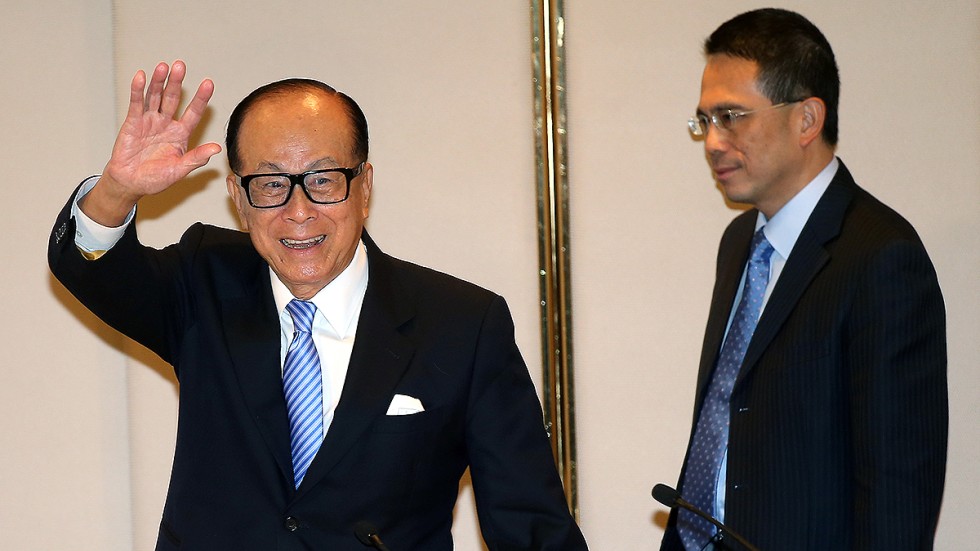
Can anyone say Li Ka-Shing [COSCO] here?
Chapter 1
Red China’s ‘Trojan Horse’
It is less noticed than Red Chinese Generals sipping wine and eating tiny sandwiches in military exchanges at Harvard and at the Clinton White House. Though occurring in broad daylight and in morning fog every day of the year, it is a“stealth invasion” of America’s shores at every major American seaport on the West, Gulf, and East Coasts.
The invasion force is A fleet of Red Chinese ships, the merchant marine of the People’s Liberation Army (PLA), delivering millions of cargo containers of unknown content into the strategic waters of the U.S. every year. The sloppy security that killed 17 and injured 39 sailors on board the U.S.S Cole is worse in U.S. homeports. Millions of Americans are today in harm’s way on their own soil.
Red Chinese vessels call unnoticed and uninspected. Usually the China Ocean Shipping Company (COSCO) and its shadow, the Orient Overseas Container Line (OOCL) follow the rules and fill out the paperwork. Instances of smuggling guns, drugs, technology, prostitutes, and labor are rare and seldom reported.
School children were once told the story of the wooden Trojan horse built by the Greeks to smuggle soldiers inside the walls of Troy. Today no one talks of the millions of sealed containers aboard Red Chinese ships, let alone their cross-continental distribution by railcar and truck trailer to every town in America. Only 2 percent are physically checked for contents. An occasional story of drugs or human cargo makes the news. The high vulnerability of U.S. seaports to espionage and terrorism is seldom suspected and virtually never investigated.
Exposing the COSCO Threat
As opponent of the China Ocean Shipping Company (COSCO) takeover of the Long Beach Naval Station, the U.S. Intelligence Council has long taken a particular interest in the security of U.S. seaports and home-ported Naval forces. The successful terror attack upon the U.S.S Cole has renewed USIC concerns – unfortunately in the blood of sailors and in the tears of families.
In 1997 Senator John McCain questioned the national security implications of awarding a $157 million contract between the China Ocean Shipping Company (COSCO) and a Mobile, Alabama, shipbuilder. Yet several federal authorities told Congress that “COSCO (the China Ocean Shipping Company) represents no threat to our national security.” Maritime Commission Chairman Harold J. Creel also denied any threat, but testified. that China the Ocean Shipping Company (COSCO) engaged in bribes, kickbacks, and predatory pricing. “They are not profit-driven,” he said. “They want to have their flag and their name on their ships.”
Since COSCO is not driven by profits and is interested in flying the Red Chinese flag, it is clearly an agent of its master – The People’s Liberation Army (PLA) - and it is an everyday available instrument of the military objectives of the People’s Republic of China (PRC). Indeed, the The People’s Liberation Army (PLA) has forward deployed about 100 of its COSCO, the (China Ocean Shipping Company) into the waters of the U.S.A.
One of COSCO’s (the China Ocean Shipping Companie’s) potential threats is its commingling with U.S. Navy ships within the waterways and chokepoints of strategic U.S. seaports. Since men and women of the U.S.S Cole are dead and injured because of a mere rubber dinghy, it is prudent to watch the PLA (People’s Liberation Army) deployment of COSCO’s, the (China Ocean Shipping Companie’s) worldwide fleet of 600 vessels. It is rational and reasonable to improve security measures for vessels, facilities and citizens at American seaports where COSCO (the China Ocean Shipping Company) calls. Soon after the Cole disaster, Dateline found it easy to move vessels amidst U.S. warships.
Other Threads of Beijing’s Web
In addition to COSCO the (China Ocean Shipping Company), USIC (the United States Intelligence Community) recommends that U.S. intelligence and law enforcement agencies add the Beijing-dependent, Tung family-owned Orient Overseas Container Line (OOCL) to its watch list.
USIC (the United States Intelligence Community) also wishes to alert authorities of the presence of Beijing-tied Li Ka-shing enterprises in the waterways of Vancouver (BC)-Seattle-Tacoma where the U.S. Navy homeports major submarine and destroyer forces and one aircraft carrier. USIC (the United States Intelligence Community) also recommends heightened security in those ports where Chinese commercial vessels – both COSCO the (China Ocean Shipping Company) and OOCL (Orient Overseas Container Line) – commingle with the naval forces of the U.S. Navy, particularly in Seattle-Tacoma, Charleston, Norfolk, and Long Island Sound. USIC (the United States Intelligence Community) seeks measures to protect national security from COSCO the (China Ocean Shipping Company) and other PRC (People’s Republic of China) “front” companies such as Orient Overseas and Hutchison Whampoa.
Chapter 2
America’s Achilles Heel: Poor Port Security
The little advertised, but long-named federal commission – the Interagency Commission on Crime and Security at U.S. Seaports – in the fall of 2000 completed an obtuse report that ploddingly revealed shocking evidence of rampant crime, corruption, and sloth on security issues at major American seaports.
The Interagency Commission made on-site surveys of 12 seaports, of which seven – Charleston, Long Beach, Los Angeles, Miami, New Orleans, New York/New Jersey and Tacoma – interest U.S.IC (the United States Intelligence Community) because of COSCO’s the (China Ocean Shipping Companie’s) presence in those ports. In addition to these, this U.S.IC (the United States Intelligence Community) report covers seaports in Portland, Seattle, Vancouver, New Orleans, Houston, Savannah, Norfolk, Halifax, and Baltimore, where COSCO the (China Ocean Shipping Company) and often OOCL (Orient Overseas Container Line) offer shipping services.
After conducting its investigation, the commission reached the alarming conclusion that the state of security in this dozen major American seaports “ranges from poor to fair.”
An independent FBI study reached a similar conclusion, ranking the vulnerability of our top 12 seaports to terrorist attack as “high.” The Bureau’s report adds that “such an attack has the potential to cause significant damage.”
Indeed, only two percent of all trade cargo is physically inspected despite widespread evidence of inaccurate or misleading paperwork.
There is no excuse for this terrible lack of even the most rudimentary security precautions at the seaports and in waterways of the United States. This is a matter of great import to our nation’s security and economic interests and the failures of local and federal governments to have basic security safeguards in place are appalling.
Poor or fair security is unwarranted given the importance of seaports to our national security and economic vitality:
• The U.S. Navy, Marine, Army or Air Force has facilities within the five of the 12 ports surveyed by the Interagency Commission on Crime and Security at U.S. Seaports.
• Of the 13 seaports with additional obligations to be ready for a national military mobilization in a war or a crisis, the Interagency Commission studied four and found them all wanting in adequate security for a mobilization, lacking readiness exercises, and having incomplete vulnerability/threat assessments.
• Nine of 12 ports had “no waterside security measures” to protect from foreign vessels.
• Nine of 12 ports could be blocked at only one to three chokepoints.
• “... U.S. seaports have become critical chokepoints for future military mobilizations ... [for overseas operations].”
Rampant Crime on Our Waterfronts
While concerns for espionage or terrorism at seaports goes unaddressed, knowledge of crime waves on America’s waterfronts has been known for perhaps a century. Massive underreported crime is known, but runs rampant on U.S. waterfronts.
Organized crime has little difficulty stealing cargoes or smuggling drugs or human beings. The Interagency Commission reported that organized crime is concealing drugs in cargoes at nine of the 12 ports it investigated. The Commission found that only three of 12 ports use modern technology to identify contraband or to verify shipments – in suspicious cases only.
Criminally organized alien smuggling is common on the West Coast. Alien stowaways were found in 10 of 12 ports. “Immigration has no way of knowing whether manifested crews actually leave on the ship they arrive on ... or remain illegally in the United States.” The CIA reported that about 50,000 women and children are lured to America annually and forced to work as abused laborers, servants and prostitutes, according to the New York Times. Some had arrived from China in COSCO (China Ocean Shipping Company) containers.
These vulnerabilities to crime are well known and their implications for organized espionage and terrorism ought to be transparent. The Royal Canadian Mounted Police, in their long-suppressed“Sidewinder” report,reveal intimate ties between the Chinese Triads (gangs) and the Communist PRC (People’s Republic of China). Clearly, American ports are open to theft of technology and destruction of human life and property and vital infrastructures.
In contrast to these street crimes, there is near total silence and little apparent action to explore vulnerability to espionage – export of militarily valuable technology – or to terrorism.
Terrorism by the Shipload
Prior to the loss of 17 lives aboard a poorly secured U.S.S Cole, the FBI told the Interagency Commission that the vulnerability of U.S. seaports to terrorist attacks was high, but said the terrorist threat was low. In other words, attacks upon U,S. ports were entirely in the hands of America’s enemies who could choose the times and places of their attacks as long as our ports did nothing about their high vulnerability.
Eleven of 12 ports are located in urban areas where millions of innocent lives are in harm’s way and where vital infrastructures (ports, roads, rail, telecommunications, water, electricity) are vulnerable to attack. Nuclear, biological, or chemical weapons – with or without missiles – might be secreted among the millions of cargo containers delivered to American ports on Red Chinese ships. Typically, ports lack basic intelligence information about terroristthreats provided to others.
“Increasing awareness of security-related threats among port facilities ... and expanding the availability of threat information ... would do much to alleviate this problem .... The federal government should establish baseline vulnerability and threat assessment for terrorism at U.S. Seaports.”
The Interagency Commission said none of the dozen ports met “the minimum port security criteria.” Only a third had barriers to halt or slow down a terrorist driving through fences. Half had “nonsecure” communications. With the exception of lighting and gates in most ports, persons and vehicles had easy physical access to most ports. Foreign sailors and domestic workers roam freely. Except for paper forms, foreign cargo is handled no differently than cargo from Kansas. It is inspected alongside domestic cargo in every port.
Smuggling Out U. S. Technology
“Seaports are vulnerable to those trying to acquire ... weapons, munitions, and critical technology [that] affect national security.” Federal inspectors working in remote locations spend more time behind computer terminals than on the docks. “The [Customs and Commerce] inspection and criminal investigation personnel ... devoted to export transactions are only a small fraction of those devoted to imports ....” Shipper’s Export Documents, SEDs, delivered as late as four days after a ship leaves port typically contain inaccurate, vague, misleading or false information.
No wonder that over two years (1996-98) in the 12 ports, the Commission reported only 296 offenses, 26 arrests, and 323 seizures valued at $33 million. “... [F]ederal agencies are probably detecting only a small portion of the controlled commodities that are being exported illegally,” said the Commission. There is no criminal statute for illegal exports.
The unstated policy of local ports is perhaps “Don’t Ask,” and the policy of intelligence agencies is “Don’t tell.” Our seaports are unaware of most security threats. The FBI, CIA, Customs, Coast Guard, local police and sheriff’s office tells them little or nothing about possible security threats. Our seaports are not ready for prime time, not prepared for attacks like that on the U.S.S Cole.
Nobody is looking. USIC (the United States Intelligence Community) urges the President, the Congress, and other government agencies to do their jobs defending national security. “Don’t know and don’t tell” is a dangerous policy of willful blindness. Our highly vulnerable seaports are open to Red Chinese vessels every day in every port.
U.S. Customs Asleep on the Docks?
The U.S. Customs Service is responsible for border enforcement having authority to search any shipment that crosses the U.S. border. One duty of the Customs Service is to cooperate with the State Department’s Office of Defense Trade Controls in conducting end-use checks of exports. The State Department sets criteria, but Customs carries them out. Despite the congressional Cox report and other intelligence agency evidence, during the entire Clintan-Gore administration U.S. Customs Service indicted only one PRC (People’s Republic of China) entity for violating U.S. export laws. CATIC – the China Aero Technology Import and Export Corporation – was indicted for using U.S. B-1 and missile machine tools from McDonnell Douglas to manufacture military aircraft and silkworm missiles in Nanchang. [U.S. Customs Today, January 2000]. Meanwhile, Customs devoted considerable resources to interdicting imports of drugs, child pornography, counterfeit clothing, bootleg software and forced labor goods.
Customs “discrepancy” statistics show China very faithfully following Customs’ rules and regulations for processing paperwork. COSCO (China Ocean Shipping Company) virtually never appears in U.S. daily newspapers, seldom in business journals, and infrequently in U.S. port websites. COSCO (China Ocean Shipping Company) is virtually always below the radar screen. This stealth company quietly dominates container cargo ports throughout the U.S. COSCO (China Ocean Shipping Company) does not draw attention to itself its routine commerce in the U.S.
Though China (plus Hong Kong) was far and away the world’s worst violator of slave labor, Customs reports in 1999 and 2000 “this merchandise ... does not appear to be a large violation of the law.” In that time, only 250 people had been prosecuted for slave trading, according to the 79-page report “International Trafficking in Women to the United States: A Contemporary Manifestation of Slavery.” This is shocking, given the CIA’s figure of 50,000 people who are brought here in secret bondage annually.
Customs did vigorously move to halt the import of Chinese artificial flowers, tea and other products through 20 detention orders and four findings in 1999. Meanwhile, Customs appeared to give scant resources and no mention on its website to preventing the export to China of U.S. nuclear, missile, stealth, fiber optic and other technologies vital to our nation’s defense. Only one Chinese company and three foreign nationals were indicted.
U.S. Customs’ automated export system flags all military goods destined for China (error 853) and does not allow China a low value exemption from reporting detailed shipping information. Yet in fiscal 1999 Customs apparently found hardly any instances of violations that it considers prosecutable except for the indictment of three foreign nationals [fiber optic, stealth, and antimissile technologies], [U.S. Customs, FY 1999 Accountability Report].
Indeed, Customs has granted COSCO (China Ocean Shipping Company) – the nearly exclusive shipper to China and a PRC (People’s Republic of China) owned entity – special processing of its cargoes usually accorded to private and free world shippers. For COSCO (China Ocean Shipping Company) these include automated remote location filings and exemptions granted in early 1997 from submitting Cargo Declarations with manifests and from presenting copies to Customs for review. Are such efficiencies worth the national security risks of potentially dangerous cargoes or exports of militarily valuable technologies?
Another breach is opened by the freight forwarder, the person often controlling the shipping manifests or the paper trail on the contents of ships and containers. Freight forwarding is a legal business. The problem is the loyalties of Red Chinese company owners.
Kenneth Timmerman writing in the October 1997 issue of the American Spectator lists Red Chinese-controlled freight forwarders such as Pan Ocean Lines, North China Cargo, CU Transport Inc. (a creature of the China National Foreign Trade Transportation Corporation) located in Alhambra, Rosemead, and Monterey Park, California. In Compton there’s the China Interocean Transport Inc. (China National Foreign Trade Transportation Corp.); CCIC North America Inc (China National Import and Export Commodities Inspection Corp.) in West Covina in El Monte, Morrison Express of El Segundo.
Timmerman’s investigative reporting for Readers Digest, American Spectator and the Cox Report disclosed thousands of Red Chinese companies based in the US – most in LA – that are open for business and possibly espionage. Under the 1999 Defense Authorization Act the Pentagon was ordered to identify Chinese front companies. It did not. Rep. Chris Coxf said, “The Clinton-Gore administration’s failure to obey the law is knowing, willful and longstanding.”
The whole Clinton-Gore response to Chinese espionage was bizarre, as described by Johnny Chung of WND (WorldNetDaily): “This White House administration not only delivered PNTR*, but it also called Taiwan an intelligence threat to the U.S. and listed the country as a terrorist threat along with Russia, China, North Korea, Serbian-controlled Bosnia, Vietnam, Syria, Iraq, Iran, Libya and Sudan.” [*“PNTR” = Permanent Normal Trade Relations, is a legal designation in the United States for free trade with a foreign nation.]
Meanwhile, the espionage threat of China inside the United States is unspoken and unexplored. We will concentrate most of our attention upon Red Chinese presence in U.S. seaports through Beijing’s “front” companies.
Chapter 3
A Red Chinese Sailor in Every U.S. Port
The Red Chinese government owns the 600-ship China Ocean Shipping Company (COSCO), one of the world’s largest container shipping enterprises. It operates as the merchant marine of the People’s Liberation Army (PLA) and as such has been caught transporting AK47 automatic rifles to street gangs in Los Angeles, components of weapons of mass destruction to Iran, Iraq, Libya, North Korea. Yet COSCO (China Ocean Shipping Company) has few critics and many friends.
The Many American Friends of COSCO
Old salts like my father, a career Navy man, remembered the days when signs saying “Dogs and Sailors Keep Off the Grass” littered the lawns of American harbor towns when swabbies “hit the beach.” Those days are gone. There are far fewer American sailors now and Red Chinese sailors are welcomed everywhere. In Long Beach and Seattle locals ooze with affection for foreign sailors – in particular those from COSCO (China Ocean Shipping Company).
With help from the Clinton White House, the City of Long Beach tried mightily to give the former U.S. Naval Station to COSCO (China Ocean Shipping Company) and local officials actively aided COSCO’s (China Ocean Shipping Company’s) quest for a larger (secure) facility in the region. For nearly three years, U.S.IC (the United States Intelligence Community) and its over 350,000 petition signers implored leaders to reconsider their short-sighted interest in trade. Finally, only acts of Congress nixed a 20-year lease of the Long Beach Naval Station to China and nudged the Port of Los Angeles out of a Pier 400 deal with COSCO (China Ocean Shipping Company). COSCO quietly stretched out at new berths at Pier J.
In the Los Angeles region proponents of increasing trade with China have largely silenced debate about the strategic importance of the Ports of Long Beach and Los Angeles to the nation’s security.
“On May 8, [2000] the Long Beach Port Authority held a ceremony in HYATT Hotel for President Chen Zhongbiao of COSCO (China Ocean Shipping Company) Group, in which President Chen got the honorary Long Beach Pilot Award. During the ceremony, Madam O’neill [sic], the mayor of Long Beach, expressed her sincere thanks for President Chen’s support for the establishment of friendly cooperation between COSCO (China Ocean Shipping Company) and Long Beach, especially under the complicated situation two years ago. The Chairman of Long Beach Port Committee song [sic] high praise for President Chen’s superior working style and his devotion to the development of shipping industry of China and the U.S., and even the whole world. After the speech, he awarded President Chen the honorary Long Beach Pilot Award on behalf of Long Beach Port Authority.”
Still the City and Port of Seattle far surpasses the Long Beach kowtow. Seattle perfected genuflection with uniforms and music provided by – one presumes – a reluctant U.S. Navy. Locals persuaded a U.S. Navy band to provide uniforms and music. One suspects the Navy was keelhauled, dragooned, impressed against its will.
Commemorating the glorious 20th anniversary of the China trade with Seattle in April 1999, a “... fireboat fired towering columns of water ... [And] ... a 13th [U.S.] Naval District band broke into ‘It’s a Small World.’ The red and gold flag of the People’s Republic of China (PRC) and the Stars and Stripes were raised and snapped together ....
“There is a larger meaning ... connections with ... one of the leading countries of the world in the next century,” said Port of Seattle Commission President Patricia Davis. “[The] ... arrival of each COSCO (China Ocean Shipping Company) ship ... [is] ... vital for world stability and security and prosperity....” [Seattle Post-IntelIigeticer, April 19,1999].
So what is COSCO? What’s the problem with thousands of jobs and billions of dollars of trade with China?
A Vast Shipping Empire
COSCO (China Ocean Shipping Company) is “one of the world’s largest shipping lines, with more than 600 vessels, several hundred [300] subsidiary companies and [has] 80,000 employees handling trade in 150 countries,” said Seattle-based COSCO spokesman Mike Foley in the April 19, 1999 issue of the Seattle Post-Intelligencer.
According to its website “COSCO GROUP ships visit more 1200 ports.” Of COSCO’s vast fleet, close to 100 ships call on U.S. ports, and about 300 use the Panama Canal. Its larger container vessels have a capacity of 5250 TEUs (20foot equivalent container units). In 1997, the volume of cargo carried by COSCO’s world container fleet was 3.4 million TEUs over 653.4 billion ton-miles.
Headquartered in Beijing, COSCO GROUP has major offices in Hong Kong, Japan, Singapore, the United States, Europe, South Africa and Australia, etc. China Ocean Shipping Company Americas, Inc., has over 85 subsidiaries and offices throughout the American continent with over 700 employees. COSCO Americas headquartered in Secaucus, New Jersey.
This shipping enterprise is listed as a “red chip,” a PRC (People’s Republic of China)-owned company, on the Hong Kong Stock exchange [Reuters, May 15, 2000] and is seeking a co-listing on New York exchanges. COSCO (China Ocean Shipping Company) floats loans in American markets. Recently, COSCO Group Ltd appointed BankBoston NA to arrange a $50 million loan to refinance debt. [Bloomberg- News May 9, 2000] .
COSCO (China Ocean Shipping Company) has an increasingly routine presence in America’s ports. Its ships sail in and out of American ports every day – Baltimore, Charleston, Houston, New York, Miami, New Orleans, Norfolk, Oakland, Port Elizabeth (NJ), Portland (OR), Seattle, Tacoma.
Even Washington, D.C., has noted COSCO’s (China Ocean Shipping Company’s) presence – although not in the form of a fleet on the Potomac. Under the adept leadership of Rep. Christopher Cox (R-CA) Congress issued a highly revealing report of Red Chinese theft of U.S. nuclear secrets and access U.S. missile guidance technology, which just happened to mention a certain shipping operation.
“The China Ocean Shipping Company (COSCO), the PRC’s (People’s Republic of China’s) state-owned shipping company ... operates under the direction of the Ministry of Foreign Trade and Economic Cooperation and answers to the PRC (People’s Republic of China) State Council,” the congressional report stated.
The Clinton-Gore administration suppressed further information within the full-classified Cox report. “The Clinton administration has determined that additional information concerning COSCO that appears in the Select Committee’s classified Final Report cannot be made public ....”
Perhaps the Bush administration will see fit to reveal more about COSCO (China Ocean Shipping Company) than did his kow-towing predecessor. “Although presented as a commercial entity,” according to the House Task Force on Terrorism and Unconventional Warfare, “COSCO [the China Ocean Shipping Company] is actually an arm of the Chinese military establishment.”
Chapter 4
The PLA’s Merchant Marine
COSCO’s (China Ocean Shipping Company’s) civilian trappings and predominantly commercial enterprises obscure its military mission.
The China Ocean Shipping Company (COSCO) is the merchant marine of the People’s Liberation Army (PLA) of the People’s Republic of China (PRC). The PRC refers to COSCO ships as zhanjian or “warships” and boasts that COSCO workers are and will be ready for battle into the next century.
The Communist Chinese government owns it. COSCO Beijing’s website carries quotations from top Communist Party officials. COSCO is intimately linked to the China International Trust and Investment Corp. (CITIC), a key fund-raiser for the Chinese government and a technology-acquiring source for China’s military. COSCO serves its master.
An article in the November 10, 1997, New American described COSCO as “hardly a typical state-owned shipping company. COSCO ships have been used to ferry tanks to the Marxist regime in Burma, ship North Korean rocket fuel to Pakistan, smuggle heroin into Canada, ship AK-47s bound for California street gangs, technology smuggling to China.” It has even purchased a Russian K-3 nuclear attack submarine from Finland.
Espionage and Other Clandestine Activities
Indeed, COSCO ships have been caught and cited for transporting components of weapons of mass destruction such as Chinese missile-technology, and nuclear, chemical, and biological weapons components, materials and fuels into North Korea, Pakistan, Syria, Iraq and Iran, according to U.S. intelligence and international authorities. COSCO has been repeatedly cited over many years and as recently as late 1999.
More ominously for our national security, COSCO (the China Ocean Shipping Company) is “known to be associated with Chinese intelligence operations,” according to Year of the Rat. Like Soviet trawlers before them, COSCO ships sail in the waterways and dock at strategic locations all across the globe and in every major American port. These locations enable them to intercept electronic communications everywhere.
Li Ka-shing, COSCO Senior Advisor and owner of Hutchison Whampoa – operators of ports worldwide – “is to the Chinese army intelligence HQ what Howard Hughes was for the CIA,” says William Triplett, author of Red Dragon Rising.
Recently, the Chinese were caught monitoring Japanese radio signals and mapping undersea approaches to Japan for their sub marines. In July 2000 a secret CIA report described Russian merchant ships gathering signals intelligence north of Puget Sound and the Ports of Seattle and Tacoma. It is prudent to presume that – like the Soviets and the Russians – the Chinese are gathering intelligence in the U.S.A with their forward deployed assets – COSCO (China Ocean Shipping Company) ships and agents.
Smuggling is another activity in which COSCO vessels have been employed, transporting contraband weapons, drugs, slave labor, and prostitutes.
Richard Delgaudio testified before a U.S. Senate Armed Services Committee hearing chaired by Sen. John Warner, that Li Ka-shing is “China’s Red Billionaire” and his firm is deeply involved in clandestine operations for Red China’s military. Delgaudio’s testimony and his book Peril in Panama amply document China’s threats to the Panama Canal and to the U.S. from missiles smuggled into Li’s port facilities there.
The New American calls COSCO “a PLA (People’s Liberation Army)-connected container shipping fleet that specializes in drug and weapon smuggling.” COSCO smuggled 2,000 AK-47 assault rifles into San Francisco in 1996 – the largest seizure of smuggled automatic weapons in U.S. history. Smuggled aboard the COSCO vessel Empress Phoenix, the weapons were “destined for Asian street gangs founded by illegal immigrants who were once members of the PLA’s (People’s Liberation Army’s) elite Red Guard,” according to the New American.
Added Canada’s Globe and Mail in a May 4, 1996 story: “Top officials of the two Beijing-based companies Norinco and Poly Technologies that make weapons for the Chinese military participated in the smuggling.”
In February 1996, President Clinton met with Poly Technologies Chairman Wang Jun after taking a donation from Charlie Trie. A Rand report says, “Wang Jung is both director of CITIC (China International Trust and Investment Corporation) and Chairman of Poly Group, the arms trading company of the General Staff Department.”
Wang Jun’s employer of record is COSCO (China Ocean Shipping Company), according to the New American. Wang Jun, the chairman of the Poly Group is a business partner with Ng Lap Seng, described by the New American as a “Macau mobster,” who in turn is a business partner with Macau casino king Stanley Ho and, through Charlie Trie, a conduit of other Chinese money to Clinton and Gore.
“Poly’s U.S. subsidiaries were abruptly closed in August 1996,” states a Rand report. “Allegedly, Poly’s representative, Robert Ma, conspired with China North Industries Corporation’s (NORINCO) representative, Richard Chen, and a number of businessmen in California to illegally import 2000 AK-47s into the United States.” Their customers were undercover U.S. Customs and BATF agents.
A year later, after Senator John McCain questioned an above-market and taxpayer-subsidized COSCO contract for $157 million with a Mobile Alabama shipbuilder, the CIA, the Coast Guard, and the Customs Service told congressmen Steve Horn and David Dreier, that, “COSCO represents no threat to our national security.” [Washington Times, April 4, 1997].
Harold J. Creel, Maritime Commission chairman, did admit that COSCO engaged in bribes, kickbacks, and predatory pricing. “They are not profit-driven ... They want to have their flag and their name on their ships,” said Creel.
Today COSCO (the China Ocean Shipping Company) has become a dominant force in modern container shipping in the world while the U.S. retreats from maritime activities vital to its own defense.
Chapter 5
Surrendering the High Seas
In contrast to COSCO’s (China Ocean Shipping Company’s) massive merchant marine fleet the U.S. Navy Military Sealift Command operates only 110 ships across the globe. While these ships are identified as “U.S.NS” – United States Naval Ships – they are not commissioned ships of the U.S. Navy. Civilians man U.S. sealift ships, not military personnel. In contrast, COSCO’S large fleet is under the absolute control of the People’s Liberation Army (PLA).
Most U.S. sealift vessels are in reserve and require time to activate. The National Defense Reserve Fleet (NDRF) has activated up to 600 ships to meet sealift needs during the Korean War, Berlin Crisis, Suez Crisis, Vietnam War, and to ship coal to Europe and grain to India. These historically proven needs aside, “Currently, the NDRF consists of [only] 258 vessels .... However, 85 are no longer militarily useful and are slated for scrapping. In addition ... another 51 ships are held ... on a reimbursable basis. Forty-one of these are naval vessels awaiting disposal. These vessels are maintained at Benicia (Suisun Bay), California; Beaumont (Neches River), Texas; and Fort Eustis (James River), Virginia and at designated outported berths.” [U.S. Department of Transportation, Bureau of Transportation Statistics, Maritime Administration, U.S. Coast Guard Maritime Trade and Transportation 1999, BTS99-02, Washington, DC: 1999].
Thus America’s available defense reserve fleet now comprises 143 ships – far less than the 600 found necessary several times since World War II and about equal to the COSCO (China Ocean Shipping Company) fleet servicing just U.S. seaports.
In addition, American capacity to draw upon private U.S. shippers is quite limited. “U.S.-flag oceangoing vessels play a small role in carrying the nation’s international commerce ... [T]he United States ranks 26th in the number of [U.S. flagged] ships and 11th in total DWT (deadweight tonnage). ...The United States ranks 13th in the number of tankers, 9th in tanker DWT (deadweight tonnage), 8th in containerships, and 6th in containership DWT (deadweight tonnage).” While, “approximately 45 percent of the world fleet by deadweight capacity calls at U.S. ports (U.S. Industry and Trade Outlook 1998), most is carried in foreign – increasingly Red Chinese – bottoms.
China Leads the Container Revolution
Enclosed 20- and 40-foot-long metal containers are increasingly the standard of efficiency. Most containers are truck trailer sized bodies easily moved from truck to railcar to ship. Containers ease storage, retrieval, and transfers of bulk cargo among ship, railcar or truck but they are major security problems. Drugs, weapons, and human beings are easily hidden from view and closed containers are difficult to inspect.
The latest containerships have a capacity of 4,500 20-foot equivalent container units (TEUs) [a measure used for capacity in container transportation] or more, and require drafts of 40 to 46 feet when fully loaded.
“To physically accommodate megaships at U.S. ports, channel and berth depths must be at least 50 feet. However, only five of the top 15 U.S. container ports – Baltimore, Tacoma, Hampton Roads, Long Beach, and Seattle – have adequate channel depths, and only those on the west coast have adequate berth depths. In addition, ports may need to expand terminal infrastructure, such as cranes, storage yards, and information systems, to facilitate the increased volumes of cargo from these ships. Also, landside modes and facilities ... will face higher volumes of rail and truck traffic. Many ports have initiated expansion projects to accommodate these ships.” (U.S.DOT MARAD 1998, 49-51). [U.S.DOT MARAD = Maritime Administration]
Local port expansion projects of over a billion dollars are common as U.S. ports compete to accommodate new container traffic – much of it by Beijing-owned COSCO (China Ocean Shipping Company) and the Beijing-friendly Orient Overseas Container Line, (OOCL). While using taxpayer funds is common, the use or swapping of former military port facilities is well hidden. (Long Beach, Oakland, Charleston, New York, Newport).
The world’s containership fleet increased 15 percent annually from 1993 to 1997 as the larger ships handling 4,000 or more 20-foot equivalent container units came into service mostly in east/west trade.
Who is building the ships? Japan and South Korea alone build a third. China may be a distant third, but the U.S. ranks 14th, accounting for an anemic 1 percent of gross tonnage of ships built. In late September 2000 the Washington Times discovered a Clinton Pentagon proposal to build American auxiliary military ships overseas. After protests from Congress, Rear Adm. Craig Quigley claimed that Clinton’s Defense Secretary William Cohen had “emphatically not” supported the idea. The only remaining support ship builders in the U.S. are National Steel in San Diego and Avondale Industries in New Orleans. American shipbuilders shrunk from 21 firms in the 1980s to six defense shipyards in 2000.
Foreign flagged, built, and manned vessels are landing on U.S. coasts – 42 percent of the value of U.S. waterborne trade hit the West Coast, 38 percent the East, and 18 percent the Gulf in 1997. (U.S.DOC Census 1997, table 1069; U.S.DOT MARA.D 1998). COSCO leads this foreign armada. [U.S.DOT MARAD = Maritime Administration]
Long Beach and Los Angeles dominate West Coast trade, but waterways contiguous to the ports of Vancouver, B.C., Seattle and Tacoma are strategic assets for U.S. Navy operations on the Pacific Rim. The port of New York/New Jersey leads the East Coast in both value ($68 billion) and in containers (1.7 million TEUs) handled in 1997, but Charleston and Norfolk are major container ports. The Gulf ports of Houston and South Louisiana handle bulk commodities and crude petroleum making them the top two U.S. ports by gross tonnage. [TEUs) = a measure used for capacity in container transportation]
COSCO’s Role in Red China’s Naval Strategy
Evidence suggests COSCO (China Ocean Shipping Company) plays a greater role as “a naval arm” of the People’s Liberation Army (PLA) of the People’s Republic of China (PRC) far beyond that of merchant marine.
“There is a consensus among military specialists that China is prioritizing two areas of military growth: its missile program and its navy,” states the authors of Year of the Dragon. “COSCO (China Ocean Shipping Company) is essential to its naval program.”
Red China seems to be preparing to contest with the U.S. Navy, Taiwan, and Japan in its own region. Six hundred COSCO merchant vessels do not appear as major combatants in that theater. However, they perform other functions of naval strategy – COSCO is China’s forward-deployed naval forces across the globe.
Chinese naval strategy for COSCO might be described as follows:
Some vessels could serve as platforms for theater ballistic missiles ,as well as containers for nuclear, biological and chemical weapons. They might provide mobile bases for the cyberwar much discussed as part of China’s RMA (Revolution in Military Affairs).
Ships equipped with electronic information gathering devices can provide signals intelligence from every important U.S. seaport.
Delgaudio in Peril in Panama shows how COSCO (China Ocean Shipping Company) can secretly deploy an intermediate range nuclear missile at Li Ka-shing’s Panama ports to threaten 100 or more major U.S. cities.
And COSCO might conceivably serve as an expeditionary force projecting military power far from China.
The U.S. Navy describes naval forces as “sea-based, self-contained, and self-sustaining ... relatively unconstrained by regional infrastructure requirements or restrictions. Further, naval forces can exploit the freedom of maneuver afforded by the seas ....
“Mobility and Adaptability. Naval forces can operate anywhere on the oceans, free of diplomatic restraint. As such, they have an unmatched ability to operate forward continuously, react to contingencies ... and act as the enabling force for follow-on Army and Air Force power ....
“Presence and Visibility. Ships can be purposely conspicuous or exceptionally difficult to detect. In peacetime, ... visibility ... signal[s] interest, readiness, and ability to act if a crisis brews. The same ships, stationed close in, on the horizon, just over it, or in unlocatable places and circumstances, can be used as needed in crisis or conflict. With the ability to cumulate forces, naval power can be adjusted or scaled at will, increasing or decreasing pressure ... as ... leadership chooses to raise or lower ... commitment, and engage or disengage much more easily than land-based forces, ... the enduring attractiveness of naval power is the flexibility that stems from these inherent characteristics and attributes. Investments in the Navy and Marine Corps are like money in the bank. We do not need to know precisely how and where we will use this resource in order to see its value – indeed our value is greater because we are useful virtually anywhere and anytime. Our expeditionary character, mobility, adaptability, variable visibility, and cooperative and independent capabilities ... an especially relevant and useful force. Entering this new century, the technology, information, strike and telecommunications revolutions are rapidly undoing ... bounds on naval power ... Communications capacities ... have increased by several orders of magnitude. Information processing capabilities have expanded concomitantly. Sensor and surveillance systems provide ship-based forces with information about and insights into the land environment that can equal that of land-based forces. [U.S. Navy, Posture Statement 20001.”
The China Ocean Shipping Company’s (COSCO’s) vast fleet already enjoys both the classic advantages and the modern application of all naval vessels outlined above. And it also benefits from the support of some very influential allies around the world.
Chapter 6
COSCO’s Network of Powerful Allies
The China Ocean Shipping Company does not have to conduct its mission alone. In addition to its expanding web of operations in North America and around the world, COSCO can rely on a network of influential “friends.” The surprising range of connections include a Chinese billionaire whose Hong Kong-based company operates ports around the globe, a former U.S. Secretary of State, and a “shadow” container company bailed out by a member of the Chinese mafia.
The ‘Red Billionaire’
In Perils in Panama and in testimony before the U.S. Senate, USIC (the United States Intelligence Community) Chairman Richard has detailed the career and activities of Li Ka-shing. A plastic flower king at thirty, Li met Y.K. Pao, a Hong Kong banker, who introduced him to banker Michael Sandberg. Sandberg was looking for a Chinese with the best guanxi to the Beijing leadership. Li was just the right man. Sandberg helped Li get a bargain price for his bank’s 22 per cent stake in a British owned hong – Hutchison Whampoa.
By late 1999, a secret “Intelligence Assessment” by the U.S. Southern Command Joint Intelligence Center, said, “Li Ka-shing, Hutchison Whampoa’s owner, has extensive business ties in Beijing and has compelling financial reasons to maintain a good relationship with Beijing ... Hutchison’s containerized shipping facilities in the Panama Canal, as well as the Bahamas, could provide a conduit for illegal shipments of technology or prohibited items from the west to the PRC (People’s Republic of China), or facilitate the movement of arms and other prohibited items into the Americas.”
Li Ka-shing’s vast global shipping empire requires watching because of his intimate connection to COSCO (China Ocean Shipping Company) as its Honorary Senior Advisor. COSCO Beijing website says:
“Mr. Li Ka-shing. Mr. Li is one of Hong Kong’s most prominent businessmen; as Chairman & Managing Directorof Cheung Kong Holdings and Hutchison Whampoa Ltd., Hong Kong he requires no forther [sic] introduction.”
China military specialist William Triplett, co-author of Red Dragon Rising, describes Li as “the banker” for the Chinese army. The Rand Corporation, the U.S. Bureau of Export Affairs, and the U.S. Embassy in Beijing, all report that Li Ka-shing and his companies serve the Chinese military as financiers and acquirers of high technology for the PLA (People’s Liberation Army.) [Charles Smith, WorldNetDaily]
Li Ka-shing is also major investor in the China International Trust and Investment Corporation. Both the White House in 1994 and the Rarid Corporation in 1997 revealed Li Ka-shing’s role in CITIC. “According to the 1994 White House dossier, Li Ka-shing is a ‘member of the boards of directors of the China International Trust and Investment Corporation (CITIC). The CITIC bank is also more than it seems. The Rand report said, “CITIC does enter into business partnerships with and provide logistical assistance to PLA (People’s Liberation Army) and defense-industrial companies like Poly (Technologies).” Poly Technologies, Ltd. is the primary commercial arm of the PLA (People’s Liberation Army) General Staff Department’s Equipment Sub-Department. CITIC (China International Trust and Investment Corporation), according to the Rand Corporation, “became identified with the PLA (People’s Liberation Army) as a result of the scandal surrounding (Poly Technologies chairman) Wang Jun and his visit to the White House on 6 February 1996.” [Charles Smith, WorldNetDaily]
According to a 1994 Clinton dossier provided to participants in a trade mission, Li has “significant economic and political ties to China,” including investments in a “power station, a highway construction project and a large contribution to Shantou University.” [Charles Smith, WorldNetDaily].
In 1997, the Rand Corporation’s secret report on the “Chinese defense industry” revealed, according to Charles Smith, Li Ka shing’s direct connections to the Chinese military, “Hutchison Whampoa of Hong Kong, controlled by Hong Kong billionaire Li Kashing, is also negotiating for PLA (People’s Liberation Army) wireless system contracts, which would build upon his equity interest in (Chinese army) Poly-owned Yangpu Land Development Company.”
A USIC (the United States Intelligence Community) search of recent financial and stock market news reveals Li Ka-shing, his family, and his companies heavily invested in the Internet, telecommunications, electricity, and water. China’s new military doctrines – a Revolution in Military Affairs, RMA – advocate cyberwar against the internet and disruptions of telecommunications. This doctrine taken with the Chinese appreciation of the vulnerability of infrastructures is disturbing – given its possible use of agents to exploit Li Ka-shing in strategic industries and locations around the world. Prudent intelligence services ought to watch.
COSCO (China Ocean Shipping Company) senior advisory board member, Li Ka-shing, has his own shipping empire mostly concentrated in port facilities used by COSCO outside of the U.S.A. Li’s principal property holding company Cheung Kong owns a maritime arm through Hutchison Port Holdings Ltd. (HPH). HPH has 18 major ports around the world (4 in the UK alone) and 8 other affiliates. Li’s companies recently handled 10 percent of the world’s global shipments.
Hong Kong International Holdings (HIT) operates at Container Terminals 4, 6, 7 and through its joint venture with China Ocean Shipping Company (COSCO) at Terminal 8 East. In 1996, HIT (Hong Kong International Holdings) was offered the right to develop and operate two berths in Container Terminal 9 (CT9). HPH owns three other incomplete container terminals in Hong Kong, is purchasing port facilities at the Suez Canal, owns Frazer docks in Vancouver, and has interests in other shipping container companies. Li Ka-shing’s container facilities include: Freeport Container Port, Bahamas; Panama Ports Company, Balboa & Christobal; UK -Port of Felixstowe; Harwich International Port; Thamesport; Europe Combined Terminals, Rotterdam; Port Said, Eygpt; Jakarta International Container Terminals; Jakarta’s Koja Container Terminal; Myanmar International Terminals (Burma); Thilawa, Yangon.
In mainland Red China Li Ka-shing operates: Shanghai Container Terminals; Yantian International Container Terminals, Shenzhen; Nanhai International Container Terminals; Jiangmen International Container Terminals; Zhuhai International Container Terminals (Jiuzhou); Shantou International Container Terminals; Xiamen International Container Terminals; Zhuhai International Container Terminals (Gaolan); Hong Kong InternationalTerminals;NigboPort.
A Former Secretary of State
Li serves with General Alexander M. Haig, a COSCO (China Ocean Shipping Company) advisor, according to the COSCO Beijing website in the first week of June 2000. The former NATO Commander, Secretary of State, Presidential Chief of Staff, has been a paid “domestic and overseas senior honorary advisor” to the China Overseas Shipping Company. He lobbied to obtain the Naval Station in Long Beach for the Chinese.
As owner of Worldwide Associates, Haig advises United Technologies, a manufacturer of jet engines, air conditioners, and elevators. The company has made billions in 17 joint ventures in China. It is reminiscent of Armand Hammer’s exclusive franchises in the Soviet Union for pencils, asbestos, chemicals, artwork, banking, medicines, and oil.
Haig’s backing of China trade extends to newspaper columns and expert commentary on television. McAlvany Intelligence reports, “Haig has been ... aggressive in defending the Red Chinese butchers ... defending the Red Chinese leaders just a few months after they slaughtered up to 10,000 student demonstrators in 1989. When China (in early '96) blockaded the Taiwan Straits and lobbed nuclear capable missiles ... off the coast of Taiwan ... and threatened to nuke Los Angeles if America came to the aid of Taiwan, Haig frantically called members of Congress, defending China and urging [Congress] not to impose trade sanctions ....”
Haig is just one of six former Secretaries of State who publicly support permanent normal trading relations with China.
The “Shadow” Company
According to the Royal Canadian Mounted Police, Li Ka-shing is very connected to Tung Chee-hwa, the Beijing appointed Chief Executive of Hong Kong and shares many ventures with the Tung family company Orient Overseas Container Line, OOCL.
“Orient Overseas (International) Ltd. OOIL owns a 23 percent stake in $1.8 billion Oriental Plaza, in Beijing ... backed by the Tungs, Richard Li (Pacific Century) and Li Ka-shing (Hutchison),” [Business Week March 24, 1997; 22nd March 1999.... FEATURES June 1999 Issue GREAT MALLS OF CHINA, Paul Money].
The brothers Tung of Hong Kong have a successful family business and profitable political relations with Beijing. Younger brother C.C. Tung, chairman of the OOCL (Orient Overseas Container Line) since 1996, is a member of advisory boards for both COSCO and the Panama Canal. Rescued from bankruptcy by Beijing and Li Ka-shing, C.C.’s older brother Tung Chee Wah was CEO of Orient Overseas until he was chosen by Beijing to run Hong Kong as its chief executive after the Communist takeover in July 1997. Despite Tung’s high position, a man named Henry Fok may really be “the puppet master in Hong Kong.”
In 1986 when Tung Chee-hwa’s OOCL (Orient Overseas Container Line) shipping business was on the brink of bankruptcy owing some $2.7 billion to its creditors, Red Chinese interests came up with the $120 million he needed to stay in business. They restructured $1.6 billion in debt and declared $1 billion of it as equity. Henry Fok, identified by the U.S. Justice Department as a member of the Chinese mafia Triad and a Hong Kong businessman with extensive ties to the Red Chinese mainland, engineered the deals to bail out OOCL.
It is widely believed that Henry Fok brokered bridge loans from Li Ka-shing and PLA-owned COSCO to keep Orient Overseas afloat. Fok was a decades-long Communist Party activist who assisted the PRC (People’s Republic of China) during the Korean War. [Chapter 8, The Year of the Rat]. “Further support for Tung in Peking came from Li Ka-shing, who also helped rescue Orient Overseas.” [Dr. Karl-Heinz Ludwig Ursulastr. 5D-80802 MUNCHEN].
According to the Far Eastern Economic Review, Fok and his Red partners invested still again two years after the bailout, “giving them a key role in the restructuring of the Tung empire.” Though having a financial stake in Orient Overseas International (OOIL), they allowed Tung to recover equity very quickly. In 1987 Tung’s wealth was “peanuts.” A vehicle called Tung Holdings Trust, THT, held 65 percent of the company that controlled 74.6 percent of Orient. Fok acquired 27.48percent of THT in 1989. In 1991 Tung borrowed to buy back 23 percent from Fok. In 1992 debts were converted to Tung shares of Orient Overseas. By 1996 Tung had recovered 57.6 percent of a now very profitable company.
One well-placed source (he asks to remain nameless when discussing Fok) says: “Henry Fok could become the next leader of Hong Kong just by asking the Chinese for it.” But Fok seems to have concluded that he can exercise all the power he wants through his man, Cheehwa Tung, while maintaining the very low profile he craves.” [Nov 18, 1996 Forbes Today].
His financial future secure and his loyalty certain, Beijing appointed Tung Chee hwa to become Hong Kong’s executive officer and his brother C.C. Tung took over OOCL (Orient Overseas Container Line) in October 1996. [”Henry Who: A Friend Indeed,” By Simon Fluendy, Far Eastern Economic Review, January 9,1997; Fortune April 1,1996].
In late June 2000 the South China Morning Post reported that Chinese leaders in Beijing “told a group of visiting Hong Kong tycoons they should support Hong Kong Chief Executive Tung Chee-hwa for a second term in exchange for favorable business treatment.” The paper’s largest shareholder, Robert Kuok, complained that the reporter, Willy Lam, didn’t appreciate “manifestations of patriotism to the mother.” [Reuters, Nov 4, 2000]. Chinese President Jiang Zemin “lashed out at journalists for asking whether Tung was the ‘emperor’s choice’ to serve for another five-year term,” reported Reuters on Nov 11, 2000. Demoted as China editor, Lam resigned. [Reuters, Nov 4, 2000].
A Beijing-revitalized OOCL (Orient Overseas Container Line) is back as “one of the world’s largest international integrated containerized businesses,” according to its website. In 2000 OOCL had 13 offices and very extensive business activities the People’s Republic of China and 160 offices in 50 countries. With 21 branches in China, OOCL “covers virtually every province and major trade center.” OOCL calls at 13 Chinese ports - Dalian, Fuqing, Fuzhou, Huangpu, Ningbo, Qingdao, Shanghai, Shantou, Shekou, Taiping, Xiamen, Xingang and Yantian. Li Ka-shing operates many of these ports including Shanghai Yantian, Shantou, Xiamen, and Nigbo.
In the United States OOCL (Orient Overseas Container Line) operates in many of the same ports as COSCO (China Ocean Shipping Company). OOCL in America is headquartered in the San Francisco-Oakland Bay area town of Pleasanton. OOCL has service offices in the coastal cities of Boston, Charleston, Houston, Long Beach, New York, and Seattle and in Vancouver, B.C. and Panama. In addition to services in cities with OOCL offices, OOCL ships also deliver cargoes to Savannah, Norfolk, Miami, Los Angeles, and Oakland.
OOCL (Orient Overseas Container Line) owns Long Beach Container Terminal, berths 6-10 at Pier F in Long Beach, Global Terminal in New Jersey, Howland Hook on Staten Island New York, and Deltaport and Vanterm vessel berths on Stewart St. and Roberts Bank in Vancouver, B.C.
OOCL (Orient Overseas Container Line) claims its business in Vancouver and New York-New Jersey was particularly profitable in 2000. Its Long Beach terminal was twice cited as the “Best Container Terminal Operator in North America.” Given Orient Overseas intimate ties to Beijing, U.S. intelligence agencies ought to have security interests in OOCL.
Chapter 7
A Clear and Present Danger
Every American port competes for ships and sells itself as “having quick turn-around times and efficient operating systems.” Indeed, “the contest to have the most efficient and modern facilities is not new ... Shipping lines are undergoing a lot of consolidation – and the competition... [can] ... get even more intense ... [a] bidding war between East Coast ports erupted [in 1998] ...when Maersk Sealand, ... owned by the Danish industrial group A.P. Moller, threatened to move its hub out of New York,” said Ken Cottrill, logistics and maritime editor at Traffic World.
“Everyone was falling all over themselves to offer them tax breaks and the best possible facilities,” reported the Atlanta Business Chronicle of August 7, 2000.
Competition for business among America’s ports is a national phenomena that has pushed considerations of national security entirely outside the scope of local thinking. USIC (the United States Intelligence Community) favors free markets and competition, but warns that local efforts to aid COSCO (China Ocean Shipping Company) as a critical element of successful trade with China, may be costly to our country’s defense.
“Los Angeles and Long Beach rule container traffic on the West Coast; in the East it’s Norfolk, Virginia, and Charleston, South Carolina. For ships using the Gulf of Mexico ... Houston is in high-stakes competition with New Orleans. [Houston Press 7/2/98]
The Beijing-owned COSCO security problem is not confined to Long Beach/Los Angeles, which first gave rise to public concerns. It is nationwide. COSCO (China Ocean Shipping Company) ships sail in and out of American ports every day – Baltimore, Charleston, Houston, New York, Miami, New Orleans, Norfolk, Oakland, Port Elizabeth (NJ), Portland (OR), Seattle, Tacoma, and contiguous Vancouver, B.C.
A quiet private company with the extensive Beijing ties is the Orient Overseas Container Line. OOCL in the U.S. is headquartered in Pleasanton, California, around the San Francisco-Oakland Bay area. OOCL (Orient Overseas Container Line) has service offices in the coastal cities of Boston, Charleston, Houston, Long Beach, New York and Seattle and in Vancouver, B.C. and Panama. In addition to services in cities with OOCL offices, OOCL ships also deliver cargoes to Savannah, Norfolk, Miami, Los Angeles, and Oakland.
U.S. Customs is ill equipped to check any more than 2 percent of every cargo container – and then only if the paperwork is irregular or it has specific intelligence information. In fact, documents obtained by USIC (the United States Intelligence Community) show some Chinese shipping firms have falsified their import papers.
As the Interagency Commission revealed, most American seaports have “fair to poor” security, rampant crime, corruption, and high vulnerability to terrorist attacks. It is in this context that it is prudent to alert the public and port authorities to the potential security risks presented by Beijing-owned COSCO (China Ocean Shipping Company) and Beijing-intimate OOCL (Orient Overseas Container Line).
USIC (the United States Intelligence Community) urges that more CIA and NSC resources be devoted to preventing the export of U.S. military secrets to China. Moreover, USIC recommends that Congress and the Bush administration budget additional funds to the CIA, NSC (National Security Council), NSA (National Security Agency), Customs, FBI and other agencies to halt such exports dangerous to our nation’s survival.
USIC urges the Bush administration and Congress to provide Customs with the resources necessary to perform its export control duties. For example, Custom’s Automated Export System (AES) can account for only 39 percent of all U.S. exports and its Automated Commercial System is near meltdown. A new Automated Commercial Environment, ACE, system needs funding for $130 million.
At the very least, COSCO’s ships and sailors must be considered as likely instruments of espionage as well as a source of revenue that will be used to modernize Red China’s massive military machine. In the worst-case scenario, COSCO is the forward-deployed forces of a potential enemy who has already achieved a “stealth invasion” on our shores.
Right now, Red Chinese “front” companies like COSCO brazenly conduct their clandestine operations in our seaports because they’re free from the scrutiny of U.S. authorities. These provide Beijing’s agents with the perfect cover for:
• Intelligence gathering devices to spy on our navy
• Transportation to Red China of high-tech equipment stolen from America
• Concealed shipments into our country of arms, slave labor, prostitutes, drugs – or worse, weapons of mass destruction.
COSCO has already been caught red-handed running 2,000 illegal AK-47 assault rifles to LA street gangs – the largest seizure of automatic weapons in U.S. history. Beijing could easily blackmail America by smuggling nuclear, chemical or biological weapons right into a major seaport like Los Angeles.
The presence of nearly 100 ships of Red China’s merchant marine and millions of unopened, uninspected containers entering the United States is a clear and present danger to American lives and property on our home shores. ....
Let us pray our leaders heed those words and that we’re not too late in closing our gates to Red China’s “Trojan Horse.”
[If the reader thinks the Canaanite-Edomite-jew is not the mover, shaker and financier of all of this intrigue, read again:
“... Y.K. Pao, a Hong Kong banker, who introduced him to banker Michael Sandberg. Sandberg was looking for a Chinese with the best guanxi to the Beijing leadership. Li was just the right man. Sandberg helped Li get a bargain price for his bank’s 22 per cent stake in a British owned hong – Hutchison Whampoa ...”
“... China military specialist William Triplett, co-author of Red Dragon Rising, describes Li as “the banker” for the Chinese army ...”
“... The company has made billions in 17 joint ventures in China. It is reminiscent of Armand Hammer’s exclusive franchises in the Soviet Union for pencils, asbestos, chemicals, artwork, banking, medicines, and oil ...”
[Note: “Sandberg” is definitely a Canaanite-jewish name, and no doubt “Li” was a Canaanite-jew who took a Chinese name, which the jews are notorious for doing when infiltrating a different geographic region! Armand Hammer was a jew and had the mannerisms of a jew, so why would “Li” be any different? Clifton A. Emahsier]
Key Abbreviations, Words And Phrases For Further Research:
(COSCO) China Ocean Shipping Company.
(PLA) People’s Liberation Army
(OOCL) Orient Overseas Container Line
(PRC) People’s Republic of China.
USIC (the United States Intelligence Community)
Interagency Commission on Crime and Security
SEDs, Shipper’s Export Documents
State Department’s Office of Defense Trade Controls
CATIC (China Aero Technology Import and Export Corporation)
CITIC (China International Trust and Investment Corporation)
Pan Ocean Lines, North China Cargo, CU Transport Inc (a creature of the China National Foreign Trade Transportation Corporation) located in Alhambra, Rosemead, and Monterey Park, California.
China Interocean Transport Inc. (China National Foreign Trade Transportation Corp.)
CCIC, North America Inc. (China National Import and Export Commodities Inspection Corp.)
PNTR = Permanent Normal Trade Relations, (a legal designation in the United States for free trade with a foreign nation)
(NORINCO) China North Industries Corporation’s
(NDRF) National Defense Reserve Fleet
DWT (deadweight tonnage)
(TEUs) [a measure used for capacity in container transportation]
RMA (Revolution in Military Affairs)
U.S. Southern Command Joint Intelligence Center
(HIT) Hong Kong International Holdings
(OOIL) Orient Overseas (International) Ltd
Canadian intelligence flagged Chinese meddling 37 years ago, document shows
A resident crosses a quiet street near the Central Business District skyline in Beijing, Tuesday, Dec. 13, 2022.
A newly released document shows intelligence officials have been tracking China’s attempts to meddle in Canadian affairs for more than one-third of a century.
The February 1986 intelligence report warned that Beijing was using open political tactics and secret operations to influence and exploit the Chinese diaspora in Canada.
It said China was using new and potentially more potent techniques to accomplish these goals.
The Canadian Press used the Access to Information Act to obtain the report, called “China/Canada: Interference in the Chinese Canadian Community,” produced by the federal Intelligence Advisory Committee.
Much of the document remains secret on the grounds disclosure could harm the conduct of international affairs, the defence of Canada or the detection, prevention or suppression of subversive or hostile activities.
Release of the heavily redacted report comes amid pressure on the Liberal government to hold an inquiry into foreign interference in Canada following a series of leaks to the media about purported meddling by China.
The 1986 committee report “demonstrates that this issue has been on the radar of Canadian intelligence for decades,” said Alan Barnes, a former intelligence analyst who is now a senior fellow with Carleton University’s Norman Paterson School of International Affairs.
Barnes, who recently came across the title of the document during archival research, said the Intelligence Advisory Committee was chaired by the federal security and intelligence co-ordinator in the Privy Council Office.
“Its reports were sent to a wide range of senior officials across government,” Barnes said.
The 1986 report advised that the People’s Republic of China “has continued its efforts to influence the many large Chinese communities abroad and to exploit those communities for its economic and political purposes.”
“In Canada, as in many other western countries, the PRC uses both overt political activities and covert intelligence operations … to achieve those ends,” the report added. “New, and potentially more effective, techniques are being used to influence the Canadian Chinese communities.”
Cheuk Kwan, co-chair of the Toronto Association for Democracy in China, said he was not surprised by the report.
Kwan said he is aware of Chinese efforts to cultivate individuals and groups to interfere in Canadian affairs dating from the early 1980s, though the activity was at “a very low level” in those days.
“But certainly, they knew what they were trying to do. It was not an accident,” he said in an interview.
“I’m glad that at that time, somebody was aware of it. I’ll bet nobody took any action.”
Kwan said Beijing stepped up efforts to influence Chinese communities in Canada following the bloody 1989 crackdown on pro-democracy protesters in Tiananmen Square, with the aim of burnishing its badly damaged image.
Evidence has surfaced from time to time over the decades indicating interest on the part of Canadian intelligence officials in China’s behind-the-scenes actions.
In recent years, the federal government and its security agencies have begun to openly point a finger at Beijing as particularly active in foreign interference activities against Canada.
Representatives of the Chinese government have consistently denied meddling in Canadian affairs.
Leaks to the media from unnamed security sources about alleged Chinese attempts to interfere in the last two general elections have prompted calls for the federal Liberals to explain what Canada is doing in response.
Opposition parties continue to press the government to establish a full public inquiry.
Kwan said while an inquiry could help document the history of China’s interference ploys, it would essentially be “looking backward” but not “going to help you going forward.”
The partial release of the intelligence report, 37 years after it was written, illustrates the need for Canada to adopt a proper system for the declassification of historic intelligence and security records after a specific period of time, Barnes said.
Canada is the only member of the Five Eyes intelligence alliance – which also includes the United States, Britain, Australia and New Zealand – that does not have a declassification process for historic records, he noted.
LOST in the final days of the 36th Parliament was the quiet release by SIRC, the civilian watchdog committee of CSIS, of its report on the demise of the joint CSIS/RCMP Project Sidewinder and the alleged interference by the Prime Minister's Office in the process.
The report was buried in the Annual Report to Parliament of SIRC and tabled by the Solicitor General to the House on Friday, the last day before an election call by the prime minister.
Jean Chrétien's premature political ejaculation has effectively buried a week of incredibly bad news, in the feeding frenzy of an election. With the election call he has stifled the criticism of his government in the wake of the damning Auditor General's report. He deflected the public's attention on the equally damning Information Commissioner's report and polished off the criticism on Project Sidewinder by having the report tabled in the final hours of a now defunct parliament.
And now he goes to you, cap in hand, saying "please give me another mandate. You can trust me." He's got some kind of brass neck, this prime minister of ours.
Not that it matters much, I suppose, in the matter of the SIRC report. I have already explained to you how the report had been compromised, as evidenced by Liberal Solicitor General Parliamentary Secretary Lynn Myers, in his response in Question Period to Alliance MP Jim Abbott. Myers, you'll recall, said the report cleared the prime minister, ostensibly before the report was even done and shortly after the committee chairwoman, Paule (sic) Gauthier, had stated publicly that the report was not yet complete.
Indeed, reading the relevant sections of the SIRC annual report one can't help but see a smear campaign. SIRC even complained about the grammar and the syntax used by its author.
So let's get this straight. Project Sidewinder was a joint CSIS/RCMP investigation into inordinate influences exerted on Canada by the Government of the People's Republic of China (PRC). It also examined the ability of elements of Asian Organized Crime to act in concert with the People's Liberation Army (PLA) and the PRC to take control of sensitive Canadian industries and corrupt our politicians through direct and indirect donations.
The investigators were examining the planned and deliberate attempts to exert significant influence on the sovereignty of this nation and the SIRC committee says there was no political interference and by the way, the grammar, syntax and spelling were bad.
SIRC also claims in its report that project was never terminated as claimed in "media reports." According to the report, "The project was not terminated; it was delayed when its initial product proved to be inadequate." Huh?
Oh, and what about all the documents and material ordered shredded by the brass at CSIS?
No problem, according to SIRC. "CSIS disposed of what is regarded as "transitory" documents related to Sidewinder's first draft in accordance with what it regards as standard practice. The service is unable to locate other related documents the committee regards as non-transitory in nature. The committee does not believe this lapse had a material impact on the events surrounding Project Sidewinder.
So CSIS destroyed "transitory" documents in what CSIS claims is "standard practise." CSIS is "unable to locate other related documents" and the committee "does not believe this lapse had a material impact." SIRC just accepts this and then makes an absolute conclusion that there was no interference. And on top of that, SIRC claims the project was never terminated, but was only "delayed"! For almost three years, it's "delayed"?
The SIRC report also reiterated several times the claim that the Sidewinder report was little more than "innuendo" and "provides a loose, disordered compendium of "facts" connected by insinuations and unfounded assertions. Overall, the document is rich with the language of scare-mongering and conspiracy theory."
Oh really? I have read the Sidewinder report. It examines specific companies and the individuals who control them. It also examines the history, which led up to the series of events it investigated. It even documents a meeting on May 23, 1982 between Deng Xiao Ping, Li Ka Shing and Henry Fok.
The author of the Sidewinder report almost seems to have anticipated the criticisms. Consider this sentence from paragraph 2 of the forward.
"This document does not present theories but indicators of a multi-faceted threat to Canada's national security based on concrete facts drawn from the databanks of the two agencies involved, classified reports from allied agencies and various open sources."
Later in the next paragraph, it says, "It should be reiterated that this report presents concrete facts, not just ideas or speculation."
Let there be no doubt in your mind that the SIRC report does nothing to dispel the fundamental criticism and allegations made by the people who worked on Sidewinder.
In a previous column, I explained the presence on the SIRC committee of Bob Rae, former Premier of Ontario and brother of Jean Chrétien's campaign manager, John Rae. But there is another member of that committee whom we need to have a peek at.
James Grant is a lawyer with the law firm Stikeman, Elliott. That law firm is the fourth largest in Canada and has extensive links to Li Ka Shing, mentioned predominantly in the Sidewinder report. Several former partners of the firm now work directly for Li and are on the boards of several of Li's companies including Concord Pacific and Husky Oil.
Their Hong Kong offices are literally two floors above Li's in the China building. He is their landlord for their offices in Vancouver. Part of the Sidewinder report dealt with Li's extensive shareholdings in the CIBC. Grant is a director on the board of the CIBC. Given all of this, how is it possible that Grant was part of the review for SIRC? At the very least, he should have recused himself to avoid the appearance of conflict of interest.
And Chrétien, in calling the election, has effectively dissolved this parliament, the only legal forum which could have examined all of this and demanded answers.
I hope you remember all of this as you consider where to place your "X" on election day.
Ex-spy takes on CSIS review bodysays security agency squelched report on threat posed by Chinese triads ANDREW MITROVICA Tuesday, October 24, 2000
Straddling his high-powered motorcycle and clad in leather pants and jacket, Michel Juneau looks more like a pinup boy than a veteran spy.
But for 16 years, the articulate and highly educated French Canadian worked inside the shadowy world of intelligence, first with the RCMP's Security Service and then its successor agency, the Canadian Security Intelligence Service.
"I loved and was devoted to the work," said the bilingual 41-year-old former intelligence officer and policeman.
Now, Mr. Juneau, who left the espionage agency earlier this year to set up his own security firm, has reluctantly emerged from the shadows not to spill secrets but to forcefully fire back at CSIS's watchdog, the Security Intelligence Review Committee, for a contentious report that it issued last week.
"Unfortunately, SIRC's report does a profound disservice to the men and women at the RCMP and CSIS who have dedicated their working lives to the protection of Canada and Canadians," Mr. Juneau said in an interview.
At issue is a sensitive probe of Chinese espionage activity in Canada, code-named Project Sidewinder, that was the product of years of joint analysis by CSIS and the RCMP.
Mr. Juneau, who worked in CSIS's research and analysis branch, co-authored a draft of the Sidewinder report with an RCMP intelligence analyst in May of 1997. It concluded that China posed the single largest threat to Canada's national security.
Ample evidence exists that senior RCMP officers found that the original report went a long way toward proving its overarching thesis and wanted to vigorously pursue its findings. But CSIS unilaterally shelved the report because it believed the study was based on inneundo.
SIRC has acknowledged that a tense schism percolated for years between the RCMP and senior CSIS managers over the fate of the original report. Despite that, in its annual report, SIRC dismissed the original Sidewinder report as "deeply flawed in almost all respects" and "rich with the language of scare-mongering and conspiracy theory."
Mr. Juneau, who was the chief analyst on the original Sidewinder team, which included three other intelligence analysts from CSIS and the RCMP, insisted that it is SIRC's report that is wrong, shrill and "silly."
"My colleagues at CSIS and the RCMP devoted a great deal of time and energy to the report, and I know that our findings, although disturbing and unsettling, were based on concrete evidence," Mr. Juneau said.
"We were not in the business of promoting or conjuring up conspiracy theories and any suggestion that we were is silly, wrong and betrays a profound misunderstanding of how we went about our work."
Rather, Mr. Juneau said, the Sidewinder analysts worked hard to identify an intricate web of connections between Chinese intelligence services and criminal gangs, which they were convinced posed a threat to Canada's national security.
"The original report was thorough and backed up by substantive and tangible evidence," he said. "Their [SIRC's] attack was, regrettably, insulting and deflected attention from the real issue. The report concluded that China posed a multifaceted threat to Canada, and the RCMP analysts agreed."
Indeed, Mr. Juneau said that the original Sidewinder team (it was only the second time the two agencies had collaborated on a major analysis) culled some of its information from a Chinese intelligence officer who defected in 1997.
The man, who was a member of the United Front Work Department, one of China's five espionage arms, went public with allegations that he had been ordered to go to Hong Kong to engineer a pact between Beijing and criminal gangs known as triads.
Mr. Juneau also pointed out that at the RCMP's request, the original Sidewinder team produced a binder, brimming with what is known in the intelligence business as facting. It provided documented evidence, culled from secret CSIS reports, other government departments and agencies and foreign intelligence agencies, that supported every single line in the original report, he said.
Mr. Juneau noted that other Western intelligence organizations and a bipartisan U.S. congressional committee have since produced reports that echoed many of Sidewinder's conclusions. "We were ahead of our time and that's what probably killed our report."
He also flatly rejected a suggestion in the SIRC report that his departure from the Sidewinder team was voluntary and simply the result of a internal reorganization.
"The implication is that I left the Sidewinder team willingly and voluntarily; that is simply untrue," Mr. Juneau said. "I wanted to see the project through to its end."
To his chagrin, CSIS brought in another intelligence officer to complete the report, renamed Project Echo. CSIS told its watchdog that the RCMP agreed with the report's tone-downed findings. But the RCMP informed SIRC that it was "not fully satisfied with the final report" because unlike the first draft it "fails to raise key strategic questions."
A SIRC spokesman refused to respond to Mr. Juneau's allegations. ======================================================
A leaked report makes explosive allegations about links between the Liberals and Chinese agents
RCMP Commissioner Giuliano Zaccardelli gave an extraordinary press conference on September 7. He told startled reporters, "There are criminal organizations that target the destabilization of our parliamentary system." The commissioner refused to give details but insisted he was not "fear-mongering." He concluded, "We don't want to wait until we become, unfortunately, like some countries around the world, where criminal organizations actually run part of the country."
On October 20 the Security Intelligence Review Committee (SIRC), the government agency that oversees the Canadian Security Intelligence Service, issued its annual report. It devotes six pages to a joint RCMP-CSIS operation, Sidewinder, whose secret interim report, "Chinese Intelligence Services and Triads Financial Links in Canada," was issued in 1997. This report was suppressed, and all copies were ordered destroyed, as were all background materials.
Project Sidewinder was abandoned but then restarted in 1998. A secret final report, "Echo," was issued in 1999. Sources close to Sidewinder have alleged that its 1997 report was first killed and then gutted because it revealed Chinese infiltration as a grave threat to Canadian security and sovereignty.
The SIRC report rejects these allegations. It finds "no evidence of political interference" and claims Sidewinder "was not terminated; it was delayed when its initial product proved to be inadequate." The 1997 report is judged "deeply flawed...a loose, disordered compendium of 'facts' connected by insinuations and unfounded assertions. Overall, the document is rich with the language of scare-mongering and conspiracy theory." SIRC concludes that the destruction of "'transitory' documents related to Sidewinder's first draft" was "standard practice." The disappearance of other "non-transitory" documents is described as "disconcerting" but of no "material impact."
The timing of the SIRC report two days before an election call and its pre-release leak to the National Post are suspicious. SIRC said in September that the report would not be released until the end of the year. Even more suspect is the September 25 assertion in the House of Commons by MP Lynn Myers, parliamentary secretary to Solicitor-General Lawrence MacAulay: "I would like to emphasize that I was not reading from or directly quoting the SIRC report, which is a classified report." He was referring to his September 20 statement to Canadian Alliance MP Jim Abbott dismissing the 1997 Sidewinder report as "deeply flawed" and a "conspiracy theory"--phrases identical to those used in the then-supposedly unwritten, unread, classified SIRC report.
Unfortunately for the Liberals, however, all copies of Sidewinder were not destroyed. The Canadian Alliance and various media, including this magazine, now possess them. The report, 30 pages long and badly translated from the original French, makes a shocking allegation--Hong Kong tycoons, triads (gangs) and Chinese intelligence services "have been working for 15 years in concert with the Chinese government, and some of their 'financial ventures' in Canada serve to conceal criminal or intelligence activities."
These activities include money laundering, human & heroin trafficking and the transfer of economic, high technology and intelligence data to Beijing. Sidewinder points out the corruption of the Canadian business and political establishments: "The triads, the tycoons and [Chinese intelligence] have learned that [the] quick way to gain influence is to provide finance to the main political parties...China has obtained access to influential figures who are now or once were active at various levels of Canadian society."
Foremost among the Chinese tycoons, according to Sidewinder, is Li Ka-Shing, of whom U.S. Congressman Dana Rohrabacher has testified, "The U.S. Bureau of Export Affairs, the U.S. Embassy in Beijing and the Rand Corporation...have identified Li Ka-Shing and [his company]Hutchison Whampoa as financing or serving as a conduit for Communist China's military for them to acquire sensitive technologies and other equipment." Last year Forbes estimated Mr. Li's family as the eighth richest in the world, with assets totalling US$10.6 billion.
According to Sidewinder, Mr. Li is a director of the Beijing-controlled China International Trust Investment Company (CITIC), which had 1997 assets of US$23 billion. CITIC owns or controls Cathay Pacific Airlines, Hong Kong Telecom, Star TV, Poly Technologies and Norinco, suspected of arms shipments to Mohawk reserves. Mr. Li's company Hutchison owns 49% of Husky Energy. CITIC has invested $500 million to buy Canadian companies Celgar Pulp Mill and Nova Corp Petrochemical. Mr. Li and his son own "at least one-sixth to one-third of downtown Vancouver" and have extensive real estate holdings in Toronto. CITIC has "developed...close business links with Power Corporation." (Andre Desmarais, Prime Minister Chretien's son-in-law, is president and co-chief executive officer of Power Corporation.)
Li is the largest (10%) single shareholder of CIBC, and a shareholder and director of the Hong Kong and Shanghai Bank, which in the 1980s acquired the Hong Kong and Shanghai Bank of Canada, Continental Bank and Lloyds Bank Canada. CIBC, in turn, bought the securities firms Wood Gundy and Merrill Lynch. Li Ka-Shing's son Richard bought 50.1% of Gordon Capital in 1985. (Jean Chretien was a senior adviser there from 1986 to 1990.)
All of the above proves that Canada has been subverted by the People's Republic of China, but the linkages and connections revealed between Mr. Li and Mr. Chretien and his family (which are not detailed in Sidewinder but were reported elsewhere) are, as SIRC might say, disconcerting and extremely interesting
But then, SIRC itself is not entirely in the clear. One SIRC member, James Andrews Grant, has a serious unreported conflict of interest. His biography on the SIRC Web site identifies him as a director of CIBC and chairman of the executive committee of the law firm Stikeman, Elliott, which has a long-standing relationship with CIBC's largest shareholder, Li Ka-Shing.
Canadian Alliance MP Jim Abbott, who raised the Sidewinder issue in the Commons, reports that he was immediately denounced by a Liberal MP as a "racist." He adds, "Unfortunately, many Canadians are prepared to buy into these labels, and for that reason they find so much of this [Sidewinder] unbelievable."
Mr. Abbott takes pains to stress that while he understands "there is a very malicious, a very serious criminal side to triad organizations, there's also the other side within the Chinese culture, where they are part of exchanging power and influence. This is something that we, from our Caucasian, Judeo-Christian basis, just don't comprehend."
Elections Canada loopholes make it easy for gangsters and foreign agents to contribute to Canadian politicians, money which is sometimes received unwittingly. While Mr. Abbott admits his party has "not taken any formal steps" to prevent such occurrences, he explains, "We're very deeply concerned about it and are doing our level best with what information we have to make sure we aren't compromised." =======================================================
29 May '00
(13)Chinese triads sought footholdin Vancouver port operations
Fabian Dawson, Staff Reporter The Province
The Vancouver Port Authority ignored warnings about the Chinese business interests it was wooing in the 1990s -- allowing a number of questionable business connections to take root in the port, The Province has learned. In the mid-'90s, as courting efforts aimed at Chinese shipping giant Cosco went into overdrive, intelligence officials -- including local ports police -- sounded alarm bells about the conglomerate's questionable connections. The shipping line is intimately linked to the China International Trust and Investment Corp., a key fundraiser for the Chinese government and a technology-acquiring source for China's military.
U.S. Senate investigators and Canadian intelligence officials have described Cosco as the merchant marine of the Chinese military.
Its vessels have been caught carrying thousands of weapons into California and Chinese missile-technology and biological-warfare components into North Korea, Pakistan, Iraq and Iran, according to U.S. intelligence reports. Last summer -- two years after the ports police were disbanded -- the port signed a deal with Cosco to make Vancouver its gateway to North America. Cosco had chosen the only major port on the West Coast of North America without a dedicated police force.
Port officials claim they have no evidence Cosco is directly involved in any illegal activity and cannot recall receiving police warnings. Cosco officials have declined interviews.
Police and immigration documents obtained by The Province show that, in the early '90s, Chinese mafia members or triads were attempting to infiltrate port operations.
In one case, a man identified as Chan Chung Hiu applied for a visitor visa at the Canadian consulate in Hong Kong to come to Vancouver on Jan. 14, 1992. Chan said he was an advisor to a company that had concluded a deal with the B.C. government to take over operations at one of the docks.
Background checks conducted found that Chan was a member of the notorious Sun Yee On triad and had served a four-year jail term for armed robbery in Hong Kong.
Chan abandoned the application after being asked to produce a police certificate. In another case, members of the same triad group, who are among the world's biggest heroin traffickers, were seen entertaining a senior officer of the now defunct Co-Ordinated Law Enforcement Unit. The party aboard a yacht was hosted bya Vancouver-based shipping company suspected of having links with the Chinese mafia.


 Dolkun Kamberi, Ph. D


:format(jpeg)/cloudfront-us-east-1.images.arcpublishing.com/tgam/C7G43ILZK5LDJDXJY243M7TQVU.jpg)