China says it wants to partner with Canada to push back [fight] against American ‘bullying’
August 23 2025

OTTAWA — China’s ambassador says Beijing is offering to form a partnership with Canada to push back against American “bullying,” suggesting the two countries could rally other nations to stop Washington from undermining global rules.
“We want to avoid the situation where humanity is brought back to a world of the law of the jungle again,” Chinese Ambassador Wang Di told The Canadian Press in a wide-ranging interview.
“China is Canada’s opportunity, not Canada’s threat,” he said through the embassy’s interpreter.
Wang — whose office requested the interview with The Canadian Press — said that China and Canada appear to be the only countries taking “concrete and real countermeasures against the unjustified U.S. tariffs” imposed by U.S. President Donald Trump.
“We have taken notice that, faced with the U.S.’s unilateral bullying, Canada has not backed down,” he said. “Instead, Canada is standing on the right side of the history, on the right side of international fairness andjustice.”
He said Beijing and Ottawa should work together to convince other countries not to placate the Trump administration and to make Washington pay a price for breaking global trade rules.
Roland Paris, who leads the University of Ottawa’s graduate school of international affairs, said Beijing has long sought to reshape international institutions to advance its own interests — efforts that often have put China at odds with Ottawa’s foreign policy.
He said Canadian businesses should take a cautious approach to China, where they still face the risk of import bans and arbitrary detainment.
“The mercenary use of tariffs and non-tariff barriers that we’re seeing from the Trump administration has been practised for a long time by China in different forms,” Paris said.
“China has played its own version of hardball and abused trade rules in the past to coerce countries, including Canada, that have dared to displease Beijing.”
As the rivalry between the U.S. and China has intensified, Canada has generally followed Washington’s lead on restricting certain types of commerce with China.
Last fall — in an effort to protect Canadian auto sector jobs and allay American concerns about threats to supply chains — the federal government imposed 100 per cent tariffs on imports of Chinese-made electric vehicles that all but banned Chinese EVs from the Canadian market.
Canada alleged unfair trade practices including “a state-directed policy of overcapacity and oversupply,” and “lack of rigorous labour and environmental standards.”
Beijing retaliated by imposing large tariffs on Canadian canola and pork — duties Wang said Beijing is happy to drop if Ottawa drops its own tariffs.

“The causes of Chinese tariffs are very clear and the merits of this case are also very clear,” he said.
“We should give the driver’s seat to market principles and rules in China-Canada bilateral trade, instead of allowing our practical co-operation to be hijacked by any ideological biases.”
Wang said China knows its tariffs are affecting Western Canada more than other regions, though he suggested this was not by design. He said Beijing sees numerous opportunities with western provinces, noting he spoke recently with Saskatchewan Premier Scott Moe.
“To some extent, we are neighbours that have been separated by the Pacific Ocean,” Wang said.
The international cargo firm Vortexa reports that China imported a record amount of Canadian crude last month, thanks to the Trans Mountain pipeline and a collapse in Chinese imports of U.S. oil.
“We are sincere in being ready to share the opportunities brought by China’s high-quality development,” Wang said.
The ambassador said he’s been in touch with various federal bureaucrats in Canada about forming some sort of partnership. He said both countries stand to lose economically if the United Nations and World Trade Organization unravel.
“Both Canada and China have shouldered our international and historical responsibilities,” he said.
“China is ready to take this opportunity to work with Canada and all the other countries to firmly uphold the UN-centred international system and the WTO-centred multilateral trading regime, to (oppose) any regressive practices in the world.”
He called Trump’s threats to annex other countries and infringe on Canadian sovereignty “typical hegemonic and bullying actions.”
Chinese President Xi Jinping delivered a similar message during a recent tour of southeast Asian nations, who face some of the highest U.S. tariffs.
The U.S. recently proposed trade deals with various countries that pledge to reduce trade with China, prompting Beijing to threaten “countermeasures.” China convened an informal meeting at the UN Security Council on Wednesday and invited all member states to speak out against U.S. coercion.
It all amounts to “diplomatic bargain-hunting,” said Paris, a former foreign policy adviser to former prime minister Justin Trudeau.
“It’s a fairly transparent attempt to curry favour with countries that are feeling alienated from the United States,” he said.
It’s not clear whether that message will resonate with Ottawa. During the federal party leaders’ English election debate, Liberal Leader Mark Carney described Beijing as “the biggest security threat to Canada.”
A day later, he said China has been supporting Russia’s invasion of Ukraine, is “an emerging threat to the Arctic” and is “one of the largest threats with respect to foreign interference.”
Conservative Leader Pierre Poilievre has long described Beijing as an autocracy that disrupts the world order and his platform promises to “maintain tariffs on strategic Chinese imports to protect our national security and Canadian workers.”
Canadian officials have continued to report Chinese campaigns of interference in Canadian politics, reports that Beijing argues are not based on clear evidence. China also rejects claims it’s supporting Russia or seeking to destabilize the Arctic.
China has told Ottawa since January 2024 that while it wants to reset relations on the basis of common interests, it wants Canada to accept responsibility for the stresses in the bilateral relationship.
Wang claimed that in his 11 months as ambassador, he’s seen a groundswell of support for closer ties with China among Canadians, who he said are applying for more visas to visit China.
He said Ottawa should “earnestly reflect upon the policy it has taken toward China in the past few years.”
In June 2024, Abacus Data asked Canadians to rank countries on a scale of 1 to 10, and China ranked relatively low — 3.1 on average, closer to 4 among adults under 30. The poll was conducted for the University of Toronto’s Munk School.
“China has always regarded Canada as our friend and partner,” Wang said. “For the bilateral relationship to go well, it takes two to tango.”
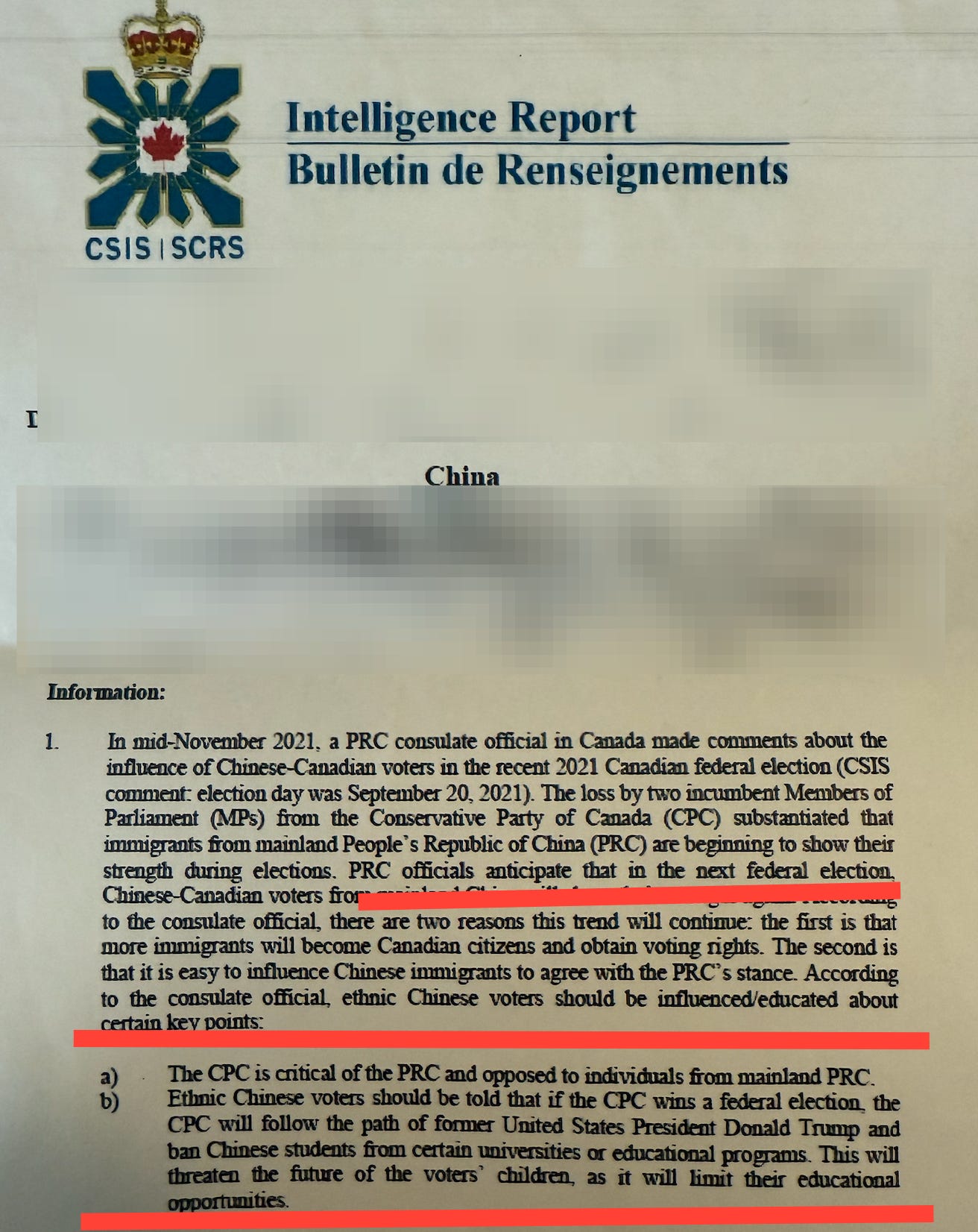
CSIS Warned Beijing Would Brand Conservatives as Trumpian. Now Carney’s Campaign Is Doing It.
∙OTTAWA — Canadian intelligence reported in 2021 that Beijing planned to interfere in Canada’s next federal election with disinformation suggesting the Conservatives “will follow the path of … Donald Trump”—a narrative now echoed in a clandestine dirty tricks operation exposed inside Prime Minister Mark Carney’s campaign.
The warning comes from a classified CSIS bulletin dated December 20, 2021 and marked Secret, distributed to Canadian departments including Global Affairs Canada, the Privy Council Office, the Communications Security Establishment, and Five Eyes intelligence partners. The report was based on information from Chinese consular officials in Canada.
According to the CSIS assessment, a consulate official in mid-November 2021 discussed how Chinese influence in federal ridings with large Chinese-Canadian populations had proven effective, and laid out a forward-looking strategy to shape future electoral outcomes. The official reportedly stated:
“Ethnic Chinese voters should be told that if the CPC wins a federal election, the CPC will follow the path of former United States President Donald Trump and ban Chinese students from certain universities or educational programs. This will threaten the future of the voters’ children.”
The consulate official also suggested that during Canada’s next federal election, the message should be circulated that the Conservative Party of Canada “is critical of the PRC and opposed to individuals from mainland China.” The remarks were made shortly after Justin Trudeau’s Liberals won a minority government in the fall of 2021.
CSIS concluded that PRC officials believed Chinese immigrants were relatively easy to influence toward Beijing’s geopolitical goals and could be mobilized to oppose Canada’s Conservative Party. The bulletin describes a broader context in which Chinese state actors sought to paint Canadian Conservatives as hostile to immigrants, aligned with Trump-style nationalism.
The Bureau’s analysis suggests that if Chinese state-linked actors intended to repeat this narrative in the 2025 federal campaign, they would find their narrative echoed by the Liberal Party’s own war room tactics.
Prime Minister Mark Carney this morning acknowledged wrongdoing inside his campaign, following revelations that Liberal operatives had planted fake political buttons at a major Conservative conference in an effort to smear Pierre Poilievre's campaign as a Trump-style threat to Canada.

No comments:
Post a Comment
Comments always welcome!